heatherfromthegrove’s New Year’s Revelation No 2 of 7: Walk the walk

3443161577_97896d6693_o
“We will open the book. Its pages are blank. We are going to put words on them ourselves. The book is called Opportunity and its first chapter is New Year’s Day.”
— Edith Lovejoy Pierce, American Poet & Pacifist

When Opportunity knocks, by all means open the door. But what happens if it doesn’t knock, or ring, or fall down from the sky right into your lap? And you keep waiting, and waiting, and waiting…

The reality is that we create our own destiny. I know this is a cliché, but it’s worth repeating. If we keep waiting for good things to happen to us, we may be sorely disappointed when they don’t. When you work long and hard on something – be it a passion or a project – you will likely see a return on your investment. By investment, I mean your time. And time is precious.

“The bad news is time flies. The good news is you’re the pilot.”
Michael Altshuler, Speaker & Trainer

So begin the new year by shelving anything and everything that simply didn’t yield anything for you. Then start fresh. Make a strategy, hatch a realistic plan and then see it through. By “seeing it through” I also mean spreading the word. Networking with people is a surefire way to create a domino effect of opportunity. If you ‘walk the walk’ (translation: work diligently and follow through), you will most likely be smiling like a Cheshire cat by the end of the year.

There’s nothing wrong with dreaming big…. as long as you’re not being delusional. For instance, if your big dream is to be a singer when, in reality, you’re kind of tone deaf… then you may want to rethink your strategy.  I have always been in awe of Barbra Streisand and dreamed of singing (with a voice like hers) in Carnegie Hall. But I’m a realist. I will never have That Voice. So I sing in the shower instead.

Don’t wait for Opportunity to knock. Steer your own ship. Make 2017 your flagship year and wake up each morning, excited about what you’re doing.  Keep at it and don’t let anyone dampen your spirits or weaken your resolve. Here’s to a great year – for all of us!

“Sow a thought and you reap an act;
Sow an act and you reap a habit;
Sow a habit and you reap a character;
Sow a character and you reap a destiny.”
Ralph Waldo Emerson


heatherfromthegrove’s New Year’s Revelation No 1 of 7: Take the time to read

2017

Scroll_Grey

It’s a new year, ladies and gentlemen!
May it be a good one for all of us!
This year, the inspiration for my New Year’s “Revelations” stems from some of the sage words and wisdom of the great philosophers  and literary figures of all time.
I hope that some or all of these revelations resonate with you.

Scroll_Grey

Take the time to curl up in a comfortable chair and read a book. Read, not skim. A book, not a tablet or computer screen.  Turn your phone off, close your computer and let yourself be transported into a beautiful piece of literature, a gripping bestseller, an interesting biography, or a thought-provoking work of non-fiction.  Reading is quite simply the best therapy in the world. It’s right up there with music, dance and art. Therapy aside, reading helps you to relax and de-stress.  And, of course, there is something to be said about learning new things, opening up your mind and… actually stimulating your mind.

 “The art of reading is in great part that of acquiring a better understanding of life from one’s encounter with it in a book.”

André Maurois

I have always been a bookworm. As a child, when my friends would knock on our door and ask my mother whether I was coming out to play, I would tell them that I was in the middle of a good chapter and would come out when finished. Several hours later, I would join them and smile sheepishly as they rolled their eyes at me.

“I consider as lovers of books not those who keep their books hidden in their storage chests and never handle them, but those who, by nightly as well as daily, use them, thumb them, batter them, wear them out… who fill out all the margins with annotations of many kinds, and who prefer the marks of a fault they have erased to a neat copy full of faults.”

Erasmus

A decade ago, I used to read at least three books a week and as 2016 drew to an end, I realized that I had read only 20 or so books throughout the year. For me, that is unacceptable! It’s also simply not in character. Clearly my priorities were all wrong. This will change in 2017.

So I encourage each of you to pick up a good book and take the time to savour each word. Then pick up another.

Happy reading!

P.S. In case you’re wondering, this is not a photo of me. I hail from the Baby Boomer generation. This is a photo of a young Millennial who is clearly enjoying a good read.

Over and out, 2016!

good

“Tomorrow, is the first blank page of a 365-page book. Write a good one.” ― Brad Paisley

What a year it has been! G’bye 2016. It’s been a slice.

Many blessings for 2017 and may tonight’s New Year’s Eve celebration be filled with laughter, good food, plenty of bubbly libation, and the company of those you hold dear!

And, as always, a very special shout-out to my family and friends across the globe.

Stay tuned tomorrow for the first of my annual seven New Year’s Revelations (not to be confused with resolutions!).  And a new chapter begins ….

Cheers!

heatherfromthegrove


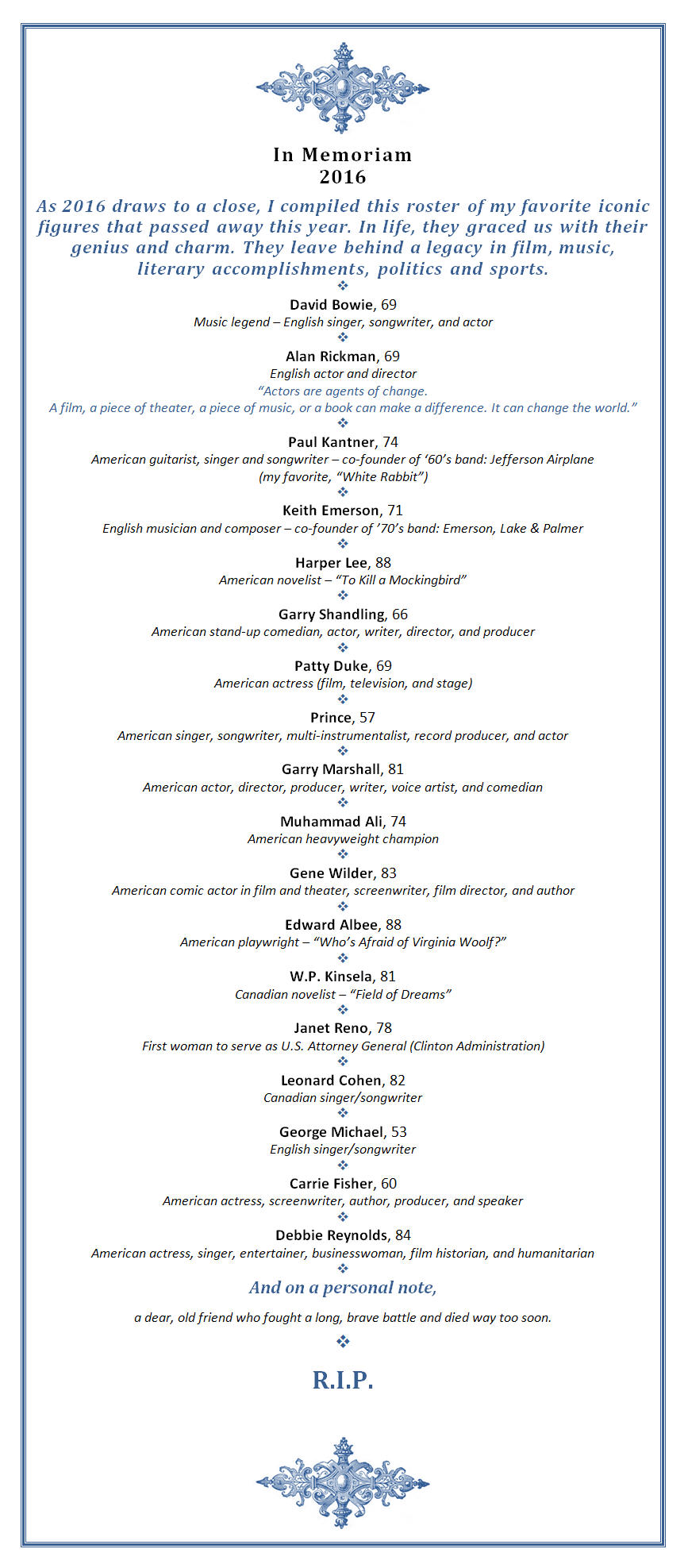
In Memoriam 2016 – the loved and the lost

“It’s so much darker when a light goes out than it would have been if it had never shone.”

– John Steinbeck, The Winter of Our Discontent

inmemoriam2016

The Teacher and the Student

Some great quotes to live by…..

… so, I’m in a philosophical frame of mind these days and for the rest of 2016, my posts will highlight famous philosophical quotes and the philosophers who said them. This month (September), the focus will be on some of the greatest ancient Greek philosophers whose influence and thinking have transcended the passage of time.

PLATO & ARISTOTLE

plato_and_aristotle_in_the_school_of_athens_by_italian_rafael

Plato (left) and Aristotle (right) – School of Athens

Some famous quotes by “The Teacher” — Plato:

“Be kind, for everyone you meet is fighting a harder battle.” 

“In politics we presume that everyone who knows how to get votes knows how to administer a city or a state. When we are ill… we do not ask for the handsomest physician, or the most eloquent one.” 

“Wise men speak because they have something to say; fools because they have to say something.” 

Plato  (427—347 BCE) was born in Athens,  of Athenian nobility. He was the devout and most brilliant student of Socrates, and they became close friends. After the death of Socrates, Plato turned his back on Athenian politics. His most productive works were written in the course of three voyages to Sicily. He began to write the dialogues (writing in the form of conversation) ad this became the foundation of his philosophical teachings. Upon returning to Athens, he founded the Academy – the first institution of higher learning in the Western world. Aristotle became one of his star pupils and closest associate.

Perhaps the most influential philosopher of all time, Plato is known for his usage of dialectic – a discussion of ideas and insights into the nature of reality. And his philosophy espoused cognitive optimism – a belief in the capacity of the human mind to seek and attain the truth, and to use this truth for the rational and virtuous management of  life and government. He believed that all the conflicting elements in society could (and should) be harmonized. Each of these elements will flourish when they coexist in harmony.  The existence of such a balanced society is impossible without virtue.

Plato’s Academy remained in existence for another thousand years. Centuries after his death, his philosophical system resurfaced as  Neoplatonism.

♦ ♦ ♦ ♦ ♦ ♦ ♦

Some famous quotes by “The Student” — Aristotle:

“Happiness is the meaning and the purpose of life, the whole aim and end of human existence.” 

“Excellence is never an accident. It is always the result of high intention, sincere effort, and intelligent execution; it represents the wise choice of many alternatives – choice, not chance, determines your destiny.” 

“He who has overcome his fears will truly be free.” 

Aristotle (384—322 BCE) was born in Stagira (northern Greece). He was the son of Nichomachus –court physician to the Macedonian royal family. Trained first in medicine, he then later went on to study philosophy with Plato (in Athens). Aristotle was a brilliant student, so much so that he questioned some of Plato’s teachings. After  Plato died, Aristotle was not appointed head of the Academy. and so he left Athens for the islands. In 338 B.C.E., he returned to Macedonia to tutor Alexander the Great. When Alexander conquered Athens, Aristotle went there to set up a school of his own, known as The Lyceum. After the death of Alexander the Great, Aristotle opposed Macedonian rule and his rebellion nearly cost him his death. He fled to the island of Euboea, where he later died.

It is believed that Aristotle’s body of written work included as many as 150 philosophical treatises – of which 30 survived. From biology and physics to morals, aesthetics and politics, he wrote prolifically. Although his teacher (Plato) believed ultimate reality was found in ideas or eternal forms, Aristotle saw ultimate reality in physical objects, through experience. But what really distinguished Aristotle from other ancient, medieval and modern philosophers was that, according to him, the universe never had a beginning or an end. It was eternal.  He also believed that change was cyclical. In the Middle Ages, Aristotle’s philosophy was adopted and fused into Christian doctrine, forming a philosophical system known as Scholasticism. Indeed, the Roman Catholic Church embraced Aristotelian thought as its official philosophy.

And the rest, as they say, is history.

READ SOME OF THEIR MOST FAMOUS WORKS:

The Trial and Death of Socrates, by Plato

The Republic, by Plato

Apology, by Plato

Politics, by Aristotle

The Neomachian Ethics, by Aristotle

Metaphysics, by Aristotle

A little Socratic wisdom

I’m in a philosophical frame of mind these days.  So for the rest of 2016, my posts will highlight famous philosophical quotes and the philosophers who said them. This month (September), the focus will be on some of the greatest ancient Greek philosophers whose influence and thinking have transcended the passage of time.

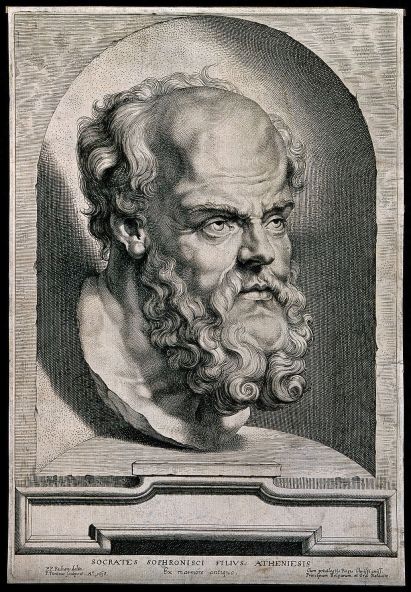
SOCRATES

socrates-_line_engraving_by_p-_pontius_1638_after_sir_p-_p_wellcome_v0005528

“The only true wisdom is in knowing you know nothing.”

– Socrates, (469—399 BCE),  classical Greek philosopher

Socrates was considered the father of Western logic and philosophy. He espoused an ethical system based on human reason, rather than theological doctrine. According to Socrates, the more we come to know ourselves, the greater will be our ability to reason and make choices that lead to true happiness. His quest for knowledge focused on one simple idea: how to live a good and virtuous life. We know him through the writings of the students he mentored, the most famous of whom was Plato. It was Plato who later taught Aristotle, who then went on to tutor Alexander the Great.

He taught his students by asking them questions, with the objective of getting them to think for themselves. This became known as “the Socratic Method” which, in today’s world, is a method of teaching most often used by law and medical professors in universities and colleges across the globe.

“I cannot teach anybody anything. I can only make them think”

– Socrates

Socrates refused to acknowledge class distinction or in other words, the “proper behavior” at the time. He spoke and mingled with women, servants and slaves just as easily as with nobility and scholars. This refusal to conform to social proprieties angered the so-called important men of the time. Socrates was subsequently arrested for impiety. His accusers (Meletus the poet, Lycon the orator, and Anytus the tanner) charged him with “denying the gods recognized by the state and introducing new divinities” and “corrupting the young.”  These accusations were considered (by those who favored Socrates) as being personally and politically motivated.

Socrates was sentenced to death by hemlock poisoning in 399 BCE. He died in his Athenian prison cell, surrounded by his friends. Socrates himself never wrote down any of his teachings. He focused on action, not words. His teachings and philosophy were later interpreted and written by his students, men like Plato who later went on to form their own philosophical schools.

“To find yourself, think for yourself.”

– Socrates

READ:

The Trial and Death of Socrates, by Plato

The Republic, by Plato


On Friendship

read-369040_1280

“The quality of a friend is one who can touch your heart and soul from across the world or across the room. Trust that person who can see through the sadness behind your smile. The one who can hear your words in your silence, can feel your love in your anger, trust them. They are your REAL, TRUE and PURE friends.”
Angie karan

Peeking Through the Cobwebs

21059227843_82f020641b_o

“Some ideas are not born of logic and good sense. They are made of clouds and cobwebs. They sprout from nowhere and feed on excitement, sprinkled with adventure juice and the sweet flavor of the forbidden. The psyche moves from the realms of the ordinary and takes a delicate step towards the unknown. We know we shouldn’t and that is exactly why we do.”
― 
Brigid LowryGuitar Highway Rose

(Photo by Pratik Kadam via flickr.com)

Say “No” to Hate

rain-930262_960_720

Picture via pixabay.com

“Laugh when you can, apologize when you should, and let go of what you can’t change. Kiss slowly, forgive quickly, play hard, take chances, give everything, and have no regrets. Life is too short to be anything but happy!” – Unknown

Just the other day, I went online to research urological treatment options for cats and I came across a vet med site where other cat owners shared their advice and experiences. As I read down the endless list of back-and-forth comments,  I was appalled.  A subject as benign as “cats with bladder issues” unleashed a barrage of hateful commentary. Rather than giving constructive advice, empathy or encouragement, there were nasty comments like “You gave your cat that medication? You’re an idiot and an irresponsible cat owner!”  And that was one of the nicer comments. These people didn’t even know each other, but were quick to pass judgment – all behind the shield of anonymity, of course.

It never ceases to amaze me how many haters there are out there. Blogs and social media sites like Twitter, Facebook and LinkedIn seem to be a breeding ground for these angry people, emboldened by the name “Anonymous.”  Amazingly, I’ve only had one hater comment on this blog – since its inception in October 2011.  I never published the comment, because my policy is to never give a hater any public platform to spew their hate.  Criticism is fine. Venom is not. Sarcasm and dark humor is okay. Crass and ignorant commentary is not okay.

Apparently, hate is not relegated to social media.  Just look at the ridiculous nastiness and vulgarity displayed during the recent GOP presidential debates. Opportunistic presidential nominees are feeding off the anger of  a nation, as the world watches with amazement and disgust.

Now, there is nothing wrong with being angry.  But when anger becomes rage and gives birth to a population of serial haters, then we’ve got a problem, folks. Anger, when properly channeled, can bring about positive change.  Rage is a different animal altogether.  It just festers. It becomes malignant.

The fact of the matter is, Life is too short.

Who in their right mind would choose rage and hate over happiness and love?  Yes, I said “choose.”  It’s all about choice.

Say “No” to hate.  It simply takes up too much energy.  It gives you frown lines and makes you bitter.  It’s like a dark, murky cloud that follows you around everywhere.

I firmly believe that a positive attitude attracts good energy.  So, I say “Yes” to love.  And I’d rather have a face riddled with laugh lines, than frown lines – any day.

Cheers,

Heather  (not “Anonymous”)

Remembering Yesterday

keithFebruary 28, 1953 – June 30, 2015

Photo: Copyright © 2016 by Heather Joan Marinos. All Rights Reserved.

“To the outside world we all grow old. But not to brothers and sisters. We know each other as we always were. We know each other’s hearts. We share private family jokes. We remember family feuds and secrets, family griefs and joys. We live outside the touch of time.”– Clara Luz Zúñiga Ortega, Spanish author

When a sibling dies unexpectedly, it reminds us (acutely so) of our own mortality – of how precious life is, how finite our journey really is. The sorrow we feel… not only for the loss itself, but also for the words left unsaid… sears the heart. It’s hard to wrap our minds around the fact that there will never be another dinner together, or stories and jokes to tell, or confidences to share.

But amidst all the uncertainty of what life has in store for us, one thing remains fixed and certain: the memory of our loved ones will be etched forever in our thoughts and hearts.