The dish about book reviews

confessions-of-a-book-reviewer

“I would rather be attacked than unnoticed. For the worst thing you can do to an author is to be silent as to his works.” 
― Samuel Johnson

So, you’ve written a book. It’s out there…. for all the world to pick up and read. Some may love it or  like it, others may have mixed feelings about it, and some readers may thoroughly hate it.  The worst scenario? No one bothers to read it at all.

Presumably if you’ve given birth to a book (after all, it is a long, laborious process and the end result is your very own precious “baby”), you’re proud of it – or at least, you should be (note: if you’re not, you shouldn’t have had it published).

As you wait for the feedback (reviews) to come in,….

… do you pace back and forth?

… wring your hands or restlessly tap your fingers on the desk?

… toss and turn in bed, one endless night after another?

… anxiously check and recheck your Inbox?

… pick up smoking again, to calm your nerves?

No, of course not.

Here’s the dish:  like, dislike, love, hate, indifference – these are all subjective emotions.

How one reader will react to your book or writing style may be radically different from how another reader will respond. Whether the reader is a respected book critic, a professor, an Amazon customer, a friend or family member – it’s all subjective.

This doesn’t mean that you should discount any positive or negative feedback. Nor should you let the great reviews swell up your head or the bad reviews keep you from ever writing again.

Keep it in context. Learn from the criticism.  Be thankful that someone actually took the time to read your book — your book! — and then took more of their own time to write a review. They may give you some new perspective, some information that you could benefit from and will help you as you sit down to write your next book.

Do not take anything personally.

However, there are (unfortunately) haters out there. These are people – cowards and bullies, really – who get off on writing mean-spirited things, who spread nasty gossip, and who try to bring you down.  Disregard those types of people, comments, and reviews.  They are not worth your mindshare. Enough said.

Now, here’s an interesting tidbit of information: in a recent study conducted by the Harvard Business School, it was found that Amazon customer book reviews are just as likely to give an accurate summary of a book’s quality as those of professional newspapers.” The study surveyed 100 non-fiction reviews from 40 media outlets, for HBS’ paper What Makes A Critic Tick? The study also examined all the Amazon customer reviews.  Whilst it was noted that there is “virtually no quality assurance” in Amazon customer reviews (in fact, some reviews can be “plants” by the book publisher, author or competitors),  they still found that both customers and book critics agreed (overall) about the quality of the book. Amazon ratings and expert media  ratings generally concurred.

I suppose that the lesson to be learned from this is to take Amazon customer reviews seriously, but be discerning.

The study further notes that Relative to consumer reviews, professional critics are less favorable to first-time authors. This suggests that one potential advantage of consumer reviews is that they are quicker to identify new and unknown books.”  Professional critics were generally more inclined to positively favor the works written by well-known, prizewinning authors.

Don’t let any of this dishearten you.  Keep writing. Stand by what you say and what you mean. The professional book critics will eventually come around.

But, remember, even the professionals are subjective, so stand your ground.

“From my close observation of writers… they fall into two groups: 1) those who bleed copiously and visibly at any bad review, and 2) those who bleed copiously and secretly at any bad review.”
Isaac Asimov 

Image: Vetta/Getty Images
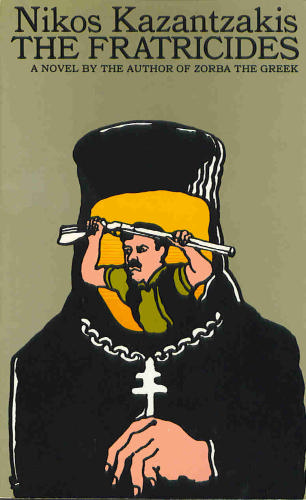
heatherfromthegrove’s story spotlight for today: “The Fratricides” by Nikos Kazantzakis

♦ ♦ ♦

Monday, July 15 – Saturday, July 20

FICTION

@ heatherfromthegrove!

Enjoy some good summer reading.

♦ ♦ ♦


edab9833e7a094e1d1012110.L

“Their life is an unceasing battle with God, with the winds, with the snow, with death. For this reason the Castellians were not surprised when the killing began, brother against brother. They were not afraid; they did not change their way of life.  But what had been simmering slowly within them, mute and unrevealed, now burst out, insolent and free. The primeval passion of man to kill poured from within them. Each had a neighbor, or a friend, or a brother, whom he had hated for years, without reason, often without realizing it. The hatred simmered there, unable to find an outlet.  And now, suddenly, they were given rifles and hand grenades; noble flags waved above their heads. The clergy, the army, the press urged them on — to kill their neighbor, their friend, their brother. Only in this manner, they shouted to them, can faith and country be saved! Murder, that most ancient need of man, took on a high mystic meaning. And the chase began — brother hunting brother.”

Nikos Kazantzakis , The Fratricides

To the rest of the world, the brilliant Greek writer and philosopher Nikos Kazantzakis is best known for his masterpiece, Zorba the Greek.   But to the Greeks, he remains a national treasure.  His body of writing is a clear attestation of the deep love he felt for his country and his people.  This passion, along with his devotion to his faith, and  a profound fascination with the magnetic power of charismatic leadership  ―  all come into play in his final curtain call, The Fratricides

The Fratricides (the act of a person killing his or her brother), was Kazantzakis’  last novel. The story takes place in a remote mountainside village (Castellos) in Macedonia, during the Greek Civil War (December  1944 – January 1945, and from 1946-49) when Greek communists tried (unsuccessfully) to gain control of Greece.  The novel’s central figure, the village priest (Father Yiannaros), tries to reconcile the two warring factions ― the monarchist troops who are in control of the town and the communist guerrillas who are trying to infiltrate the area.  Although sympathetic to some aspects of the communists’ vision of society, he is repelled by their acts of savagery. Their inhumanity goes against his moral and religious beliefs, yet Father Yiannaros takes steps to negotiate a settlement, with tragic results.  Enough said. 

Told by a master storyteller, The Fratricides is a gripping account of a turbulent time in Greek history, when brothers were (figuratively and literally) pitted against brothers.

Other novels by Nikos Kazantzakis:

* adapted into a film (1988) by the same name; directed by Martin Scorsese and starring Willem Dafoe (as Jesus), Harvey Keitel (as Judas) and Barbara Hershey (as Mary Magdalene).

** adapted into a film (1964) by the same name; directed by Mihalis Kakogiannis and starring Anthony Quinn (as Alexis Zorba) and Alan Bates (as Basil)

In addition, he wrote a vast body of work:  plays, poetry, and a wide selection of non-fiction works (travel books, translations, anthologies, memoirs, essays and letters).

My favorite Nikos Kazantzakis quote:

“I hope for nothing. I fear nothing. I am free.”


Getting lost inside a book

Young-couple-reading-a-bo-001

“I go back to the reading room, where I sink down in the sofa and into the world of The Arabian Nights. Slowly, like a movie fadeout, the real world evaporates. I’m alone, inside the world of the story. My favourite feeling in the world.” 
― Haruki MurakamiKafka on the Shore

The great outdoors is my “reading room” this summer.  Whether lying down on a carpet of grass, sitting cross-legged on a terry cloth towel by the beach, or curled up in my comfy patio armchair — nature provides the perfect ambience for reading.

Tomorrow marks the beginning of fiction week, here at heatherfromthegrove. Each day, from Monday through Saturday, I’ll be spotlighting one novel/author. Summertime is ideal for catching up on all the books you’ve been meaning to read.  I hope that you will find my recommendations helpful and I would love to hear back from you, with some of your own favorites!

Cheers,

Heather

Image via guardian.co.uk (photograph: Kevin Mackintosh/Getty Images)

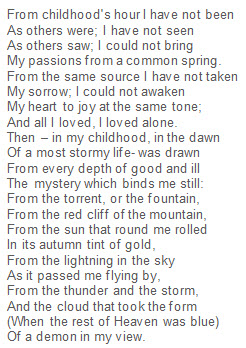
heatherfromthegrove’s poetry spotlight for today: “Alone” by Edgar Allan Poe

j0255382

POETRY

heatherfromthegrove!

Enjoy!

Alone

by Edgar Allan Poe

7-6-2013 12-37-18 PM

Edgar Allan Poe – born on January 19, 1809 in Boston, Massachusetts – was an American short-story writer, poet, critic, and editor.  Renowned for his tales of mystery and horror, he was dubbed  as “Father of the Detective Story.”  He married his cousin, Virginia, in 1836. She became his literary muse.  Her death in 1847 caused the grief-stricken Poe to begin a downward spiral into financial ruin and poor health. He died on October 7, 1849, in a Baltimore (Maryland) hospital. The exact cause of his death remains a mystery. Although a very troubled and haunted man, Poe’s brilliant imagination has left a compelling legacy in the literary world.  His poems and tales still have the power to shock and to move his readers.   

Alone originally written in 1829, when the author was only 20 years old, the 22-line poem was only published and titled posthumously.  Written at the time of his foster mother’s (Frances Allan) death, the poem reflects the haunting sense of isolation that he felt throughout his childhood.  

Poem via poemhunter.com

Image via faithfulhomeschool.com.

Think first, write later

5385287084_2702462500

 “Poirot,” I said. “I have been thinking.”
“An admirable exercise my friend. Continue it.”
 
― Agatha ChristiePeril at End House

Have you ever responded to an offensive or distressing email without thinking first?  “WHAT?!” you say to yourself, as your fingers agitatedly skim over the keys and, without a second thought…Send. Moments later, you could kick yourself for having been so impulsive.

This has surely happened to all of us, at one time or another.

Or perhaps, as a student, you were seated for your mid-term essay exam and you skimmed the questions quickly, then proceeded to write feverishly because the clock was ticking and you wanted to make sure that you had enough time to answer all the questions. It was only after you handed in the test, that you realized you missed the second part of the question because you didn’t take the time read carefully and organize your thoughts.

Mea culpa, mea culpa.

In the writing world, however, the process varies from writer to writer.  Not everyone likes to adhere to the “think first, write later” principle. Many writers just sit down at the computer (or, if they’re traditionalists, with pen and paper), and write. Then they edit. Stream of consciousness writing works for many and these are the writers who, when at home, probably don’t write shopping lists or who prefer not to structure their time rigidly. They are the free thinkers.  Write first, think while writing, and then edit later.

However, there are just as many writers (myself included) who prefer to organize their thoughts, prior to writing them down.  They do this by notes, index cards, outlines and also by just thinking (or daydreaming) it out in their minds. 

I am a great proponent of outlines.  My book writing process always commences with quiet contemplation… to think carefully about what I want to say and why, who will my readership be and how will I engage their attention. From there, I craft an initial Table of Contents which serves as my starting point and basic outline.  I then begin the initial research process (when research is required for the book) and the results of my initial research prompts me to write a more detailed outline which helps dictate the overall flow of the book. At that point. I move to a more advanced stage of research, finetune the outline further and then I am ready to sit down and write. I prefer to think first, write later. I carry a small  Moleskine reporter’s notebook with me wherever I go, to jot down thoughts. The challenge is being able to read my own messy handwriting later!

There really is no right or wrong process. Ultimately, the objective is to write.  How you get to that point is subject to whatever works for you.

So, think on the fly or  think in advance, but just make sure to carefully review your writing first before pressing that “Send” button!


Image via everydaygyaan.com.

Confessions of a Daydreamer

daydreaming-girl

“As I quietly stare off into space, eyes glazed over and brow thoughtfully taut, know that I am going about my business.  I am a storyteller.  Daydreaming is the best part of my job.”
― Richelle E. Goodrich

Couldn’t have said it better myself.

And now for the confession.

I have been daydreaming all of my life: characters, scenes and dialogue – all created in my mind. I am not crazy (although that subject is a matter of jovial debate in my family).  My mother totally understood the eccentricities of her youngest child.  After years of adjustment, my husband now knows that when he walks by the study and sees me in a trance-like state, tears streaming down my face, he needn’t worry.  Nor does he say a word because there is nothing more annoying to a consummate daydreamer than jarring interruptions. He just walks away, shaking his head and wondering to himself whether or not he lives in a madhouse.

So, I just like to conjure up storylines in my mind. The downside is that there are quite a few unfinished scripts in my filing drawer. Too many ideas, too little time. The upside is that I am never, ever bored.

One loop away from being totally loopy.

Now that the proverbial cat is out of the bag, I’d like to focus a little wrath on the naysayers who give daydreaming a bad name. In a world where everyone seems to be rushing around like the rabbit in Alice in Wonderland, daydreaming is often considered frivolous, lazy, a waste of valuable time and downright “flakey.” 

Not so, say many mental health experts. Daydreaming is not only beneficial to our state of mind, but it also contributes to our productivity.

“How on earth can this be true?”  say the anti-daydreamers.

Well, ye of little faith, psych specialists compare daydreaming to meditation.  Both help us to relax, relieve stress, take a mental “time out.”  After a daydreaming session, we are refreshed, energetic and ready to tackle the rest of the day.

In the Smithsonian article, The Benefits of Daydreaming,” Joseph Stromberg writes about a recent research study (published in Psychological Science) which indicates “that a wandering mind correlates with higher degrees of what is referred to as working memory. Cognitive scientists define this type of memory as the brain’s ability to retain and recall information in the face of distractions.

Therefore, despite the daydreamer’s propensity to let the mind wander, she (or he) possesses a heightened working memory which allows her (or him) to snap out of La-la Land when required to do so.

Moving the discussion of science back to the arts, most creative people would concur that daydreaming sparks the imagination. It helps to motivate and stimulate ideas.

Walk into a room filled with writers, authors, poets and novelists, and ask “Who among you daydreams regularly? Please raise your hand.”  With few exceptions, every hand will be raised.

Storytellers daydream. It’s what we do.

La-la land is a great place to visit.  The key is to know when it’s time to leave and come back home.


Image via mommasmoneymatters.com.

The Psychology of Blogging

hammer

Like many of you, I enjoy reading blogs that pique my interest.  I also read them to gain insight, whether expected or unexpected, and to gather information on a specific topic. It is always a delight to discover a really good blog site and an articulate writer with a unique perspective.

So, we know why we read blogs. The question is, why do we write blogs?

Why do we blog?

Do we do it…

… as a form of cathartic self-expression (cyber-catharsis)?

… because we are narcissists (varying from mild to extreme)?

… just simply to write down our musings, because we believe we have something interesting to say, to share, or to teach?

… as an outlet for self-promotion?

… as a writing exercise, to tone and hone our writing skills?

Perhaps it is a combination of some or all of the above.  To understand the reasons, we’ll need to delve into the psyche of a blogger.  

Cathartic Self-expression (Cyber-catharsis)

Psychologists and psychiatrists often recommend journal writing as a tool to help release stress, work through issues, and as a means of self discovery.  Blogging takes journal writing to a completely new dimension. Not only does it provide cathartic therapy for those who need it, it also opens the door to a worldwide web of  support – a cyber support group whereby people can connect, share and commiserate with others who are experiencing (or who have experienced) similar challenges. Advice is given and received.  Stories are shared. And, in many cases, friendships are made. 

Narcissism

If we’re being truly honest with ourselves, we are all narcissistic to some degree. For most of us…. just a wee bit.  It only really becomes a problem, however, when we get so self-absorbed that our sense of what is real and rational becomes clouded. That is when it’s time to seek help. It’s one thing to write about “me, myself, and I” if there’s a valid purpose, an opinion to express, or a valuable lesson to impart.  But it is quite another to blog for no other reason than to feed the ego.

Musings

We all have something to learn and something to teach. Writing about our thoughts and experiences – on such a vast platform – gives us a forum to exchange ideas, to offer and receive a different perspective. 

An Outlet for Self-promotion

There is absolutely nothing wrong with self-promotion. We all need to keep a roof over our heads and food on the table. But, again, it’s all a matter of degree.  If it’s done properly and gracefully, it will not repel people. If it’s crass, full of redundant sales pitches and slogans (like an “As Seen on TV” commercial)… people will find it offensive and be turned off.  

A Writing Exercise, to Tone and Hone Writing Skills

Blogging is an excellent way to finetune that writing muscle. The more often we write, the better we get.  When we blog, we get an opportunity to connect instantaneously  with our readership which, in turn, helps us to understand what engages the reader. And, finally, blogging regularly helps us to avoid and/or battle that soul-destroying disorder that we all dread:  writer’s block.

What I personally find most gratifying about blogging (and this one was not the list) is the access I now have to people from across the globe. The thrill of being able to interact with men and women from all walks of  life, from different cultures, young and old and everyone in-between ― in real time. What an amazing opportunity!  To travel seamlessly through cyberspace, via the written word, has effectively bridged all physical distance. And, with just the click of a button, this gargantuan world we live in… has suddenly become a whole lot smaller.


Image via contestmob.com.

How to Resist the Lure of Summer Distractions

17XgPyfrdGU

Summer is a temptress. She dazzles us with bright colors and hot sun. Every year, we impatiently await her arrival.  For many, she is a welcome respite after a long, cold winter.  She exudes a sense of lightness and freedom and her flamboyance and playfulness is infectious.  School is out and children suddenly find themselves with loads of time… to play!  And they don’t waste a minute.  With the rigor of school schedules and extracurricular activities set  aside, parents reconnect with their children.  Men and women start to loosen up a bit and their busy lives begin to take a back seat to weekend barbecues, picnics and summertime activities.  That glorious smell of barbecue grilling wafts from house to house.

Yes, summer is a temptress.  But, as a writer who is working on multiple book projects while trying to promote her newly published book, it is difficult to resist the lure of summertime distractions.   Am I up for the challenge?  Can I muster enough will and discipline? 

I’ll let you know at the end of the summer.

In the meantime, I am going to try out some of these tips.  Maybe they can help you, as well.

1. Channel your inner Gumby

gumbyThe key is flexibility.  Summer schedules need to be flexible, not rigid.  Otherwise, you’re setting yourself up to fail.  “Fail” is perhaps too strong a word, but I’m sure you understand my meaning.

2. Move like an inchworm

inchworm

Take it one steady, small step at a time. Break up your day into increments of time – time to research, time to write, time to relax and time for eating and sleeping. Set smaller, more frequent goals and milestones for yourself and this will encourage you to keep moving forward and ultimately fill you with a sense of accomplishment. On the other hand, if you flit like a butterfly – from task to task – nothing will ever get completed.

3. Set your boundaries

writing-contest-scams

Let your family and friends know when you’re in the writing zone, so that they can respect your space and privacy for the time that you’ve allocated. Afterwards, they can have your full attention.

4. Don’t bite off more than you can chew

gerbil

It’s summertime. Focus on the most important  and enjoyable projects, then make a plan to tackle the rest in the Autumn months.

5. Bring it outside

woman_writer_outside_laptop

You don’t have write behind closed doors on a beautiful summer’s day.  Take your laptop or notepad, a pot of tea or coffee, and do your writing (and thinking) outside.  If you live in an apartment and don’t have a yard, pack yourself some refreshments and go to your nearest park.  If you live near water, sit on the beach or by the lake. Maybe the sights and sounds all around you will bring you some interesting perspective or inspiration.

Enjoy your summer and happy writing!

Images via anordinarywomn.net, gumbyworld.com, piedmontwildlifecenter.org, writingforward.com,  dorrys.com and cloudsandchecks.com.

Grooving in Coconut Grove

Parrot

One of many tropical parrots preparing to get tipsy and silly on a feast of sea grapes.

(Photo credit: heatherfromthegrove)

There are many unique cities and towns across the globe, but I have a particular fondness for the place that I call Home:  Coconut Grove.

This artsy, bohemian village is a friendly haven for writers, artists, architects, musicians and academics. Its mellow, unpretentious residents (Grovites) hail from a cross-section of cultures and spiritual leanings, and they possess a strong sense of community.  The Grove is a place where people actually walk everywhere and say “hello” to each other (in many cases, by name!).  Coconut Grove businesses readily support each other — in the spirit of camaraderie, mutual respect and collaboration.  Almost every household has a dog and/or cat.  Colorful parrots fly freely, squawking loudly as they perch atop the branches of lush, tropical trees. Even the stray cats and possums are happy and well-fed  (well, at least the ones that frequent my yard!).

For those of you who have never visited The Grove, you really must add it to your list of “must see’s.”

I’ve created a special page on this blog site (see menu tabs on top, labeled The Grove) — for anyone interested in reading more about this idyllic community.  The page is a work in progress and I will be adding more to it, as the days/months progress.

As always, I welcome your comments and feedback.

Cheers,

heatherfromthegrove

Writing in an Authentic Voice

exam6

“Believe in yourself and in your own voice,

because there will be times in this business when you will be the only one who does.

Take heart from the knowledge that an author with a strong voice

will often have trouble at the start of his or her career –

because strong, distinctive voices sometimes make editors nervous.

 But in the end, only the strong survive.”

―  Jayne Ann Krentz

Most writers are blessed (although some would say, cursed) with the uncanny ability to see through another person’s outward façade, body language and emotional barriers.  Good writers are keen observers.  We watch. We don’t just listen, we hear.  And we notice – everything. Then, we write.

Similarly, a voracious reader opens up a book, in anticipation of a good read – expecting to be transported into someone else’s words, someone else’s thoughts. The reader has high expectations. He or she  wants to soak up all that the writer has to say. But when the words seem forced, when the thoughts do not ring true – the reader is left deflated and unsatisfied.

It all boils down to one word:  Authenticity.  When a writer is ready to commit his or her observations, experiences, life lessons and creativity to paper, it must be done clearly and in an authentic voice.  If the writing is not authentic, the reader will detect it in a flash. If a story appears forced to the reader, it is forced.

Say what you mean.  Mean what you say.

A writer should never worry about being popular.  We can’t please everybody.  There will always be those who take umbrage at what we say.  Conversely, there will be just as many who will champion us. One has to be philosophical about the whole writing experience.  When we are true to ourselves, when we write in an authentic voice – we should be happy with the end result.

However…

… this should not preclude us from exercising the art of self-restraint.  When a writer is passionate (and believe me, I know whereof  I speak), it becomes an interesting balancing act of saying what needs to be said, yet reigning the words in a tad – to avoid rabid repetition. 

A word to the wise:  gather together an unbiased focus group of people and have them read and critique the manuscript. Heed their feedback well, without taking it personally.  Then, apply it.  We are all classmates in a lifelong Continuing Education program. The objective must always be to learn and to keep on learning, until we are dead and buried.

On that lively note, I shall bid you all Godspeed as you continue your writing journey.

Be true to yourself and to your craft.  The best is yet to come.

Image via destinationsdreamsanddogs.com