heatherfromthegrove’s poetry spotlight for today: “Forgiveness” by John Greenleaf Whittier

a-music-from-heart1

♦ ♦

As we wrap up poetry week @ heatherfromthegrove, enjoy this last one.

♦ ♦ ♦

Forgiveness

by John Greenleaf Whittier

poemForgiveness

John Greenleaf Whittier born on December 17, 1807, in Haverhill, Massachusetts – dubbed as one of the “Fireside Poets“, this American Quaker was an ardent and vocal advocate for the abolition of slavery.  His first poem was published in 1826, in a publication called the Newburyport Free Press.  The paper’s editor was abolitionist William Lloyd Garrison and it was Garrison who encouraged Whittier to take up the abolitionist cause – which he did on a local, state and national level.  He was involved with the formation of the Republican party and was keenly engaged in politics.  Whittier edited papers in Boston and Hartford (Connecticut) and – from 1857 until his death on September 7, 1892 – he was associated with the magazine, Atlantic Monthly.

Forgiveness although famous for his lengthy poems, the most popular being Snow-Bound: A Winter Idyll, this poem is one of his shortest and is often quoted because of its quiet but clear message of “forgive those who trespass against us.”  Only when we forgive, can we truly heal.  Forgiveness is freeing. And, to quote a line from the Prayer of  St. Francis, “It is in pardoning that we are pardoned.”  

Poem via poemhunter.com.

Image via pimminag.com.

heatherfromthegrove’s poetry spotlight for today: “The Fury of Abandonment” by Anne Sexton

HelpingHand

♦ ♦

POETRY 

@ heatherfromthegrove!

Enjoy!

♦ ♦ ♦

The Fury of Abandonment

by Anne Sexton

poemTheFuryOfAbandonment

Anne Sexton born on November 9,1928, in Newton, Massachusetts – a deeply troubled and brilliant American poet known for her extremely personal, emotional and conversational verse. She battled mental illness for most of her life.  Her first manic episode occurred in 1954, followed by a complete nervous breakdown a year later. Encouraged by her therapist to write poetry, as a means of cathartic therapy, Sexton discovered what was to be her true calling in life. Her poetry covered themes that reflected her own psychological challenges: depression, manic tendencies and suicide and nothing in her personal life was off-limits. She wrote about it all – becoming one of the most honored American poets and earning herself a Pulitzer Prize for Poetry. Sadly, her illness (today, she would have been diagnosed as suffering from bipolar disorder) began to escalate and, on October 4, 1974, she committed suicide by carbon monoxide poisoning. She was forty-six years old.

The Fury of Abandonment “Raw emotion” is what best describes this disturbing poem. One of 15 poems from the “Fury” sequence, later published in a collection titled, “The Death Notebooks.”  Published just after her divorce from her husband, it was the last collection of her poetry to be published before her suicide in the autumn of 1974. The advancement of her mental decline is felt with every unapologetically tortured word. It is as riveting as it is disturbing.

Poem via poemhunters.com.

Image via lydiamagazine.gr.

heatherfromthegrove’s poetry spotlight for today: “Love One Another” by Khalil Gibran

adorable-awesome-couple-hug-Favim.com-336964

♦ ♦

POETRY 

@ heatherfromthegrove!

Enjoy!

♦ ♦ ♦

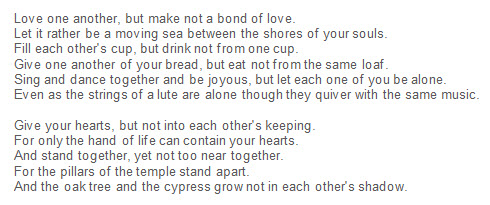
Love One Another

by Khalil Gibran

poemLoveOneAnother

Khalil Gibran born on January 6, 1883 in Lebanon – renowned Lebanese-American poet, philosopher and artist who emigrated to America with his family in 1895, settling in Boston’s culturally diverse South End.  Although he became popularly known in North America for his compilation of inspirational philosophical essays (written in poetic prose) , The Prophet, he was also a very accomplished artist, schooled (in Paris) in drawing and watercolors.  Favoring symbolism and romanticism over realism, Gibran showcased his work at his first exhibition in 1905 (Boston), where he met Mary Elizabeth Haskell, a respected headmistress.  He and Haskell formed an intimate, lifelong friendship and she played a pivotal role in his life, becoming his editor and confidante. Khalil Gibran, who never became a naturalized American citizen (in deference to his Lebanese roots), died in New York City, on April 10,1931 — at the age of forty-eight.  The cause of his death was a combination of cirrhosis of the liver and tuberculosis.  His request to be buried in his homeland of Lebanon was respected and fulfilled by his devoted friend, Mary Elizabeth.

Love One Another is an extract from his magnum opus, The Prophet. Beginning with the simple commandment of “Love One Another”, he writes philosophically about the sanctity of marital love while also acknowledging the importance of maintaining one’s individual spirit.  He writes poetically about the necessity to let love grow and evolve, just as we do.  If love is rigid and unchanging, the bonds of love will break down. In very eloquent and poetic language, he drives home the point that two people should complement each other, yet maintain and respect their separate identities.

Poem via poemhunter.com.

Image via write-brained.com

heatherfromthegrove’s poetry spotlight for today: “Desertion” by Rupert Brooke

left_alone

♦ ♦

POETRY 

@ heatherfromthegrove!

Enjoy!

♦ ♦ ♦

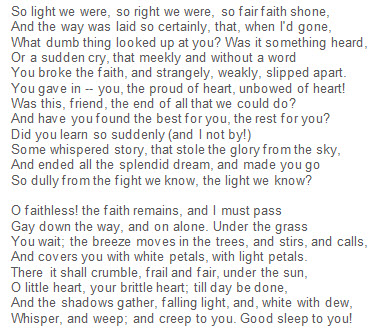
Desertion 

by Rupert Brooke

poemDesertion

Rupert Brooke  born on August 3, 1887 in England –  extremely handsome English poet famous for his neo-Romantic poems, most notably his war sonnets (the most famous one was “The Soldier”) written during World War One.  The idealistic nature of his poetry was likely a function of his youth. The well-traveled Cambridge graduate, commissioned into the Royal Naval Division, set sail for the Dardanelles in February 1915 – where he contracted septicaemia from a mosquito bite and died a month later (April 23), aboard a hospital ship off the Greek Island of Skyros. He lays buried beneath an olive grove on the Aegean island. He was only twenty-seven when he died.

Desertion I could not find any learned analysis of this poem.  The graceful lyricism of this poem, along with the theme of desertion, betrayal and fractured friendship/relationship, drew me in. The treachery of a friend or loved one who succumbs to gossip, rather than staying faithful to the friendship/relationship – written in such a beautifully, melodic manner  – resonated deeply with me, so much so that I chose to share this poem with you.

Poem via poemhunter.com.

Image via stylelemon.com, Photo credit: Julie de Waroquier.

heatherfromthegrove’s poetry spotlight for today: “The Road Not Taken” by Robert Frost

forest-trail

POETRY

@  heatherfromthegrove!

Enjoy!

The Road Not Taken

by Robert Frost

frost

Robert Frost born on March 26, 1874 in San Francisco, California – was one of the most popular and critically acclaimed American poets of the twentieth century. During his lifetime, he received a plethora of honors, most notably four Pulitzer Prizes for Poetry, numerous honorary degrees, and, in 1960, a Congressional Gold Medal. Robert Frost’s poetry was most often written with early twentieth century, rural New England as a backdrop, from which he explored intricate philosophical and social questions of human existence. His grasp and usage of down-to-earth, American  colloquial language (mirroring ordinary, everyday speech) resonated with his readership and he became an American literary icon.  His wife and inspiration for much of his poetry, Elinor Miriam White, married him in 1895.  She died from breast cancer in 1938. On January 29, 1963, at the age of eight-eight, Robert Frost died in Boston Massachusetts, of complications from pancreatic surgery.

The Road Not Taken one of Robert Frost’s most popular and yet most misunderstood poems. When he writes about the two roads, he says “Though as for that the passing there/Had worn them really about the same/And that morning equally lay/in leaves no step had trodden back”  – meaning that neither of the two roads are less traveled and therefore one is faced with the dilemma of choice: which of the two identical forks in the road do I take? Our route is determined by the fusion of both choice and chance (or fate). There is no right path, just the chosen path and the other one that was not chosen. The poem is about the moment of decision, not the actual decision itself. By making a choice, the traveler is aware that only sometime in the future, will he realize whether or not he took the road less traveled by. The poem encapsulates the agony of decision, stemming from  the very human (and common) fear of remorse/regret.

Poem via poemhhunter.com.

Image via spiritualdrift.com.

heatherfromthegrove’s poetry spotlight for today: “Alone” by Edgar Allan Poe

j0255382

POETRY

heatherfromthegrove!

Enjoy!

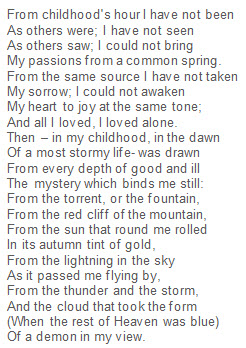
Alone

by Edgar Allan Poe

7-6-2013 12-37-18 PM

Edgar Allan Poe – born on January 19, 1809 in Boston, Massachusetts – was an American short-story writer, poet, critic, and editor.  Renowned for his tales of mystery and horror, he was dubbed  as “Father of the Detective Story.”  He married his cousin, Virginia, in 1836. She became his literary muse.  Her death in 1847 caused the grief-stricken Poe to begin a downward spiral into financial ruin and poor health. He died on October 7, 1849, in a Baltimore (Maryland) hospital. The exact cause of his death remains a mystery. Although a very troubled and haunted man, Poe’s brilliant imagination has left a compelling legacy in the literary world.  His poems and tales still have the power to shock and to move his readers.   

Alone originally written in 1829, when the author was only 20 years old, the 22-line poem was only published and titled posthumously.  Written at the time of his foster mother’s (Frances Allan) death, the poem reflects the haunting sense of isolation that he felt throughout his childhood.  

Poem via poemhunter.com

Image via faithfulhomeschool.com.

A Good Summer Read

Book-Reading-on-Beach

“One benefit of Summer was that each day we had more light to read by.”
― Jeannette WallsThe Glass Castle

Whether you’re en route to some exotic travel destination for the summer or simply sitting in your back yard, sipping a refreshing glass of your favorite libation… you’ll probably want to enjoy some good summer reading.  Here’s a list of ten books (novels, non-fiction and debut releases by new authors) that you may want to try out.

Happy reading!

Not in any particular order:

Fiction:

  1. The Secret Life of Bees by Sue Monk Kidd
  2. Lolita by Vladimir Nabokov
  3. South of Broad by Pat Conroy
  4. A Hundred Summers by Beatriz Williams
  5. Rockaway by Tara Ison

Non-fiction:

  1. Thinking In Numbers: On Life, Love, Meaning, and Math by Daniel Tammet
  2. Quiet: The Power of Introverts in a World That Can’t Stop Talking by Susan Cain

First Releases (Fiction) by New Authors:

  1. No One Could Have Guessed the Weather by Anne-Marie Casey

First Releases (Non-fiction) by New Authors:

  1. Along the Shore: Rediscovering Toronto’s Waterfront Heritage by M. Jane Fairburn
  2. Casualties of the (Recession) Depression by Heather Joan Marinos

“Come with me,’ Mom says.
To the library.
Books and summertime
go together.”
 

― Lisa SchroederI Heart You, You Haunt Me

Photo via holidayrentals.com.

Freedom and Individualism Revisted

download (2)

I am reposting this blog because it seems to have struck a chord with people from across the globe − with thousands of views.

In the first sentence (below), I mentioned that three uniquely brilliant people came into my life in the mid-1970s.  What I did not say then was how they came into my life.  Many of us have someone in our lives who we look up to and who holds an extra special place in our hearts.  A mentor,  a teacher, or  a family member. In my case, it was all three rolled into one — my brother.  Six years my senior, he took me under his wing many, many times.  He introduced me to jazz music, specifically Thelonious Monk and I still have the tapes he gave me (back in the day when we listened to tape cassettes!) well over three decades ago.  Then he gave me two book recommendations for my “must read” list:  The Prophet, by Khalil Gibran and Atlas Shrugged, by Ayn Rand.  I read them and I was not disappointed.

So, that’s how these visionaries were introduced to me. 

And now, here’s the blog once again:

Freedom and Individualism, as expressed by three creative geniuses:

Thelonious Monk, Khalil Gibran and Ayn Rand.

(originally posted by heatherfromthegrove on October 21st, 2011)

In the mid-1970’s, three uniquely brilliant people came into my life. 

The first was American jazz pianist and composer, Thelonious Monk (b.1917 – d.1982).  His improvisational style set him apart from the traditional jazz musicians of the time.  In the 1940’s, the music genre known as jazz was experiencing a cultural revolution of sorts, with Thelonious Monk as its revolutionary leader. A new style of jazz  — be-bop —  was born. Considered jazz for intellectuals, the be-bop sound was all about intricate melodies, complex harmonies – and fast tempos. Thelonious Monk once said: “If you really understand the meaning of be-bop, you understand the meaning of freedom.” 
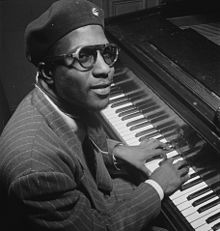
220px-Thelonious_Monk,_Minton's_Playhouse,_New_York,_N.Y.,_ca._Sept._1947_(William_P._Gottlieb_06191)Freedom – in my opinion – is the most beautiful word in the dictionary.  The meaning and experience of freedom is unique to each and every one of us.  What tastes like freedom to me may be radically different than anyone else. Some savour it as a private, spiritual experience, while others view freedom on a global scale. There is no right or wrong answer.  It is in the eye of the beholder.

I love to listen to the discordant sounds of Thelonious Monk. I never met the man. Nevertheless, I owe him a debt of gratitude because when I listen to improvisational jazz, I feel  free – and vibrantly alive.
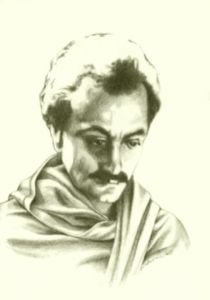
gibran2The second visionary genius was the Lebanese-American poet, philosopher, and artist  – Khalil Gibran (b.1883 – d.1931).  His works (The Prophet became an iconic favorite) were notably influential in American popular culture during the tumultuous 1960’s. On the subject of Freedom, Khalil Gibran’s eloquent poetry always strikes a chord with me –regardless of the number of times I read and reread his words:

“…Verily all things move within your being in constant half embrace, the desired and the dreaded, the repugnant and the cherished, the pursued and that which you would escape.

These things move within you as lights and shadows in pairs that cling. And when the shadow fades and is no more, the light that lingers becomes a shadow to another light. And thus your freedom when it loses its fetters becomes itself the fetter of a greater freedom.”

Finally, there is my muse.  Her name, Ayn Rand.  Ayn is pronounced “Ein” (which means “one” in German).  In my study, there are at least three long bookshelves devoted to Ayn Rand  (her novels, essays, philosophical treatises, biographies, and virtually everything I could find that has been written about her).  If I ever choose to go back to do my PhD in Philosophy, the subject of my dissertation would most definitely be Ayn Rand.
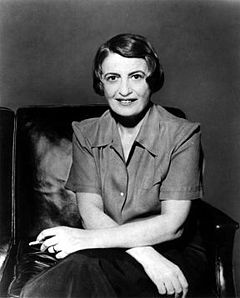
240px-Ayn_Rand1Born in St. Petersburg, Russia in 1905, Ayn witnessed the Bolshevik Revolution firsthand and despised the collectivism that was so entrenched in Russian culture at the time.  Her family lost everything in Communist Russia and this intelligent student of philosophy and history decided that the American model of freedom was the path she wanted to pursue. In 1926, she went to visit relatives in Chicago, then traveled to Hollywood … and never looked back.  Her first novel, We the Living (1936), was inspired by her earlier exposure to Russian tyranny.  In her novels, Ayn understood that in order to create the wonderfully heroic fictional characters, she would have to articulate the philosophical principles which – in her view – made these characters truly heroic.  As such, her novels were interwoven with politics, philosophy, economics, metaphysics, ethics and epistemology. And sex.  In 1957, her last work of fiction – Atlas Shrugged – was considered her greatest achievement. 

However, my personal favorite of hers is The Fountainhead (1943). It was the masterpiece that solidified Ayn Rand as the champion of Individualism.  And this is why I am so inspired by this brilliant intellectual who, incidentally, died in 1982.

For me, individualism is freedom. It’s at the core of everything I believe in.  Individual thought, choice, and actions.  Our journey into this world is a singular experience. As is our journey out of this world.  And our lives are made up of a series of individual choices, reactions and experiences that we (and no one else) are accountable for. For every action, there is a reaction.  For every choice we make, there is a consequence. Good and bad.  (preferably more good , than bad!).

I know, these are pretty heavy thoughts on a Friday evening.  So, I’ll leave you with some words that resonate deeply with me.  In The Fountainhead, the hero – architect Howard Roark – passionately explains the essence of individualism:

“… Man cannot survive except through his mind. He comes on earth unarmed. His brain is his only weapon. Animals obtain food by force. Man has no claws, no fangs, no horns, no great strength of muscle. He must plant his food or hunt it. To plant, he needs a process of thought. To hunt, he needs weapons, and to make weapons—a process of thought. From this simplest necessity to the highest religious abstraction, from the wheel to the skyscraper, everything we are and everything we have comes from a single attribute of man—the function of his reasoning mind.

But the mind is an attribute of the individual. There is no such thing as a collective brain. There is no such thing as a collective thought. An agreement reached by a group of men is only a compromise or an average drawn upon many individual thoughts. It is a secondary consequence. The primary act—the process of reason—must be performed by each man alone. We can divide a meal among many men. We cannot digest it in a collective stomach. No man can use his lungs to breathe for another man. No man can use his brain to think for another. All the functions of body and spirit are private. They cannot be shared or transferred…” 

I’ve given you just a snippet of this courtroom speech. It is riveting and worth reading in its entirety.

Here’s to Freedom!

Cheers,

hftg

Images via care2.com, karabess.wordpress.com, wikipedia.org, and civilclothing.com.

Writing in an Authentic Voice

exam6

“Believe in yourself and in your own voice,

because there will be times in this business when you will be the only one who does.

Take heart from the knowledge that an author with a strong voice

will often have trouble at the start of his or her career –

because strong, distinctive voices sometimes make editors nervous.

 But in the end, only the strong survive.”

―  Jayne Ann Krentz

Most writers are blessed (although some would say, cursed) with the uncanny ability to see through another person’s outward façade, body language and emotional barriers.  Good writers are keen observers.  We watch. We don’t just listen, we hear.  And we notice – everything. Then, we write.

Similarly, a voracious reader opens up a book, in anticipation of a good read – expecting to be transported into someone else’s words, someone else’s thoughts. The reader has high expectations. He or she  wants to soak up all that the writer has to say. But when the words seem forced, when the thoughts do not ring true – the reader is left deflated and unsatisfied.

It all boils down to one word:  Authenticity.  When a writer is ready to commit his or her observations, experiences, life lessons and creativity to paper, it must be done clearly and in an authentic voice.  If the writing is not authentic, the reader will detect it in a flash. If a story appears forced to the reader, it is forced.

Say what you mean.  Mean what you say.

A writer should never worry about being popular.  We can’t please everybody.  There will always be those who take umbrage at what we say.  Conversely, there will be just as many who will champion us. One has to be philosophical about the whole writing experience.  When we are true to ourselves, when we write in an authentic voice – we should be happy with the end result.

However…

… this should not preclude us from exercising the art of self-restraint.  When a writer is passionate (and believe me, I know whereof  I speak), it becomes an interesting balancing act of saying what needs to be said, yet reigning the words in a tad – to avoid rabid repetition. 

A word to the wise:  gather together an unbiased focus group of people and have them read and critique the manuscript. Heed their feedback well, without taking it personally.  Then, apply it.  We are all classmates in a lifelong Continuing Education program. The objective must always be to learn and to keep on learning, until we are dead and buried.

On that lively note, I shall bid you all Godspeed as you continue your writing journey.

Be true to yourself and to your craft.  The best is yet to come.

Image via destinationsdreamsanddogs.com

Typecasting a writer: folly or not?

pigeonholed.expertise

“Don’t classify me, read me. I’m a writer, not a genre.” 
― Carlos Fuentes

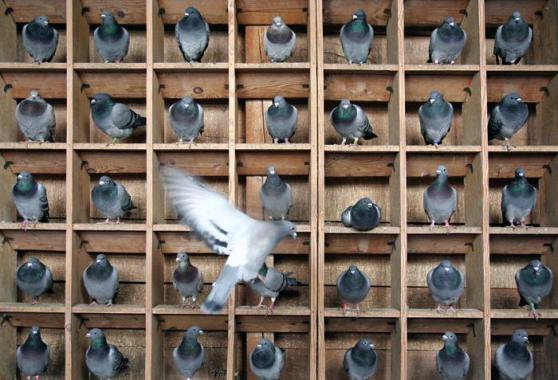
In one of my earlier blogs (New Year’s Revelation No. 5, “Never, Never Assume!”), I wrote about the unfortunate common practice of making assumptions ― about people or situations.  So many of us, whether intentionally or unintentionally, fall into that trap – to our detriment.  In so doing, we run the risk of making erroneous assumptions (because we are not aware of all the mitigating factors) and rush to judgment, perhaps too quickly.  The same applies to pigeon holing or typecasting someone.

In the acting world, for example, actors are often typecast as comedic, dramatic, character, leading role, action hero, and so on.  Yet many actors have proven – time and time again – that they can seamlessly apply their acting talent and skills to any genre. And when they do this, we are always surprised (yet delighted).  Why are we surprised? The answer, of course, is that we made an erroneous assumption. Yes, Robert De Niro has played some seriously intense and dramatic roles.  However, as “Vitti” in Analyze This and Analyze That (opposite Billy Crystal), De Niro had me rolling on the floor, laughing.

The same applies to writing.  Just because a writer publishes a book in one genre, this does not mean he or she is incapable of writing in a different voice, for a variety of target audiences, or in multiple genres.

As for myself, I have multiple book projects in the works.  Many are non-fiction.  Casualties of the (Recession) Depression is a political and economic commentary and collection of real-life vignettes.   This does not mean that the only genre I write is non-fiction editorial.  I write fiction, as well as industry-specific pieces and scripts for documentaries. 

Whether one is a writer or a photographer, an actor or an artist ― the fact is, we are complex and multi-faceted.  Labels are very limiting and should not be assigned so readily.

If we only focus our eyes on the moon, we may miss the beauty of the rest of the galaxy.

Image via trivworks.com.