A book with a local story, but a global message

419VA7+2MsL__AA278_PIkin4,BottomRight,-49,22_AA300_SH20_OU01_

Around the world with Casualties of the (Recession) Depression….
… amazingly, the Kindle (eBook) edition is available virtually everywhere!
 

Although Casualties of the (Recession) Depression is about middle-class America, the experiences narrated in this book, along with the issues of recession, hunger, joblessness, homelessness… are experiences and issues that have no geographic boundaries.  They are global.  Especially in today’s world economy. 

There are approximately 870 million people, worldwide,  who are experiencing  hunger. 

Book Details:

Genre: Non-fiction

Categories: Commentary, Economics, Economic Condition, Politics

Topic: Economic crisis in middle-class America. Real people. Real stories. Real issues. Complete with commentary, historical/comparative economic analysis and statistics, helpful resources, and philanthropic programs.

Available (in English) through the following worldwide Amazon sites:

        Europe:

amazon-kindle-and-bintang


Image via spartantraveler.com.

Announcing “Casualties of the (Recession) Depression” on Amazon Kindle!

419VA7+2MsL__AA278_PIkin4,BottomRight,-49,22_AA300_SH20_OU01_

My book, Casualties of the (Recession) Depression is now available in eBook format… on Amazon Kindle, is US $9.99 (Paperback edition retails at US $20).

Although Casualties of the (Recession) Depression is about middle-class America, the experiences narrated in this book, along with the issue of recession, hunger, joblessness, homelessness…are experiences and issues that have no geographic boundaries. They are global. Especially in today’s world economy. Therefore, this book is applicable everywhere. As I write on the front cover: “They could be you. They could be me. They could be anyone.”

Here’s who will find added value to buying a copy of Casualties of the (Recession) Depression:

  1. Civics and humanities students/teachers – this book would be perfect suggested reading for the class.
  2. If you are involved with your own organizations, in the fight for hunger, this book would be a good one to use as collateral material for your cause(s).
  3. If you are in government, this book would be good reference/collateral material for your political platform and/or constituency.
  4. If you are involved in your religious community and work with community outreach programs, to fight hunger and homelessness, this would be a good book to raise awareness in your congregation/religious programs.
  5. If you work in the field of hospital administration, social work or advocacy, this book would be an interesting (and valuable) reference to have.

Some of the Amazon customer reviews are on the right sidebar of this blog site.

I hope that you’ll give it a read!

Cheers,

— Heather

The “Golden Years” are not always so golden

elderlywoman1

Unless one’s heart is made of stone, most can agree that the reality of child hunger is a heartbreaking and very unpalatable pill to swallow. 

Human existence is cyclical. We begin life as children who depend on parents or family members for our food, our living conditions, and our sense of well-being and worth.   

As we move towards the last chapter of our lives, our health and frailty make it impossible to survive without depending on our children, family members, or community − for our food, our living conditions, and our sense of well-being and continued worth.

The golden years are supposed to be a time in life when we, who have worked so hard and who have taken care of so many, earn the right to kick back, relax and enjoy the company of loving family and friends, as they surround us with their affection and care.

Sadly, this is not everyone’s reality.  Many seniors are left to cope alone.  Many have to juggle with decisions like whether to eat or pay the utility bills, whether to eat or pay for medication, and whether to eat or pay the rent. 

As I mentioned earlier, human existence is cyclical.

Unless one’s heart is made of stone, most can agree that the reality of senior hunger is a heartbreaking and very unpalatable pill to swallow. 

I’ll leave you with some sobering statistics, cited by the folks at Feeding America.  Next week, I will be taking a virtual hunger tour around the world because, as we all know, hunger has no geographic boundaries.

According to Feeding America,

“The number of older adults is projected to increase by 36% over the next decade and continue to rise in the following decade. In 2030 there will be 72.1 million older adults, almost twice as many as in 2008. Additionally, the senior population is becoming increasingly diverse.  Between 2010 and 2030, the white population of 65 and plus is projected to increase by 59% compared with 160% of older minorities.”

“These changing demographics will have profound impacts on the demand for social services, especially the need for adequate and culturally appropriate nutrition services.  Seniors may have unique nutritional needs and challenges that separate them from the rest of the population and must be considered.”

“In 2011, 4.8 million Americans over the age of 60 were food insecure. This constitutes 8.4% of all seniors. “

“The number of food insecure seniors is projected to increase by 50% when the youngest of the Baby Boom Generation reaches age 60 in 2025.”

HFH2

From Aug 14-Sept 7, purchase a copy of  Casualties of the (Recession) Depression, and for every $20 book purchased directly from my website,  I will be donating $5 from the proceeds of each book sale to either: Feeding America (US), Action Against Hunger (Canada), or The World Food Programme (Global). The purchaser chooses one of the three.

Image (at the very top) via mycarforcharity.com.

The economics of fighting hunger

Hunger

“Investment in the eradication of hunger today is a good business decision. If we fail to make this investment, it is
doubtful that we can sustain healthy economic growth. Without this investment, our nation may disintegrate into a
country sharply divided between those who have enough to eat and those who do not.”
— Alan G. Hassenfeld, Chair & CEO of Hasbro, Inc.

If the humanitarian reasons for fighting hunger are not convincing enough, let me put an economic spin on it, by breaking the issue down to dollars and cents.

According to a recent Hunger in America report prepared by the Center for American Progress and Brandeis University,  “Hunger costs our nation at least $167.5 billion due to the combination of lost economic productivity per year, more expensive public education because of the rising costs of poor education outcomes, avoidable health care costs, and the cost of charity to keep families fed.”

The hunger bill directly affects every American citizen and resident.  Oh, it’s not a bill per se.   The costs are embedded in our taxes and in the contributions we pay to charities.  Our nation’s economy is heavily weighed down by the cost of hunger, spending upwards of $94 billion dollars a year, in federal food assistance programs like SNAP (Supplemental Nutrition Assistance Program, formerly known as  “food stamps”).

As the middle-class progressively disappears below the poverty line, the drain on our economy worsens. 

Hunger adversely affects our bottom line. 

Yet, even big corporate executives realize that the eradication of hunger is not simply an issue of economics, but  a more fundamental problem of justice, equality, and humanity.

“America is the richest country in the world. And yet tonight, thousands of your neighbors will go to bed hungry.
It may be your child’s schoolmate who is undernourished and has difficulty learning on an empty stomach.
Or it could be a co-worker, a working mother whose low-wage job doesn’t make ends meet.
Perhaps it’s an elderly neighbor who has to make a decision whether to delay filling a prescription or buying groceries.
The faces of hunger are as broad as the faces of America.”
— David Nasby, retired vice president of General Mills  (one of the world’s largest food companies)

Image (at very top) via Emmaushouse.org.

Can we make a difference?

Hungry Children

“The lessons of the nation’s past tell us that liberty and justice cannot be secured for ourselves and kept from others without turning sour. Because we have cherished liberty for others, this country has sacrificed enormously (if not always wisely) in lives and material resources. We have not cherished justice as much. But justice and equality are no less a part of the nation’s ideals, and we build on them by exercising them in our relationship with others. When we are rich and others are hungry or impoverished beyond description, justice calls for ending this imbalance.” 

— Art Simon, Founder – Bread for the World

HFH2

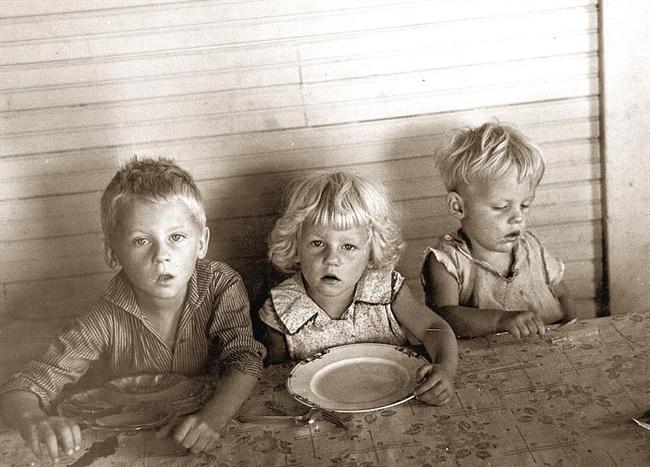
Image (b/w of three children) via blogs.dallasobserver.com.

The value of a book with a local story, but a global message

Visual

“The day that hunger is eradicated from the earth there will be the greatest spiritual explosion the world has ever known. Humanity cannot imagine the joy that will burst into the world.”

— Federico Garcia Lorca, Spanish poet

Although Casualties of the (Recession) Depression is about middle-class America, the experiences narrated in this book, along with the issue of recession, hunger, joblessness, homelessness… are experiences and issues that have no geographic boundaries. They are global. Especially in today’s world economy. Therefore, this book is applicable everywhere. As I write on the front cover: “They could be you. They could be me. They could be anyone.”

Regarding the book promotion I’ve been posting about, here’s who will find added value to buying a copy of Casualties of the (Recession) Depression:

  1. Civics and humanities students/teachers – this book would be perfect suggested reading for the class.
  2. If you are involved with your own organizations, in the fight for hunger, this book would be a good one to use as collateral material for your cause(s).
  3. If you are in government, this book would be good reference/collateral material for your political platform and/or constituency.
  4. If you are involved in your religious community and work with community outreach programs, to fight hunger and homelessness, this would be a good book to raise awareness in your congregation/religious programs.
  5. If you work in the field of hospital administration, social work or advocacy, this book would be an interesting (and valuable) reference to have.

Please feel free to share this blog with others.

Thank You!


Image (eye) via teachthought.com (photo attribute – Flickr/irargerich).

A Child’s Perspective on World Hunger

HungryGirl

As Day Two of my Fight For Hunger book promotion kicks off, I thought I would stand back and let a child’s words put things in perspective.

This was written in 1990, by Rachel Corrie.  At the time she wrote this, she was only ten years old.  Her words show a wisdom beyond her years.

It is no surprise that Rachel grew up to be an American peace activist.  She was a member of the pro-Palestinian group,  International Solidarity Movement.  She died on March 16, 2003 at the age of twenty-three while engaging in non-violent protest (in Israel) against the Israeli army’s demolition of Palestinian homes.  Wearing a bright orange fluorescent jacket and using a megaphone, Rachel was killed by a bulldozer (whose driver  ran over her twice), while she was  standing  in front of the soon-to-be-demolished home of Palestinian friends (the family of local pharmacist, Samir Nasralla).

A foundation in her name   The Rachel Corrie Foundation for Peace and Justice continues her work.

When you read what she, at the age of ten, writes about hunger… you can only imagine what wonderful things she would have accomplished, had she lived. 

Written in 1990, by Rachel Aliene Corrie:

“I’m here for other children.

I’m here because I care.

I’m here because children everywhere are suffering and because forty thousand people die each day from hunger.

I’m here because those people are mostly children.

We have got to understand that the poor are all around us and we are ignoring them.

We have got to understand that these deaths are preventable.

We have got to understand that people in third world countries think and care and smile and cry just like us.

We have got to understand that they dream our dreams and we dream theirs.

We have got to understand that they are us. We are them.

My dream is to stop hunger by the year 2000.

My dream is to give the poor a chance.

My dream is to save the 40,000 people who die each day.

My dream can and will come true if we all look into the future and see the light that shines there.

If we ignore hunger, that light will go out.

If we all help and work together, it will grow and burn free with the potential of tomorrow.” 

225px-Rachel_corrie

April 10, 1979 – March 16, 2003

Image of Rachel via rachelcorriefoundation.org.

HFH

New thought-provoking blog “Discourse on Reality” launching soon

DiscourseOnReality

“The work of an intellectual is not to mould the political will of others; it is, through the analyses that he does in his own field, to re-examine evidence and taglineassumptions, to shake up habitual ways of working and thinking, to dissipate conventional familiarities, to re-evaluate rules and institutions and to participate in the formation of a political will (where he has his role as citizen to play).”  ― Michel Foucault

Discourse on Reality, launching this Wednesday, will focus on current socio-economic, cultural, philosophical and political issues and challenges facing everyday men and women — across the globe.  As the title suggests, it is meant to be a forum for intelligent discourse, where people can share ideas, commentary, and information on subjects that are current, relevant and affect our communities — locally, nationwide, worldwide.  The objective is to learn, engage, raise awareness and, perhaps, become actively involved in the very causes, issues and challenges that we seek to address and remedy.

It is not my desire to write monologues day in and day out.  Dialoguing with oneself becomes tedious after a while.  To that end, I will be extending an invitation to anyone who may be interested in writing a guest blog post — within the scope of the subject matter discussed in the blog.  The invitation is open to writers, scholars, community leaders, and activists — subject to my approval, per  the guest blogging guidelines that will be available for review when Discourse on Reality goes live on Wednesday morning.  Non-fiction authors who post a guest blog will also be invited to highlight their latest work on the “Books” page.

Discourse on Reality embraces diversity.  This means: people from all walks of life, all cultures, all religions, all nationalities and ethnicities,  all political and philosophical leanings, all genders and orientations. 

Discourse on Reality will not provide a forum for hate, bigotry, and profanity.  It’s one thing to be passionate about what you believe in, but it is quite another to spew out hateful commentary.

One blog will be posted by 9 am EDT daily, from Monday to Friday.  Each day will focus on one theme, as follows:

       MONDAYS – Socio-economic Issues  (i.e. hunger, homelessness, health, education, environment and more)

       TUESDAYS – Economic Issues (i.e. the economy, business, technology, and more)

       WEDNESDAYS – Cultural Issues (i.e. civil rights, human rights, and more)

       THURSDAYS – Philosophical & Political Issues (i.e. commentary on current political events/news, ideology, religion)

       FRIDAYS – Philanthropy and Humanitarianism (i.e. role models and visionaries, non-profit organizations, humanitarian efforts and disaster relief,  sustainability, and more)

I hope that those of you who have been tuning in to my heatherfromthegrove (a writer’s musings) blog will also check out Discourse on Reality this Wednesday.  

As always, I welcome your feedback and comments.

Thanks for stopping by!

— Heather

We, the People

middleclass

“I am a firm believer in the people. If given the truth, they can be depended upon to meet any national crises. The great point is to bring them the real facts.” 

— Abraham Lincoln

♦ ♦ ♦

Excerpt from Casualties of the (Recession) Depression  (last two sentences in the Conclusions):

“The bottom line is:  if there are middle-class Americans who continue to experience economic hardship, then the problem still exists. If they are not in the process of recovering, then we are not “in a recovery.”

♦ ♦ ♦


(Copyright © 2013 Heather Joan Marinos – All Rights Reserved).


Photo: iStockphoto

Three Nuggets of Wisdom for Writers

YoungWriter

1a

“The process of writing a book is infinitely more important than the book that is completed as a result of the writing, let alone the success or failure that book may have after it is written . . . the book is merely a symbol of the writing. In writing the book, I am living. I am growing. I am tapping myself. I am changing. The process is the product.”

Theodore Isaac Rubin

 2a

“Nothing in this world can take the place of persistence.

Talent will not; nothing is more common than unsuccessful people with talent.

Genius will not; unrewarded genius is almost a proverb.

Education will not; the world is full of educated derelicts.

Persistence and determination alone are omnipotent. The slogan ‘press on’ has solved and always will solve the problems of the human race.”

Calvin Coolidge

 3a

“And what, you ask, does writing teach us? First and foremost, it reminds us that we are alive and that it is a gift and a privilege, not a right. We must earn life once it has been awarded us. Life asks for rewards back because it has favored us with animation. So while our art cannot, as we wish it could, save us from wars, privation, envy, greed, old age, or death, it can revitalize us amidst it all.”

Ray Bradbury  (Zen in the Art of Writing(1990) Preface)

swirly2

 Image Credit: Aliaksei Lasevich/Shutterstock