heatherfromthegrove’s story spotlight for today: “Lolita” by Vladimir Nabokov

♦ ♦ ♦

Monday, July 15 – Saturday, July 20

FICTION

@ heatherfromthegrove!

Enjoy some good summer reading.

♦ ♦ ♦

It should be noted that these book recommendations are not necessarily recently published works.  As Ralph Waldo Emerson once said, “Never read a book that is not a year old.” 

lolita_nabokov_lolita_lips_cover

“I looked and looked at her, and I knew, as clearly as I know that I will die, that I loved her more than anything I had ever seen or imagined on earth. She was only the dead-leaf echo of the nymphet from long ago – but I loved her, this Lolita, pale and polluted and big with another man’s child. She could fade and wither – I didn’t care. I would still go mad with tenderness at the mere sight of her face.”  ― Vladimir NabokovLolita

Although Vladimir Nabokov’s first nine novels were written in Russian, it was his intricate English prose that brought him the most distinction and international prominence in the literary world. Lolita is Nabokov at his best.  He wrote what would become his most famous and controversial book in 1955… in English. A decade later, he (himself) translated it into Russian. It is a tale about a middle-aged man, “Humbert Humbert” (this is not a typo!), who is both protagonist and erratic narrator — and his mad, obsessive (and very unseemly) love for a twelve-year old girl, Dolores Haze. “Lolita” is his private nickname for her.  As Humbert narrates, he draws from the disturbing, broken fragments of his own selective memory. Needless to say, the love story is doomed from the start.

This book is a masterpiece.  Listed as one of  The 100 Best Books of All Time, Lolita was adapted for film (in 1962) by the brilliant director, Stanley Kubrick and then again (in 1997), by director Adrian Lyne.

Other novels (in English) by Vladimir Nabokov:

In addition, he wrote a vast body of work:  many  short story collections, plays, poetry, Russian novels and novellas, and a wide selection of non-fiction works (critical reviews, memoirs, etc).
heatherfromthegrove’s story spotlight for today: “South of Broad” by Pat Conroy

♦ ♦ ♦

Monday, July 15 – Saturday, July 20

FICTION

@ heatherfromthegrove!

Enjoy some good summer reading.

♦ ♦ ♦

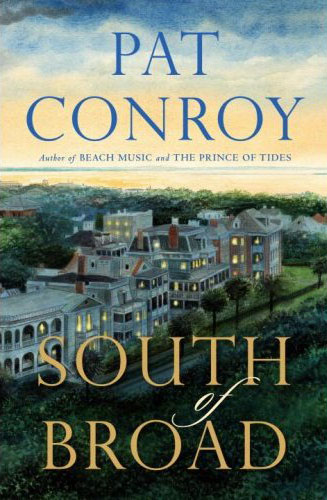
pat-conroy-south-of-broad-img

“Nothing happens by accident. I learned this the hard way, long before I knew that the hard way was the only path to true, certain knowledge. Early in my life, I came to fear the power of strange conveyances. Though I thought I always chose the safest path. I found myself powerless to avoid the small treacheries of fate. Because I was a timid boy, I grew up fearful and knew deep in my heart the world was out to get me. Before the summer of my senior year in high school, the real life I was always meant to lead lay coiled and ready to spring in the hot Charleston days that followed.” – from South of Broad, by Pat Conroy

I became a fan of Pat Conroy after reading Beach Music in 1995. In every novel, he masterfully weaves an intricate web of tales with southern charm and lyrical description ― exploring the fragility of the human mind and soul, the searing pain of tragedy and the healing  power of unexpected joy. For Conroy, all roads lead to home.  South Carolina.  Set against the lush backdrop of Charleston, South of Broad unravels an unforgettable tale of  families haunted and broken by tragedy, their closely guarded secrets that  become exposed, and the everpresent menace of racism and class division looming beneath the surface. Conroy’s protagonist and narrator is Leopold (Leo) Bloom King, the unassuming ringleader of a group of high school outcasts who sustain each other in good times and in bad, more the latter than the former. Their stories intertwine over a period of two decades, at the end of which they face their most daunting challenge which is the ultimate test of their friendship.

South of Broad is an exquisite, eloquently written ode, both to Conroy’s beloved hometown of Charleston and to the gift of lifelong friendships born and nurtured from these southern roots.

I was enchanted from beginning to end and read the book in one sitting. If you haven’t read any Pat Conroy’s novels, I would heartily recommend this as your first taste of this very gifted storyteller.

Other books by Pat Conroy:

* adapted into a film (1991) by the same name, directed by Barbra Streisand (she also starred in it), Nick Nolte and Blythe Danner.

** adapted into a feature film (1983) by the same name, starring David Keith.

*** adapted into a film (1979) by the same name, starring Robert Duvall.

**** adapted into the 1974 feature film, titled Conrack, starring Jon Voight and then later (in 2006) adapted into a TV movie, under the book’s original title, and starring Jeff Hephner.


heatherfromthegrove’s story spotlight for today: “Cocktail Hour Under the Tree of Forgetfulness” by Alexandra Fuller

♦ ♦ ♦

Monday, July 15 – Saturday, July 20

FICTION

@  heatherfromthegrove!

Enjoy some good summer reading.

♦ ♦ ♦

51sA8lMYYIL

“My mother has no patience with questions that begin, ”What if.” But I spend a great deal of my time circling that insensible eddy. What if we had been thinking straight? What if the setting of our lives had been more ordinary? What if we’d tempered passion with caution? “What-ifs are boring and pointless,” Mum says. Because however close to irreparably deep madness my mother had gone in her life, she does not now live in a ruined, regretful, Miss Havisham world and she doesn’t wish any of her life away, even the awful, painful, damaging parts. “What-ifs are the worst kind of post-mortem,” she says. “And I hate postmortems. Much better to face the truth, pull up your socks and get on with whatever comes next.”       

 — from Cocktail Hour Under The Tree of Forgetfulness, by Alexandra Fuller

The title of this book lured me in … and I was not disappointed.  This is a love story — a daughter’s ode to her mother.  It’s a real-life account of  a family’s resilience and loyalty, love wrought with pain and hardship, passion for land and country, a near descent into madness and the uphill struggle to regain some semblance of sanity — all told against a rich, vibrant canvas that was and is the untamed beauty and brutal violence of Central and Southern Africa.

Alexandra Fuller writes this candid and insightful family memoir from the perspective of both observer and participant.  She is a gifted storyteller whose beautifully crafted words and wry sense of humor caused me to tango between bouts of laughter and tears, as I read this book in one sitting.

As a writer, I admire this author’s talent and unabashed honesty. 

As a reader, I was enraptured from page 1. 

I intend to read this book a few more times, just to savour it.  I have also gone on to read what Nicola Fuller of Central Africa refers to as her daughter’s “Awful Book.”  (Note: You’ll have to read  “Cocktail Hour …” to  know what I’m referring to!!)

This book is a must-read. 

Other books by Alexandra Fuller:

Getting lost inside a book

Young-couple-reading-a-bo-001

“I go back to the reading room, where I sink down in the sofa and into the world of The Arabian Nights. Slowly, like a movie fadeout, the real world evaporates. I’m alone, inside the world of the story. My favourite feeling in the world.” 
― Haruki MurakamiKafka on the Shore

The great outdoors is my “reading room” this summer.  Whether lying down on a carpet of grass, sitting cross-legged on a terry cloth towel by the beach, or curled up in my comfy patio armchair — nature provides the perfect ambience for reading.

Tomorrow marks the beginning of fiction week, here at heatherfromthegrove. Each day, from Monday through Saturday, I’ll be spotlighting one novel/author. Summertime is ideal for catching up on all the books you’ve been meaning to read.  I hope that you will find my recommendations helpful and I would love to hear back from you, with some of your own favorites!

Cheers,

Heather

Image via guardian.co.uk (photograph: Kevin Mackintosh/Getty Images)

heatherfromthegrove’s poetry spotlight for today: “Forgiveness” by John Greenleaf Whittier

a-music-from-heart1

♦ ♦

As we wrap up poetry week @ heatherfromthegrove, enjoy this last one.

♦ ♦ ♦

Forgiveness

by John Greenleaf Whittier

poemForgiveness

John Greenleaf Whittier born on December 17, 1807, in Haverhill, Massachusetts – dubbed as one of the “Fireside Poets“, this American Quaker was an ardent and vocal advocate for the abolition of slavery.  His first poem was published in 1826, in a publication called the Newburyport Free Press.  The paper’s editor was abolitionist William Lloyd Garrison and it was Garrison who encouraged Whittier to take up the abolitionist cause – which he did on a local, state and national level.  He was involved with the formation of the Republican party and was keenly engaged in politics.  Whittier edited papers in Boston and Hartford (Connecticut) and – from 1857 until his death on September 7, 1892 – he was associated with the magazine, Atlantic Monthly.

Forgiveness although famous for his lengthy poems, the most popular being Snow-Bound: A Winter Idyll, this poem is one of his shortest and is often quoted because of its quiet but clear message of “forgive those who trespass against us.”  Only when we forgive, can we truly heal.  Forgiveness is freeing. And, to quote a line from the Prayer of  St. Francis, “It is in pardoning that we are pardoned.”  

Poem via poemhunter.com.

Image via pimminag.com.

heatherfromthegrove’s poetry spotlight for today: “The Fury of Abandonment” by Anne Sexton

HelpingHand

♦ ♦

POETRY 

@ heatherfromthegrove!

Enjoy!

♦ ♦ ♦

The Fury of Abandonment

by Anne Sexton

poemTheFuryOfAbandonment

Anne Sexton born on November 9,1928, in Newton, Massachusetts – a deeply troubled and brilliant American poet known for her extremely personal, emotional and conversational verse. She battled mental illness for most of her life.  Her first manic episode occurred in 1954, followed by a complete nervous breakdown a year later. Encouraged by her therapist to write poetry, as a means of cathartic therapy, Sexton discovered what was to be her true calling in life. Her poetry covered themes that reflected her own psychological challenges: depression, manic tendencies and suicide and nothing in her personal life was off-limits. She wrote about it all – becoming one of the most honored American poets and earning herself a Pulitzer Prize for Poetry. Sadly, her illness (today, she would have been diagnosed as suffering from bipolar disorder) began to escalate and, on October 4, 1974, she committed suicide by carbon monoxide poisoning. She was forty-six years old.

The Fury of Abandonment “Raw emotion” is what best describes this disturbing poem. One of 15 poems from the “Fury” sequence, later published in a collection titled, “The Death Notebooks.”  Published just after her divorce from her husband, it was the last collection of her poetry to be published before her suicide in the autumn of 1974. The advancement of her mental decline is felt with every unapologetically tortured word. It is as riveting as it is disturbing.

Poem via poemhunters.com.

Image via lydiamagazine.gr.

heatherfromthegrove’s poetry spotlight for today: “Love One Another” by Khalil Gibran

adorable-awesome-couple-hug-Favim.com-336964

♦ ♦

POETRY 

@ heatherfromthegrove!

Enjoy!

♦ ♦ ♦

Love One Another

by Khalil Gibran

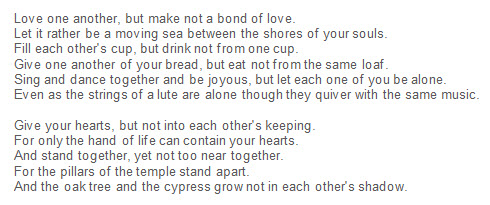
poemLoveOneAnother

Khalil Gibran born on January 6, 1883 in Lebanon – renowned Lebanese-American poet, philosopher and artist who emigrated to America with his family in 1895, settling in Boston’s culturally diverse South End.  Although he became popularly known in North America for his compilation of inspirational philosophical essays (written in poetic prose) , The Prophet, he was also a very accomplished artist, schooled (in Paris) in drawing and watercolors.  Favoring symbolism and romanticism over realism, Gibran showcased his work at his first exhibition in 1905 (Boston), where he met Mary Elizabeth Haskell, a respected headmistress.  He and Haskell formed an intimate, lifelong friendship and she played a pivotal role in his life, becoming his editor and confidante. Khalil Gibran, who never became a naturalized American citizen (in deference to his Lebanese roots), died in New York City, on April 10,1931 — at the age of forty-eight.  The cause of his death was a combination of cirrhosis of the liver and tuberculosis.  His request to be buried in his homeland of Lebanon was respected and fulfilled by his devoted friend, Mary Elizabeth.

Love One Another is an extract from his magnum opus, The Prophet. Beginning with the simple commandment of “Love One Another”, he writes philosophically about the sanctity of marital love while also acknowledging the importance of maintaining one’s individual spirit.  He writes poetically about the necessity to let love grow and evolve, just as we do.  If love is rigid and unchanging, the bonds of love will break down. In very eloquent and poetic language, he drives home the point that two people should complement each other, yet maintain and respect their separate identities.

Poem via poemhunter.com.

Image via write-brained.com

heatherfromthegrove’s poetry spotlight for today: “Desertion” by Rupert Brooke

left_alone

♦ ♦

POETRY 

@ heatherfromthegrove!

Enjoy!

♦ ♦ ♦

Desertion 

by Rupert Brooke

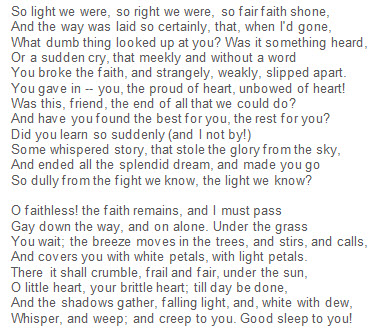
poemDesertion

Rupert Brooke  born on August 3, 1887 in England –  extremely handsome English poet famous for his neo-Romantic poems, most notably his war sonnets (the most famous one was “The Soldier”) written during World War One.  The idealistic nature of his poetry was likely a function of his youth. The well-traveled Cambridge graduate, commissioned into the Royal Naval Division, set sail for the Dardanelles in February 1915 – where he contracted septicaemia from a mosquito bite and died a month later (April 23), aboard a hospital ship off the Greek Island of Skyros. He lays buried beneath an olive grove on the Aegean island. He was only twenty-seven when he died.

Desertion I could not find any learned analysis of this poem.  The graceful lyricism of this poem, along with the theme of desertion, betrayal and fractured friendship/relationship, drew me in. The treachery of a friend or loved one who succumbs to gossip, rather than staying faithful to the friendship/relationship – written in such a beautifully, melodic manner  – resonated deeply with me, so much so that I chose to share this poem with you.

Poem via poemhunter.com.

Image via stylelemon.com, Photo credit: Julie de Waroquier.

heatherfromthegrove’s poetry spotlight for today: “The Road Not Taken” by Robert Frost

forest-trail

POETRY

@  heatherfromthegrove!

Enjoy!

The Road Not Taken

by Robert Frost

frost

Robert Frost born on March 26, 1874 in San Francisco, California – was one of the most popular and critically acclaimed American poets of the twentieth century. During his lifetime, he received a plethora of honors, most notably four Pulitzer Prizes for Poetry, numerous honorary degrees, and, in 1960, a Congressional Gold Medal. Robert Frost’s poetry was most often written with early twentieth century, rural New England as a backdrop, from which he explored intricate philosophical and social questions of human existence. His grasp and usage of down-to-earth, American  colloquial language (mirroring ordinary, everyday speech) resonated with his readership and he became an American literary icon.  His wife and inspiration for much of his poetry, Elinor Miriam White, married him in 1895.  She died from breast cancer in 1938. On January 29, 1963, at the age of eight-eight, Robert Frost died in Boston Massachusetts, of complications from pancreatic surgery.

The Road Not Taken one of Robert Frost’s most popular and yet most misunderstood poems. When he writes about the two roads, he says “Though as for that the passing there/Had worn them really about the same/And that morning equally lay/in leaves no step had trodden back”  – meaning that neither of the two roads are less traveled and therefore one is faced with the dilemma of choice: which of the two identical forks in the road do I take? Our route is determined by the fusion of both choice and chance (or fate). There is no right path, just the chosen path and the other one that was not chosen. The poem is about the moment of decision, not the actual decision itself. By making a choice, the traveler is aware that only sometime in the future, will he realize whether or not he took the road less traveled by. The poem encapsulates the agony of decision, stemming from  the very human (and common) fear of remorse/regret.

Poem via poemhhunter.com.

Image via spiritualdrift.com.

heatherfromthegrove’s poetry spotlight for today: “Alone” by Edgar Allan Poe

j0255382

POETRY

heatherfromthegrove!

Enjoy!

Alone

by Edgar Allan Poe

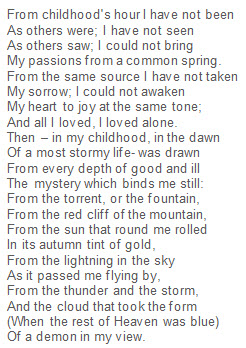
7-6-2013 12-37-18 PM

Edgar Allan Poe – born on January 19, 1809 in Boston, Massachusetts – was an American short-story writer, poet, critic, and editor.  Renowned for his tales of mystery and horror, he was dubbed  as “Father of the Detective Story.”  He married his cousin, Virginia, in 1836. She became his literary muse.  Her death in 1847 caused the grief-stricken Poe to begin a downward spiral into financial ruin and poor health. He died on October 7, 1849, in a Baltimore (Maryland) hospital. The exact cause of his death remains a mystery. Although a very troubled and haunted man, Poe’s brilliant imagination has left a compelling legacy in the literary world.  His poems and tales still have the power to shock and to move his readers.   

Alone originally written in 1829, when the author was only 20 years old, the 22-line poem was only published and titled posthumously.  Written at the time of his foster mother’s (Frances Allan) death, the poem reflects the haunting sense of isolation that he felt throughout his childhood.  

Poem via poemhunter.com

Image via faithfulhomeschool.com.