heatherfromthegrove’s non-fiction spotlight for today: “Behind the Beautiful Forevers” by Katherine Boo

♦ ♦ ♦

Monday, July 22 – Saturday, July 27

NON-FICTION

 @ heatherfromthegrove!

Enjoy some good summer reading.

♦ ♦ ♦

FabOverFifty_My_Favorite_Books_of_2012_Linda_Wolfe_Behind_The_Beautiful_Forevers

“It seemed to him that in Annawadi, fortunes derived not just from what people did, or how well they did it, but from the accidents and catastrophes they dodged. A decent life was the train that hadn’t hit you, the slumlord you hadn’t offended, the malaria you hadn’t caught.” 
Katherine Boo, Behind the Beautiful Forevers – Life, Death, and Hope in a Mumbai Undercity

From the moment we are introduced to the intelligent and resourceful Muslim teenager, Abdul, living in the slum settlement of Annawadi, we are drawn into an underground world that is as tragic and heart-wrenching as it is humorous and hopeful.  The characters are so vivid and their stories so compelling that one has to remind oneself that this is not a tale of fiction.  This beautifully crafted piece of narrative non-fiction is the end product of three intense years of reporting by master journalist and Pulitzer Prize-winner Katherine Boo.

The gripping stories of the families, surviving in a makeshift settlement near the Mumbai airport,  make us cry, wince and laugh. Living just a stone’s throw away from  luxury hotels filled with wealthy patrons, we feel their distress and anger as they battle the inequalities of class and caste.  In the dawn of a newly prosperous India, the stark contrast of the abject poverty with the neighboring wealth is a constant (and harsh) reminder that not all things (or people) are created equal. Fuelled by  hope and tenacity, the people of Annawadi strive for a better life,  despite the challenges and roadblocks that intercept them at every turn.

Behind the Beautiful Forevers is an unforgettable book and probably one of the best I’ve read in a while.

heatherfromthegrove’s non-fiction spotlight for today: “Drinking with Men” by Rosie Schaap

♦ ♦ ♦

Monday, July 22 – Saturday, July 27

NON-FICTION

 @ heatherfromthegrove!

Enjoy some good summer reading.

♦ ♦ ♦

 24book "Drinking with Men" by Rosie Schaap.

“But my attraction to bars is less governed by the laws of physics than it is by the rules of romance: I prefer one bar at a time. When it comes to where I drink, I’m a serial monogamist. Still, although loyalty is upheld as a virtue, bar regularhood—the practice of drinking in a particular establishment so often that you become known by, and bond with, both the bartenders and your fellow patrons—is often looked down upon in a culture obsessed with health and work. But despite what we are often told, being a regular isn’t synonymous with being a drunk; regularhood is much more about the camaraderie than the alcohol. Sharing the joys of drink and conversation with friends old and new, in a comfortable and familiar setting, is one of life’s most unheralded pleasures.”

Rosie Schaap, Drinking with Men: A Memoir

I want to nip any and all erroneous assumptions in the bud. This is not the memoir of an alcoholic. Drinking with Men, Rosie Schaap pays homage to all the bars, pubs, and taverns that she ever frequented, the interesting characters who sat with her around the bar, and all the stories (joyous and tragic) that they’ve shared.  I thoroughly enjoyed this book, partly because Schaap is an engaging storyteller who has clearly collected a treasure trove of humorous and poignant anecdotes in her years as a barfly… and also because I can identify with much of what she has experienced. To this day, when faced with the choice of having my meal in a restaurant’s  main dining room or eating at the bar, I always choose the latter.  It’s all about the people and listening to their stories, some of which can be quite compelling.  The wine and spirits are secondary.  It should be noted that many a barfly has been known to sip non-alcoholic drinks like San Pellegrino or Perrier, with a slice of lemon or lime. 

Kudos to Rosie Schaap, who incidentally writes the “Drinks” column for The New York Times Magazine, for she has written a memoir that is as thoughtful as it is witty. It’s the perfect summer read to enjoy, while relaxing by the pool or on the beach, and sipping your favorite libation… whether it be regular iced tea or a  Long Island Iced Tea.  Cheers!

Pick up a good non-fiction for some enlightening summer reading

reading_a_book_wallpaper_6d0dd

“I prefer the company of books. When I’m reading, I’m never alone, I have a conversation with the book. It can be very intimate. Perhaps you know this feeling yourself? The sense that you’re having an intellectual exchange with the author, following his or her train thought and you accompany each other for weeks on end.” 
― Sophie DivrySignatura 400

And now it is time to change gears and delve into the world of non-fiction, a genre that is ideal for summer reading because we have more leisure time to absorb ideas, ponder them and perhaps even learn something unexpected.

Tomorrow marks the beginning of non-fiction week, here at heatherfromthegrove. Each day, from Monday through Saturday, I’ll be spotlighting one book/author. There will be a few surprise selections, a couple of memoirs and some humorous-yet-poignant reality pieces.

I hope that you will find my recommendations helpful and I would love to hear back from you, with some of your own favorites!

Cheers,

Heather

Image via youwall.com.


heatherfromthegrove’s story spotlight for today: “Oscar and Lucinda” by Peter Carey

♦ ♦ ♦

Let’s wrap up fiction week, here @ heatherfromthegrove, with a love story.

♦ ♦ ♦

United_Kingdom7

“She held out her hand, like a man. He hesitated, then took the hand and shook it. It was very warm. You could not help but be aware of the wild passage of blood on the other side of its wall, veins, capillaries, sweat glands, tiny factories in the throes of complicated manufacture. [He] looked at the eyes and, knowing how eyes worked, was astonished, not for the first time, at the infinite complexity of Creation, wondering how this thing, this instrument for seeing, could transmit so clearly its entreaty while at the same time—-Look, I am only an eye—-denying that it was doing anything of the sort.”

Peter Carey, Oscar and Lucinda

What better way to enjoy a summer weekend than to curl up in your favorite chair and read a love story?  Written by Australian author Peter Carey, Oscar and Lucinda is a satire about two star-crossed lovers in mid-nineteenth century England and Australia. Growing up in a strict, religious (Plymouth) household, the shy young man rejects his father’s religion in favor of the C of E (Church of England), and becomes an Anglican priest.  Lucinda is a headstrong Australian heiress who is a feminist before her time. She buys a glass factory, in the hope of one day building a church made from glass and transporting it (intact) to the Australian Outback. Oscar and Lucinda meet on a ship, en route to Australia and discover they share a common vice:  gambling  (he, the racetrack; she, a deck of cards). When they arrive in Australia, neither one fits well in their social circles and the two “outsiders” form a bond.  The wickedly witty gambling duo make a wager that unleashes a series of events that affects the course of their lives.  The wager?  Lucinda bets Oscar her entire inheritance that he would be incapable of transporting the glass cathedral (without any breakage or damage) to the Outback.

Told in a long flashback, this enchanting story is about two people who were truly meant to be together.  And we, the readers, fall in love with them – vices and all.

Other novels by Peter Carey:

* adapted into a film (1997, USA) by the same name; directed by Gillian Armstrong, and starring Ralph Fiennes (as Oscar) and Cate Blanchett (as Lucinda).

** adapted into a film (1986, USA) by the same name; directed by Ray Lawrence.

In addition, he has written a large body of work: short story collections, uncollected short stories, juvenile fiction, non-fiction and screenplays.

heatherfromthegrove’s story spotlight for today: “Oryx and Crake” by Margaret Atwood

♦ ♦ ♦

Monday, July 15 – Saturday, July 20

FICTION

@ heatherfromthegrove!

Enjoy some good summer reading.

♦ ♦ ♦


81PBOoxlI4L._SL1500_

“He doesn’t know which is worse, a past he can’t regain or a present that will destroy him if he looks at it too clearly. Then there’s the future. Sheer vertigo.”

Margaret Atwood, Oryx and Crake

The creative and gifted mind of Canadian author Margaret Atwood unleashes itself yet again in the dystopian  novel, Oryx and Crake.  Written in 2003, it is the first in a trilogy in which Atwood takes us on a speculative journey into the future.  The story begins after a plague destroys civilization. The main protagonist, Snowman (formerly “Jimmy” before the world collapsed),  struggles with surviving in a world where he may be the last living human and coping with grief (and memories) over the loss of his best friend Crake, and the beautiful, evanescent Oryx , whom they both loved and coveted.  We learn more about Jimmy and his past, through flashbacks, and are drawn into his post-apocalyptic quest for answers.  Guiding this solitary man through his journey are these human-like, green-eyed Children of Crake.  As they travel through the wilderness which was once a great city, they see hybrid creatures (wolvogs, pigoons and rakunks) roaming the forest, and we later come to realize that these cross-species are the result of genetic engineering. 

It would be remiss of me to reveal more. I don’t want to spoil the story for you. 

I have read most of Atwood’s novels and this one roped me in from the get-go, and prompted me to read the second book (in the Oryx and Crake trilogy), called The Year of the Flood. Loved it. Her third installment, MaddAddam, will be released in early September (I’ve pre-ordered it).

Dystopian fiction is not for everyone.  In fact, I was ambivalent about reading Oryx and Crake but I am glad that I did.  It propelled me into a world of “what-if’s” – told by the award-winning storyteller par excellence, Margaret Atwood.

Other novels by Margaret Atwood:

adapted into a TV movie (2007, USA) by the same name; directed by David Evans and starring Mary-Louise Parker, Shawn Doyle and Susan Lynch

** adapted into a film (1990, USA) by the same name; directed by  Volker Schlöndorff and starring Natasha Richardson, Faye Dunaway and Aidan Quinn

*** adapted into a film (1981, Canada) by the same name; directed by Claude Jutra

In addition, she has written a large body of work:  children’s books,  short fiction, poetry, anthologies, television scripts, E-books,  and non-fiction.

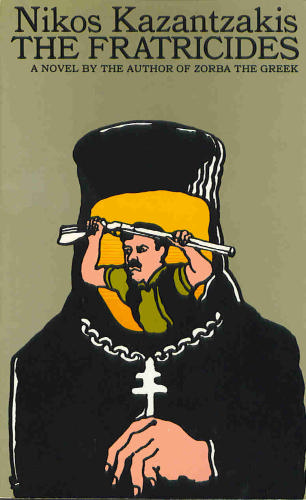
heatherfromthegrove’s story spotlight for today: “The Fratricides” by Nikos Kazantzakis

♦ ♦ ♦

Monday, July 15 – Saturday, July 20

FICTION

@ heatherfromthegrove!

Enjoy some good summer reading.

♦ ♦ ♦


edab9833e7a094e1d1012110.L

“Their life is an unceasing battle with God, with the winds, with the snow, with death. For this reason the Castellians were not surprised when the killing began, brother against brother. They were not afraid; they did not change their way of life.  But what had been simmering slowly within them, mute and unrevealed, now burst out, insolent and free. The primeval passion of man to kill poured from within them. Each had a neighbor, or a friend, or a brother, whom he had hated for years, without reason, often without realizing it. The hatred simmered there, unable to find an outlet.  And now, suddenly, they were given rifles and hand grenades; noble flags waved above their heads. The clergy, the army, the press urged them on — to kill their neighbor, their friend, their brother. Only in this manner, they shouted to them, can faith and country be saved! Murder, that most ancient need of man, took on a high mystic meaning. And the chase began — brother hunting brother.”

Nikos Kazantzakis , The Fratricides

To the rest of the world, the brilliant Greek writer and philosopher Nikos Kazantzakis is best known for his masterpiece, Zorba the Greek.   But to the Greeks, he remains a national treasure.  His body of writing is a clear attestation of the deep love he felt for his country and his people.  This passion, along with his devotion to his faith, and  a profound fascination with the magnetic power of charismatic leadership  ―  all come into play in his final curtain call, The Fratricides

The Fratricides (the act of a person killing his or her brother), was Kazantzakis’  last novel. The story takes place in a remote mountainside village (Castellos) in Macedonia, during the Greek Civil War (December  1944 – January 1945, and from 1946-49) when Greek communists tried (unsuccessfully) to gain control of Greece.  The novel’s central figure, the village priest (Father Yiannaros), tries to reconcile the two warring factions ― the monarchist troops who are in control of the town and the communist guerrillas who are trying to infiltrate the area.  Although sympathetic to some aspects of the communists’ vision of society, he is repelled by their acts of savagery. Their inhumanity goes against his moral and religious beliefs, yet Father Yiannaros takes steps to negotiate a settlement, with tragic results.  Enough said. 

Told by a master storyteller, The Fratricides is a gripping account of a turbulent time in Greek history, when brothers were (figuratively and literally) pitted against brothers.

Other novels by Nikos Kazantzakis:

* adapted into a film (1988) by the same name; directed by Martin Scorsese and starring Willem Dafoe (as Jesus), Harvey Keitel (as Judas) and Barbara Hershey (as Mary Magdalene).

** adapted into a film (1964) by the same name; directed by Mihalis Kakogiannis and starring Anthony Quinn (as Alexis Zorba) and Alan Bates (as Basil)

In addition, he wrote a vast body of work:  plays, poetry, and a wide selection of non-fiction works (travel books, translations, anthologies, memoirs, essays and letters).

My favorite Nikos Kazantzakis quote:

“I hope for nothing. I fear nothing. I am free.”


heatherfromthegrove’s poetry spotlight for today: “Forgiveness” by John Greenleaf Whittier

a-music-from-heart1

♦ ♦

As we wrap up poetry week @ heatherfromthegrove, enjoy this last one.

♦ ♦ ♦

Forgiveness

by John Greenleaf Whittier

poemForgiveness

John Greenleaf Whittier born on December 17, 1807, in Haverhill, Massachusetts – dubbed as one of the “Fireside Poets“, this American Quaker was an ardent and vocal advocate for the abolition of slavery.  His first poem was published in 1826, in a publication called the Newburyport Free Press.  The paper’s editor was abolitionist William Lloyd Garrison and it was Garrison who encouraged Whittier to take up the abolitionist cause – which he did on a local, state and national level.  He was involved with the formation of the Republican party and was keenly engaged in politics.  Whittier edited papers in Boston and Hartford (Connecticut) and – from 1857 until his death on September 7, 1892 – he was associated with the magazine, Atlantic Monthly.

Forgiveness although famous for his lengthy poems, the most popular being Snow-Bound: A Winter Idyll, this poem is one of his shortest and is often quoted because of its quiet but clear message of “forgive those who trespass against us.”  Only when we forgive, can we truly heal.  Forgiveness is freeing. And, to quote a line from the Prayer of  St. Francis, “It is in pardoning that we are pardoned.”  

Poem via poemhunter.com.

Image via pimminag.com.

heatherfromthegrove’s poetry spotlight for today: “The Fury of Abandonment” by Anne Sexton

HelpingHand

♦ ♦

POETRY 

@ heatherfromthegrove!

Enjoy!

♦ ♦ ♦

The Fury of Abandonment

by Anne Sexton

poemTheFuryOfAbandonment

Anne Sexton born on November 9,1928, in Newton, Massachusetts – a deeply troubled and brilliant American poet known for her extremely personal, emotional and conversational verse. She battled mental illness for most of her life.  Her first manic episode occurred in 1954, followed by a complete nervous breakdown a year later. Encouraged by her therapist to write poetry, as a means of cathartic therapy, Sexton discovered what was to be her true calling in life. Her poetry covered themes that reflected her own psychological challenges: depression, manic tendencies and suicide and nothing in her personal life was off-limits. She wrote about it all – becoming one of the most honored American poets and earning herself a Pulitzer Prize for Poetry. Sadly, her illness (today, she would have been diagnosed as suffering from bipolar disorder) began to escalate and, on October 4, 1974, she committed suicide by carbon monoxide poisoning. She was forty-six years old.

The Fury of Abandonment “Raw emotion” is what best describes this disturbing poem. One of 15 poems from the “Fury” sequence, later published in a collection titled, “The Death Notebooks.”  Published just after her divorce from her husband, it was the last collection of her poetry to be published before her suicide in the autumn of 1974. The advancement of her mental decline is felt with every unapologetically tortured word. It is as riveting as it is disturbing.

Poem via poemhunters.com.

Image via lydiamagazine.gr.

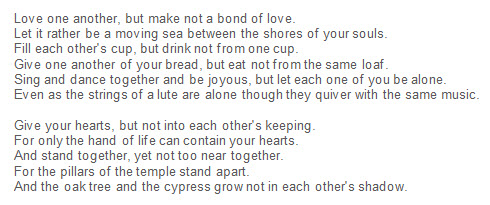
heatherfromthegrove’s poetry spotlight for today: “Love One Another” by Khalil Gibran

adorable-awesome-couple-hug-Favim.com-336964

♦ ♦

POETRY 

@ heatherfromthegrove!

Enjoy!

♦ ♦ ♦

Love One Another

by Khalil Gibran

poemLoveOneAnother

Khalil Gibran born on January 6, 1883 in Lebanon – renowned Lebanese-American poet, philosopher and artist who emigrated to America with his family in 1895, settling in Boston’s culturally diverse South End.  Although he became popularly known in North America for his compilation of inspirational philosophical essays (written in poetic prose) , The Prophet, he was also a very accomplished artist, schooled (in Paris) in drawing and watercolors.  Favoring symbolism and romanticism over realism, Gibran showcased his work at his first exhibition in 1905 (Boston), where he met Mary Elizabeth Haskell, a respected headmistress.  He and Haskell formed an intimate, lifelong friendship and she played a pivotal role in his life, becoming his editor and confidante. Khalil Gibran, who never became a naturalized American citizen (in deference to his Lebanese roots), died in New York City, on April 10,1931 — at the age of forty-eight.  The cause of his death was a combination of cirrhosis of the liver and tuberculosis.  His request to be buried in his homeland of Lebanon was respected and fulfilled by his devoted friend, Mary Elizabeth.

Love One Another is an extract from his magnum opus, The Prophet. Beginning with the simple commandment of “Love One Another”, he writes philosophically about the sanctity of marital love while also acknowledging the importance of maintaining one’s individual spirit.  He writes poetically about the necessity to let love grow and evolve, just as we do.  If love is rigid and unchanging, the bonds of love will break down. In very eloquent and poetic language, he drives home the point that two people should complement each other, yet maintain and respect their separate identities.

Poem via poemhunter.com.

Image via write-brained.com

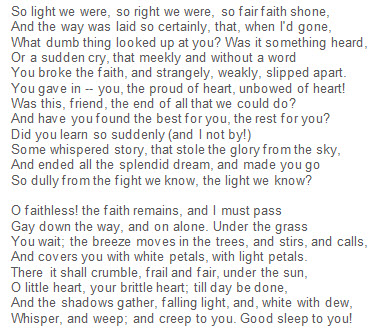
heatherfromthegrove’s poetry spotlight for today: “Desertion” by Rupert Brooke

left_alone

♦ ♦

POETRY 

@ heatherfromthegrove!

Enjoy!

♦ ♦ ♦

Desertion 

by Rupert Brooke

poemDesertion

Rupert Brooke  born on August 3, 1887 in England –  extremely handsome English poet famous for his neo-Romantic poems, most notably his war sonnets (the most famous one was “The Soldier”) written during World War One.  The idealistic nature of his poetry was likely a function of his youth. The well-traveled Cambridge graduate, commissioned into the Royal Naval Division, set sail for the Dardanelles in February 1915 – where he contracted septicaemia from a mosquito bite and died a month later (April 23), aboard a hospital ship off the Greek Island of Skyros. He lays buried beneath an olive grove on the Aegean island. He was only twenty-seven when he died.

Desertion I could not find any learned analysis of this poem.  The graceful lyricism of this poem, along with the theme of desertion, betrayal and fractured friendship/relationship, drew me in. The treachery of a friend or loved one who succumbs to gossip, rather than staying faithful to the friendship/relationship – written in such a beautifully, melodic manner  – resonated deeply with me, so much so that I chose to share this poem with you.

Poem via poemhunter.com.

Image via stylelemon.com, Photo credit: Julie de Waroquier.