heatherfromthegrove’s non-fiction spotlight for today: “Endangered Pleasures: In Defense of Naps, Bacon, Martinis, Profanity, and Other Indulgences” by Barbara Holland

♦ ♦ ♦

Let’s wrap up non-fiction week, here @ heatherfromthegrove, with a little humor.

♦ ♦ ♦
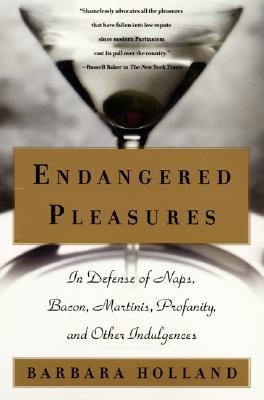
159367“Joy has been leaking out of our life… We have let the new Puritans take over, spreading a layer of foreboding across the land until even ignorant small children rarely laugh anymore. Pain has become nobler than pleasure; work, however foolish or futile, nobler than play; and denying ourselves even the most harmless delights marks the suitably somber outlook on life.”

Barbara Holland, Endangered Pleasures: In Defense of Naps, Bacon, Martinis, Profanity, and Other Indulgences

There’s nothing like a little hedonism on a hot summer day. Endangered Pleasures is an unabashed and irreverent ode to self-indulgence. In defense of small vices and taking time to smell the roses, the late Barbara Holland reminds us that we should loosen our ties, kick off our shoes and… live a little bit.  Have some fun. If only Barbara Holland had met someone like Alexis Zorba (Zorba the Greek)… they would have shared quite a few dances together!

This beautifully written book contains essays that extol every simple, little joy – from waking up in the morning to padding barefoot around the house and yard. Holland’s wry sense of humor comes through, loud and clear, making us realize that sometimes we take ourselves way too seriously.

Here are a few Barbara-isms (her endangered pleasures):

“The cold and limey rattle of a vodka-tonic being walked across the lawn.”

“Finishing our tax returns.”

“The smells of the morning paper, cut grass, and old leather jackets.”

“A glass of cold champagne and a perfectly ripe pear, perhaps with a spoonful of caviar eaten straight from the jar.”

“Singing to ourselves in the car.”

I’m so happy that I came across this book, but sad that the author has since passed away. Endangered Pleasures is a great summer read, so kick off  your shoes, pour yourself a glass of something and have a good chuckle. Life’s too short.
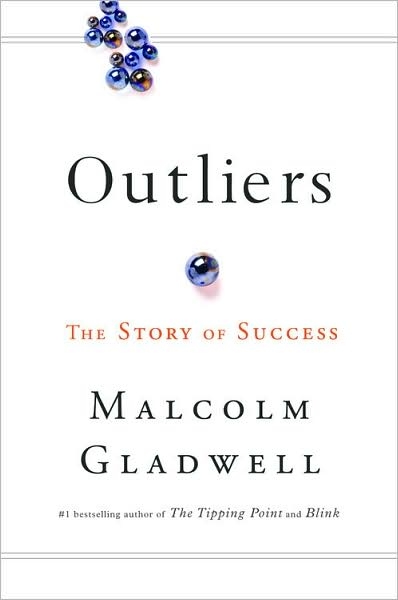
heatherfromthegrove’s non-fiction spotlight for today: “Outliers: The Story of Success” by Malcolm Gladwell

♦ ♦ ♦

Monday, July 22 – Saturday, July 27

NON-FICTION

 @ heatherfromthegrove!

Enjoy some good summer reading.

♦ ♦ ♦

 outliers

“Do you see the consequences of the way we have chosen to think about success? Because we so profoundly personalize success, we miss opportunities to lift others onto the top rung…We are too much in awe of those who succeed and far too dismissive of those who fail. And most of all, we become much too passive. We overlook just how large a role we all play—and by “we” I mean society—in determining who makes it and who doesn’t.”

Malcolm Gladwell, Outliers: The Story of Success


True to form, bestselling author Malcolm Gladwell (Blink and Tipping Point) takes us on an intellectual expedition into the realm of high achievers – über-successful people like Microsoft co-founder Bill Gates and the phenomenon known as “The Beatles.”  An “outlier” is, in Gladwell’s own words, “a scientific term to describe things or phenomena that lie outside normal experience.” In the context of his book, outliers “are the men and women who, for one reason or another, are so accomplished and so extraordinary and so outside of ordinary experience that they are as puzzling to the rest of us as a cold day in August.

Dispelling the notion that extremely successful people attain success because they make it happen –through their own smarts, tenacious drive, willingness to hustle and, good old-fashioned hard work,  Gladwell points out that there are many extremely intelligent, highly gifted, hardworking people for whom success has been an elusive mistress. Therefore, the common dogma of “You are the author of your own destiny. You make your own success.”  does not apply in many cases. In this book, Gladwell asks us to shift our focus from what successful people are like,  to where successful people come from.  He argues that one’s culture, family background and upbringing play a significant role in the makeup of a high achiever.

Clear, witty and intelligent, Outliers offers a new perspective on what it takes to achieve extreme success. Granted, success does rely – to a great extent – on individual effort. However, what should not be ignored is the degree to which outside factors, such as people and circumstances, affect a person’s success or failure.  Therefore, we (as a society) have the ability to help shape people’s lives, and  (if directed in the right way and with the best intentions) for the better.   

heatherfromthegrove’s non-fiction spotlight for today: “Behind the Beautiful Forevers” by Katherine Boo

♦ ♦ ♦

Monday, July 22 – Saturday, July 27

NON-FICTION

 @ heatherfromthegrove!

Enjoy some good summer reading.

♦ ♦ ♦

FabOverFifty_My_Favorite_Books_of_2012_Linda_Wolfe_Behind_The_Beautiful_Forevers

“It seemed to him that in Annawadi, fortunes derived not just from what people did, or how well they did it, but from the accidents and catastrophes they dodged. A decent life was the train that hadn’t hit you, the slumlord you hadn’t offended, the malaria you hadn’t caught.” 
Katherine Boo, Behind the Beautiful Forevers – Life, Death, and Hope in a Mumbai Undercity

From the moment we are introduced to the intelligent and resourceful Muslim teenager, Abdul, living in the slum settlement of Annawadi, we are drawn into an underground world that is as tragic and heart-wrenching as it is humorous and hopeful.  The characters are so vivid and their stories so compelling that one has to remind oneself that this is not a tale of fiction.  This beautifully crafted piece of narrative non-fiction is the end product of three intense years of reporting by master journalist and Pulitzer Prize-winner Katherine Boo.

The gripping stories of the families, surviving in a makeshift settlement near the Mumbai airport,  make us cry, wince and laugh. Living just a stone’s throw away from  luxury hotels filled with wealthy patrons, we feel their distress and anger as they battle the inequalities of class and caste.  In the dawn of a newly prosperous India, the stark contrast of the abject poverty with the neighboring wealth is a constant (and harsh) reminder that not all things (or people) are created equal. Fuelled by  hope and tenacity, the people of Annawadi strive for a better life,  despite the challenges and roadblocks that intercept them at every turn.

Behind the Beautiful Forevers is an unforgettable book and probably one of the best I’ve read in a while.

heatherfromthegrove’s non-fiction spotlight for today: “Thinking, Fast and Slow” by Daniel Kahneman

♦ ♦ ♦

Monday, July 22 – Saturday, July 27

NON-FICTION

 @ heatherfromthegrove!

Enjoy some good summer reading.

♦ ♦ ♦

 uc5r5QklTM4NLrJVqNdRwTl72eJkfbmt4t8yenImKBVaiQDB_Rd1H6kmuBWtceBJ

“A remarkable aspect of your mental life is that you are rarely stumped. True, you occasionally face a question such as 17 × 24 = ? to which no answer comes immediately to mind, but these dumbfounded moments are rare. The normal state of your mind is that you have intuitive feelings and opinions about almost everything that comes your way. You like or dislike people long before you know much about them; you trust or distrust strangers without knowing why; you feel that an enterprise is bound to succeed without analyzing it. Whether you state them or not, you often have answers to questions that you do not completely understand, relying on evidence that you can neither explain nor defend.”

 – Daniel Kahneman, Thinking, Fast and Slow

Noted for his extensive research, knowledge and work on the psychology of judgment and decision-making, hedonic psychology and behavioral economics, renowned Israeli-American psychologist Daniel Kahneman delivers a very fascinating exploration of the mind in Thinking, Fast and Slow. In this compelling book, we learn that there are two systems which drive the mind:  System 1 – our fast, automatic, intuitive and emotional mode, and System 2 – our slower, more calculated and logical reasoning mode.  Kahneman explains how the two systems affect how and why we make certain choices and decisions (in business and in our personal lives) and, more importantly, how we can employ certain techniques  and preemptive measures to mitigate potential problems that our intuitive mind may cause. He then teaches us ways to successfully tap into the benefits of slow, deliberate thinking.

Thinking, Fast and Slow is a treat to the intellect, one that needs to be read and digested slowly.

Daniel Kahneman, winner of the 2002 Nobel Memorial Prize in Economic Sciences, is currently Professor Emeritus of psychology and public affairs at Princeton University’s Woodrow Wilson School.

heatherfromthegrove’s non-fiction spotlight for today: “Quiet: The Power of Introverts in a World That Can’t Stop Talking” by Susan Cain

♦ ♦ ♦

Monday, July 22 – Saturday, July 27

NON-FICTION

 @ heatherfromthegrove!

Enjoy some good summer reading.

♦ ♦ ♦

quiet-final-jacket

“Introverts, in contrast, may have strong social skills and enjoy parties and business meetings, but after a while wish they were home in their pajamas. They prefer to devote their social energies to close friends, colleagues, and family. They listen more than they talk, think before they speak, and often feel as if they express themselves better in writing than in conversation. They tend to dislike conflict. Many have a horror of small talk, but enjoy deep discussions.”

Susan Cain, Quiet: The Power of Introverts in a World That Can’t Stop Talking

I love the title of this book. Quiet: The Power of Introverts in a World That Can’t Stop Talking. Listening to loud, incessant talking gives me a headache. Unfortunately this “noise” is the norm, rather than the exception. Just turn on the television set and watch a few commercials or catch a daytime talk show. Personally, I do not enjoy listening to people as they talk over each other. However, as Susan Cain points out, the “Extrovert Ideal” has indeed “permeated our culture.” Despite the premise that introverts comprise, at the very least, one-third of the people we know, they remain undervalued in American society – much to our detriment.

Impeccably researched and beautifully written, this book is replete with interesting stories of real people and we get to meet some highly successful introverts, dispelling the myth that he who shouts loudest gets heard.

This book is a thought-provoking read.  Introverts will be inspired and extroverts will gain some new and interesting perspective.

Quiet has been on the New York Times Bestsellers List (Paperback, Non-fiction) for twenty-four weeks straight and is not likely to fall off the list anytime soon.

heatherfromthegrove’s non-fiction spotlight for today: “Drinking with Men” by Rosie Schaap

♦ ♦ ♦

Monday, July 22 – Saturday, July 27

NON-FICTION

 @ heatherfromthegrove!

Enjoy some good summer reading.

♦ ♦ ♦

 24book "Drinking with Men" by Rosie Schaap.

“But my attraction to bars is less governed by the laws of physics than it is by the rules of romance: I prefer one bar at a time. When it comes to where I drink, I’m a serial monogamist. Still, although loyalty is upheld as a virtue, bar regularhood—the practice of drinking in a particular establishment so often that you become known by, and bond with, both the bartenders and your fellow patrons—is often looked down upon in a culture obsessed with health and work. But despite what we are often told, being a regular isn’t synonymous with being a drunk; regularhood is much more about the camaraderie than the alcohol. Sharing the joys of drink and conversation with friends old and new, in a comfortable and familiar setting, is one of life’s most unheralded pleasures.”

Rosie Schaap, Drinking with Men: A Memoir

I want to nip any and all erroneous assumptions in the bud. This is not the memoir of an alcoholic. Drinking with Men, Rosie Schaap pays homage to all the bars, pubs, and taverns that she ever frequented, the interesting characters who sat with her around the bar, and all the stories (joyous and tragic) that they’ve shared.  I thoroughly enjoyed this book, partly because Schaap is an engaging storyteller who has clearly collected a treasure trove of humorous and poignant anecdotes in her years as a barfly… and also because I can identify with much of what she has experienced. To this day, when faced with the choice of having my meal in a restaurant’s  main dining room or eating at the bar, I always choose the latter.  It’s all about the people and listening to their stories, some of which can be quite compelling.  The wine and spirits are secondary.  It should be noted that many a barfly has been known to sip non-alcoholic drinks like San Pellegrino or Perrier, with a slice of lemon or lime. 

Kudos to Rosie Schaap, who incidentally writes the “Drinks” column for The New York Times Magazine, for she has written a memoir that is as thoughtful as it is witty. It’s the perfect summer read to enjoy, while relaxing by the pool or on the beach, and sipping your favorite libation… whether it be regular iced tea or a  Long Island Iced Tea.  Cheers!

Pick up a good non-fiction for some enlightening summer reading

reading_a_book_wallpaper_6d0dd

“I prefer the company of books. When I’m reading, I’m never alone, I have a conversation with the book. It can be very intimate. Perhaps you know this feeling yourself? The sense that you’re having an intellectual exchange with the author, following his or her train thought and you accompany each other for weeks on end.” 
― Sophie DivrySignatura 400

And now it is time to change gears and delve into the world of non-fiction, a genre that is ideal for summer reading because we have more leisure time to absorb ideas, ponder them and perhaps even learn something unexpected.

Tomorrow marks the beginning of non-fiction week, here at heatherfromthegrove. Each day, from Monday through Saturday, I’ll be spotlighting one book/author. There will be a few surprise selections, a couple of memoirs and some humorous-yet-poignant reality pieces.

I hope that you will find my recommendations helpful and I would love to hear back from you, with some of your own favorites!

Cheers,

Heather

Image via youwall.com.


heatherfromthegrove’s story spotlight for today: “Oscar and Lucinda” by Peter Carey

♦ ♦ ♦

Let’s wrap up fiction week, here @ heatherfromthegrove, with a love story.

♦ ♦ ♦

United_Kingdom7

“She held out her hand, like a man. He hesitated, then took the hand and shook it. It was very warm. You could not help but be aware of the wild passage of blood on the other side of its wall, veins, capillaries, sweat glands, tiny factories in the throes of complicated manufacture. [He] looked at the eyes and, knowing how eyes worked, was astonished, not for the first time, at the infinite complexity of Creation, wondering how this thing, this instrument for seeing, could transmit so clearly its entreaty while at the same time—-Look, I am only an eye—-denying that it was doing anything of the sort.”

Peter Carey, Oscar and Lucinda

What better way to enjoy a summer weekend than to curl up in your favorite chair and read a love story?  Written by Australian author Peter Carey, Oscar and Lucinda is a satire about two star-crossed lovers in mid-nineteenth century England and Australia. Growing up in a strict, religious (Plymouth) household, the shy young man rejects his father’s religion in favor of the C of E (Church of England), and becomes an Anglican priest.  Lucinda is a headstrong Australian heiress who is a feminist before her time. She buys a glass factory, in the hope of one day building a church made from glass and transporting it (intact) to the Australian Outback. Oscar and Lucinda meet on a ship, en route to Australia and discover they share a common vice:  gambling  (he, the racetrack; she, a deck of cards). When they arrive in Australia, neither one fits well in their social circles and the two “outsiders” form a bond.  The wickedly witty gambling duo make a wager that unleashes a series of events that affects the course of their lives.  The wager?  Lucinda bets Oscar her entire inheritance that he would be incapable of transporting the glass cathedral (without any breakage or damage) to the Outback.

Told in a long flashback, this enchanting story is about two people who were truly meant to be together.  And we, the readers, fall in love with them – vices and all.

Other novels by Peter Carey:

* adapted into a film (1997, USA) by the same name; directed by Gillian Armstrong, and starring Ralph Fiennes (as Oscar) and Cate Blanchett (as Lucinda).

** adapted into a film (1986, USA) by the same name; directed by Ray Lawrence.

In addition, he has written a large body of work: short story collections, uncollected short stories, juvenile fiction, non-fiction and screenplays.

heatherfromthegrove’s story spotlight for today: “Oryx and Crake” by Margaret Atwood

♦ ♦ ♦

Monday, July 15 – Saturday, July 20

FICTION

@ heatherfromthegrove!

Enjoy some good summer reading.

♦ ♦ ♦


81PBOoxlI4L._SL1500_

“He doesn’t know which is worse, a past he can’t regain or a present that will destroy him if he looks at it too clearly. Then there’s the future. Sheer vertigo.”

Margaret Atwood, Oryx and Crake

The creative and gifted mind of Canadian author Margaret Atwood unleashes itself yet again in the dystopian  novel, Oryx and Crake.  Written in 2003, it is the first in a trilogy in which Atwood takes us on a speculative journey into the future.  The story begins after a plague destroys civilization. The main protagonist, Snowman (formerly “Jimmy” before the world collapsed),  struggles with surviving in a world where he may be the last living human and coping with grief (and memories) over the loss of his best friend Crake, and the beautiful, evanescent Oryx , whom they both loved and coveted.  We learn more about Jimmy and his past, through flashbacks, and are drawn into his post-apocalyptic quest for answers.  Guiding this solitary man through his journey are these human-like, green-eyed Children of Crake.  As they travel through the wilderness which was once a great city, they see hybrid creatures (wolvogs, pigoons and rakunks) roaming the forest, and we later come to realize that these cross-species are the result of genetic engineering. 

It would be remiss of me to reveal more. I don’t want to spoil the story for you. 

I have read most of Atwood’s novels and this one roped me in from the get-go, and prompted me to read the second book (in the Oryx and Crake trilogy), called The Year of the Flood. Loved it. Her third installment, MaddAddam, will be released in early September (I’ve pre-ordered it).

Dystopian fiction is not for everyone.  In fact, I was ambivalent about reading Oryx and Crake but I am glad that I did.  It propelled me into a world of “what-if’s” – told by the award-winning storyteller par excellence, Margaret Atwood.

Other novels by Margaret Atwood:

adapted into a TV movie (2007, USA) by the same name; directed by David Evans and starring Mary-Louise Parker, Shawn Doyle and Susan Lynch

** adapted into a film (1990, USA) by the same name; directed by  Volker Schlöndorff and starring Natasha Richardson, Faye Dunaway and Aidan Quinn

*** adapted into a film (1981, Canada) by the same name; directed by Claude Jutra

In addition, she has written a large body of work:  children’s books,  short fiction, poetry, anthologies, television scripts, E-books,  and non-fiction.

heatherfromthegrove’s story spotlight for today: “The Fratricides” by Nikos Kazantzakis

♦ ♦ ♦

Monday, July 15 – Saturday, July 20

FICTION

@ heatherfromthegrove!

Enjoy some good summer reading.

♦ ♦ ♦


edab9833e7a094e1d1012110.L

“Their life is an unceasing battle with God, with the winds, with the snow, with death. For this reason the Castellians were not surprised when the killing began, brother against brother. They were not afraid; they did not change their way of life.  But what had been simmering slowly within them, mute and unrevealed, now burst out, insolent and free. The primeval passion of man to kill poured from within them. Each had a neighbor, or a friend, or a brother, whom he had hated for years, without reason, often without realizing it. The hatred simmered there, unable to find an outlet.  And now, suddenly, they were given rifles and hand grenades; noble flags waved above their heads. The clergy, the army, the press urged them on — to kill their neighbor, their friend, their brother. Only in this manner, they shouted to them, can faith and country be saved! Murder, that most ancient need of man, took on a high mystic meaning. And the chase began — brother hunting brother.”

Nikos Kazantzakis , The Fratricides

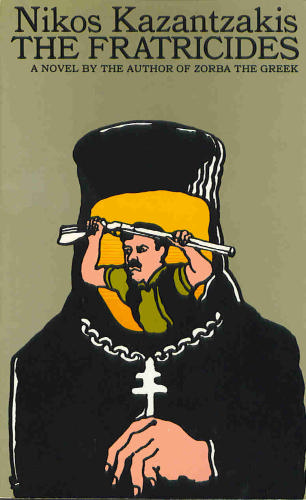
To the rest of the world, the brilliant Greek writer and philosopher Nikos Kazantzakis is best known for his masterpiece, Zorba the Greek.   But to the Greeks, he remains a national treasure.  His body of writing is a clear attestation of the deep love he felt for his country and his people.  This passion, along with his devotion to his faith, and  a profound fascination with the magnetic power of charismatic leadership  ―  all come into play in his final curtain call, The Fratricides

The Fratricides (the act of a person killing his or her brother), was Kazantzakis’  last novel. The story takes place in a remote mountainside village (Castellos) in Macedonia, during the Greek Civil War (December  1944 – January 1945, and from 1946-49) when Greek communists tried (unsuccessfully) to gain control of Greece.  The novel’s central figure, the village priest (Father Yiannaros), tries to reconcile the two warring factions ― the monarchist troops who are in control of the town and the communist guerrillas who are trying to infiltrate the area.  Although sympathetic to some aspects of the communists’ vision of society, he is repelled by their acts of savagery. Their inhumanity goes against his moral and religious beliefs, yet Father Yiannaros takes steps to negotiate a settlement, with tragic results.  Enough said. 

Told by a master storyteller, The Fratricides is a gripping account of a turbulent time in Greek history, when brothers were (figuratively and literally) pitted against brothers.

Other novels by Nikos Kazantzakis:

* adapted into a film (1988) by the same name; directed by Martin Scorsese and starring Willem Dafoe (as Jesus), Harvey Keitel (as Judas) and Barbara Hershey (as Mary Magdalene).

** adapted into a film (1964) by the same name; directed by Mihalis Kakogiannis and starring Anthony Quinn (as Alexis Zorba) and Alan Bates (as Basil)

In addition, he wrote a vast body of work:  plays, poetry, and a wide selection of non-fiction works (travel books, translations, anthologies, memoirs, essays and letters).

My favorite Nikos Kazantzakis quote:

“I hope for nothing. I fear nothing. I am free.”