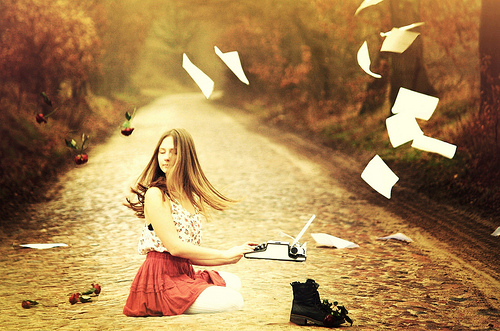
Think first, write later

5385287084_2702462500

 “Poirot,” I said. “I have been thinking.”
“An admirable exercise my friend. Continue it.”
 
― Agatha ChristiePeril at End House

Have you ever responded to an offensive or distressing email without thinking first?  “WHAT?!” you say to yourself, as your fingers agitatedly skim over the keys and, without a second thought…Send. Moments later, you could kick yourself for having been so impulsive.

This has surely happened to all of us, at one time or another.

Or perhaps, as a student, you were seated for your mid-term essay exam and you skimmed the questions quickly, then proceeded to write feverishly because the clock was ticking and you wanted to make sure that you had enough time to answer all the questions. It was only after you handed in the test, that you realized you missed the second part of the question because you didn’t take the time read carefully and organize your thoughts.

Mea culpa, mea culpa.

In the writing world, however, the process varies from writer to writer.  Not everyone likes to adhere to the “think first, write later” principle. Many writers just sit down at the computer (or, if they’re traditionalists, with pen and paper), and write. Then they edit. Stream of consciousness writing works for many and these are the writers who, when at home, probably don’t write shopping lists or who prefer not to structure their time rigidly. They are the free thinkers.  Write first, think while writing, and then edit later.

However, there are just as many writers (myself included) who prefer to organize their thoughts, prior to writing them down.  They do this by notes, index cards, outlines and also by just thinking (or daydreaming) it out in their minds. 

I am a great proponent of outlines.  My book writing process always commences with quiet contemplation… to think carefully about what I want to say and why, who will my readership be and how will I engage their attention. From there, I craft an initial Table of Contents which serves as my starting point and basic outline.  I then begin the initial research process (when research is required for the book) and the results of my initial research prompts me to write a more detailed outline which helps dictate the overall flow of the book. At that point. I move to a more advanced stage of research, finetune the outline further and then I am ready to sit down and write. I prefer to think first, write later. I carry a small  Moleskine reporter’s notebook with me wherever I go, to jot down thoughts. The challenge is being able to read my own messy handwriting later!

There really is no right or wrong process. Ultimately, the objective is to write.  How you get to that point is subject to whatever works for you.

So, think on the fly or  think in advance, but just make sure to carefully review your writing first before pressing that “Send” button!


Image via everydaygyaan.com.

Confessions of a Daydreamer

daydreaming-girl

“As I quietly stare off into space, eyes glazed over and brow thoughtfully taut, know that I am going about my business.  I am a storyteller.  Daydreaming is the best part of my job.”
― Richelle E. Goodrich

Couldn’t have said it better myself.

And now for the confession.

I have been daydreaming all of my life: characters, scenes and dialogue – all created in my mind. I am not crazy (although that subject is a matter of jovial debate in my family).  My mother totally understood the eccentricities of her youngest child.  After years of adjustment, my husband now knows that when he walks by the study and sees me in a trance-like state, tears streaming down my face, he needn’t worry.  Nor does he say a word because there is nothing more annoying to a consummate daydreamer than jarring interruptions. He just walks away, shaking his head and wondering to himself whether or not he lives in a madhouse.

So, I just like to conjure up storylines in my mind. The downside is that there are quite a few unfinished scripts in my filing drawer. Too many ideas, too little time. The upside is that I am never, ever bored.

One loop away from being totally loopy.

Now that the proverbial cat is out of the bag, I’d like to focus a little wrath on the naysayers who give daydreaming a bad name. In a world where everyone seems to be rushing around like the rabbit in Alice in Wonderland, daydreaming is often considered frivolous, lazy, a waste of valuable time and downright “flakey.” 

Not so, say many mental health experts. Daydreaming is not only beneficial to our state of mind, but it also contributes to our productivity.

“How on earth can this be true?”  say the anti-daydreamers.

Well, ye of little faith, psych specialists compare daydreaming to meditation.  Both help us to relax, relieve stress, take a mental “time out.”  After a daydreaming session, we are refreshed, energetic and ready to tackle the rest of the day.

In the Smithsonian article, The Benefits of Daydreaming,” Joseph Stromberg writes about a recent research study (published in Psychological Science) which indicates “that a wandering mind correlates with higher degrees of what is referred to as working memory. Cognitive scientists define this type of memory as the brain’s ability to retain and recall information in the face of distractions.

Therefore, despite the daydreamer’s propensity to let the mind wander, she (or he) possesses a heightened working memory which allows her (or him) to snap out of La-la Land when required to do so.

Moving the discussion of science back to the arts, most creative people would concur that daydreaming sparks the imagination. It helps to motivate and stimulate ideas.

Walk into a room filled with writers, authors, poets and novelists, and ask “Who among you daydreams regularly? Please raise your hand.”  With few exceptions, every hand will be raised.

Storytellers daydream. It’s what we do.

La-la land is a great place to visit.  The key is to know when it’s time to leave and come back home.


Image via mommasmoneymatters.com.

The Psychology of Blogging

hammer

Like many of you, I enjoy reading blogs that pique my interest.  I also read them to gain insight, whether expected or unexpected, and to gather information on a specific topic. It is always a delight to discover a really good blog site and an articulate writer with a unique perspective.

So, we know why we read blogs. The question is, why do we write blogs?

Why do we blog?

Do we do it…

… as a form of cathartic self-expression (cyber-catharsis)?

… because we are narcissists (varying from mild to extreme)?

… just simply to write down our musings, because we believe we have something interesting to say, to share, or to teach?

… as an outlet for self-promotion?

… as a writing exercise, to tone and hone our writing skills?

Perhaps it is a combination of some or all of the above.  To understand the reasons, we’ll need to delve into the psyche of a blogger.  

Cathartic Self-expression (Cyber-catharsis)

Psychologists and psychiatrists often recommend journal writing as a tool to help release stress, work through issues, and as a means of self discovery.  Blogging takes journal writing to a completely new dimension. Not only does it provide cathartic therapy for those who need it, it also opens the door to a worldwide web of  support – a cyber support group whereby people can connect, share and commiserate with others who are experiencing (or who have experienced) similar challenges. Advice is given and received.  Stories are shared. And, in many cases, friendships are made. 

Narcissism

If we’re being truly honest with ourselves, we are all narcissistic to some degree. For most of us…. just a wee bit.  It only really becomes a problem, however, when we get so self-absorbed that our sense of what is real and rational becomes clouded. That is when it’s time to seek help. It’s one thing to write about “me, myself, and I” if there’s a valid purpose, an opinion to express, or a valuable lesson to impart.  But it is quite another to blog for no other reason than to feed the ego.

Musings

We all have something to learn and something to teach. Writing about our thoughts and experiences – on such a vast platform – gives us a forum to exchange ideas, to offer and receive a different perspective. 

An Outlet for Self-promotion

There is absolutely nothing wrong with self-promotion. We all need to keep a roof over our heads and food on the table. But, again, it’s all a matter of degree.  If it’s done properly and gracefully, it will not repel people. If it’s crass, full of redundant sales pitches and slogans (like an “As Seen on TV” commercial)… people will find it offensive and be turned off.  

A Writing Exercise, to Tone and Hone Writing Skills

Blogging is an excellent way to finetune that writing muscle. The more often we write, the better we get.  When we blog, we get an opportunity to connect instantaneously  with our readership which, in turn, helps us to understand what engages the reader. And, finally, blogging regularly helps us to avoid and/or battle that soul-destroying disorder that we all dread:  writer’s block.

What I personally find most gratifying about blogging (and this one was not the list) is the access I now have to people from across the globe. The thrill of being able to interact with men and women from all walks of  life, from different cultures, young and old and everyone in-between ― in real time. What an amazing opportunity!  To travel seamlessly through cyberspace, via the written word, has effectively bridged all physical distance. And, with just the click of a button, this gargantuan world we live in… has suddenly become a whole lot smaller.


Image via contestmob.com.

How to Resist the Lure of Summer Distractions

17XgPyfrdGU

Summer is a temptress. She dazzles us with bright colors and hot sun. Every year, we impatiently await her arrival.  For many, she is a welcome respite after a long, cold winter.  She exudes a sense of lightness and freedom and her flamboyance and playfulness is infectious.  School is out and children suddenly find themselves with loads of time… to play!  And they don’t waste a minute.  With the rigor of school schedules and extracurricular activities set  aside, parents reconnect with their children.  Men and women start to loosen up a bit and their busy lives begin to take a back seat to weekend barbecues, picnics and summertime activities.  That glorious smell of barbecue grilling wafts from house to house.

Yes, summer is a temptress.  But, as a writer who is working on multiple book projects while trying to promote her newly published book, it is difficult to resist the lure of summertime distractions.   Am I up for the challenge?  Can I muster enough will and discipline? 

I’ll let you know at the end of the summer.

In the meantime, I am going to try out some of these tips.  Maybe they can help you, as well.

1. Channel your inner Gumby

gumbyThe key is flexibility.  Summer schedules need to be flexible, not rigid.  Otherwise, you’re setting yourself up to fail.  “Fail” is perhaps too strong a word, but I’m sure you understand my meaning.

2. Move like an inchworm

inchworm

Take it one steady, small step at a time. Break up your day into increments of time – time to research, time to write, time to relax and time for eating and sleeping. Set smaller, more frequent goals and milestones for yourself and this will encourage you to keep moving forward and ultimately fill you with a sense of accomplishment. On the other hand, if you flit like a butterfly – from task to task – nothing will ever get completed.

3. Set your boundaries

writing-contest-scams

Let your family and friends know when you’re in the writing zone, so that they can respect your space and privacy for the time that you’ve allocated. Afterwards, they can have your full attention.

4. Don’t bite off more than you can chew

gerbil

It’s summertime. Focus on the most important  and enjoyable projects, then make a plan to tackle the rest in the Autumn months.

5. Bring it outside

woman_writer_outside_laptop

You don’t have write behind closed doors on a beautiful summer’s day.  Take your laptop or notepad, a pot of tea or coffee, and do your writing (and thinking) outside.  If you live in an apartment and don’t have a yard, pack yourself some refreshments and go to your nearest park.  If you live near water, sit on the beach or by the lake. Maybe the sights and sounds all around you will bring you some interesting perspective or inspiration.

Enjoy your summer and happy writing!

Images via anordinarywomn.net, gumbyworld.com, piedmontwildlifecenter.org, writingforward.com,  dorrys.com and cloudsandchecks.com.

Writing in an Authentic Voice

exam6

“Believe in yourself and in your own voice,

because there will be times in this business when you will be the only one who does.

Take heart from the knowledge that an author with a strong voice

will often have trouble at the start of his or her career –

because strong, distinctive voices sometimes make editors nervous.

 But in the end, only the strong survive.”

―  Jayne Ann Krentz

Most writers are blessed (although some would say, cursed) with the uncanny ability to see through another person’s outward façade, body language and emotional barriers.  Good writers are keen observers.  We watch. We don’t just listen, we hear.  And we notice – everything. Then, we write.

Similarly, a voracious reader opens up a book, in anticipation of a good read – expecting to be transported into someone else’s words, someone else’s thoughts. The reader has high expectations. He or she  wants to soak up all that the writer has to say. But when the words seem forced, when the thoughts do not ring true – the reader is left deflated and unsatisfied.

It all boils down to one word:  Authenticity.  When a writer is ready to commit his or her observations, experiences, life lessons and creativity to paper, it must be done clearly and in an authentic voice.  If the writing is not authentic, the reader will detect it in a flash. If a story appears forced to the reader, it is forced.

Say what you mean.  Mean what you say.

A writer should never worry about being popular.  We can’t please everybody.  There will always be those who take umbrage at what we say.  Conversely, there will be just as many who will champion us. One has to be philosophical about the whole writing experience.  When we are true to ourselves, when we write in an authentic voice – we should be happy with the end result.

However…

… this should not preclude us from exercising the art of self-restraint.  When a writer is passionate (and believe me, I know whereof  I speak), it becomes an interesting balancing act of saying what needs to be said, yet reigning the words in a tad – to avoid rabid repetition. 

A word to the wise:  gather together an unbiased focus group of people and have them read and critique the manuscript. Heed their feedback well, without taking it personally.  Then, apply it.  We are all classmates in a lifelong Continuing Education program. The objective must always be to learn and to keep on learning, until we are dead and buried.

On that lively note, I shall bid you all Godspeed as you continue your writing journey.

Be true to yourself and to your craft.  The best is yet to come.

Image via destinationsdreamsanddogs.com

My Books, My Friends

BOOKS-285x300

“A book is the only place in which you can examine a fragile thought without breaking it, or explore an explosive idea without fear it will go off in your face.  It is one of the few havens remaining where a man’s mind can get both provocation and privacy.”

~ Edward P. Morgan

When I was a young girl, my mother would often call out to me and say “Your friends are at the front door.  They want to know when you’ll be going out to play.”   From my bedroom,  where I was curled up in my armchair like a content puppy — nose deep in a gripping novel, I would shout back (adjusting my glasses, as I did so): “Tell them I’ll be out as soon as I finish this chapter!”  Ten chapters later, my mother would peek around the door and say “Go out and get some fresh air. Your friends will begin to think that you don’t like them anymore.”  Reluctantly, I would put a bookmark in my book and then, very lovingly, place it down on the side table.  I’d walk past my mother, who smiled and shook her head (did she actually roll her eyes at me … really?).  

Many decades later, nothing much has changed.  With a few exceptions.  My mother died over seven years ago and I miss her so much that it hurts.  My childhood friends still live in Canada (while I now live in South Florida).  But, we still keep in touch.  Thank goodness for Facebook!

As fate would have it, my husband likes to spend some time in the company of his own mind, as I do.   So, when I get lost inside my head, reading a thought-provoking piece of fiction or non-fiction, I am rarely interrupted. 

Virtually every room in our house has bookshelves filled with books.  Every possible discipline — from literature, biographies, history, law and philosophy to engineering, architecture, music and art.  And everything in between.  

They are not there for show.  I say this because a few people (not readers themselves) have actually asked whether we truly read them!  We read them.  Some, we’ve read over and over again.

“The scholar only knows how dear these silent, yet eloquent, companions of pure thoughts and innocent hours become in the season of adversity.  When all that is worldly turns to dross around us, these only retain their steady value.”

Washington Irving

When I walk into a room full of books, I am filled with a sense of comfort and well-being.  I know every single book that is in the house and each is alphabetized and organized by discipline/category. 

Libraries are sacred sanctuaries filled with knowledge — private libraries, public libraries, university libraries …. all of them!  That wonderfully musty smell of old leather and paper, the silence (you can hear a pin drop), the rows and rows of books … it’s heaven.

“A good book is the purest essence of a human soul.”

Thomas Carlyle  (excerpt from his speech in support of the London Library, 1840)

Reading is not only good for the soul, it exercises the mind and helps reduces stress. 

Yes, my books are my friends. They are the gifts I treasure most. And, as a writer, they never cease to encourage, challenge and humble me.

beachreading1_wide-1a929731cc5a2143a42a7b6345432d77199d0d48-s6-c10

New Year’s Revelation No. 3 of 7: Resist the Mañana Syndrome

image-articolo-i-benefici-della-vacanza-manteniamoli-cosi

“Know the true value of time; snatch, seize, and enjoy every moment of it.  No idleness, no laziness, no procrastination: never put off till tomorrow what you can do today.
~ Lord Chesterfield 

In theory, I completely concur with Lord Chesterfield.  In practice, however, I’ve been known to occasionally follow Scarlett O’Hara’s logic (from Gone with the Wind):  “I can’t think about that right now. If I do, I’ll go crazy. I’ll think about that tomorrow …… After all, tomorrow is another day.” 

Putting things off until tomorrow — or, as I like to call it, The Mañana Syndrome …. has been a challenge for me throughout my life — not because I’m lazy, but because I always have so many concurrent projects and so many lists-upon-lists-upon-lists, that it becomes overwhelming sometimes.  And then I completely detach.  But, something changed for me last summer.  It wasn’t any specific event or drama.  I was just sitting at my computer, with Janis Joplin rasping in the background.  The song was Ball and Chain and the lyrics that spoke to me were:

“That’s what it is, man. If you got it today you don’t wear it tomorrow, man. ‘Cause you don’t need it. ‘Cause as a matter of fact, as we discovered on the train, tomorrow never happens, man. It’s all the same fxxxxxx day, man.”

And, right there and then, I thought to myself  “What if tomorrow never happens?”  I would not want to leave this world without having done the things I needed and wanted to do.  Now, I know that I’m taking the meaning of Janis’ lyrics out of context … but it just triggered something in my head.  So, then I thought “How can I complete what I need to complete?”   And the answers came to me in short staccato words and phrases:  You’re not Superwoman.  Be reasonable.  Prioritize.   Compartmentalize.  Streamline.  Keep it simple.  Stop writing lists.  Take a breath. 

Let’s be real, here.  This is not a Mensa puzzle.  I just needed to tweak my thinking and my process of multitasking.  And so I did. 

It worked. My book, Casualties of the Recession Depression, is written and currently in the editing phase.  The launch is set for the 26th of February, barring any glitches. And, I’ll soon pick up where I left off on my next book, When the Child Becomes the Parent. Everything is on track and on schedule. 

Yet, each day I make time to read a book while enjoying the sights, sounds and smells of my garden.

Speaking of thought processes, I’ll leave you with another very loosely related anecdote.  One evening, my husband and I were gazing up at the stars.  I asked him “What do you see when you look up in the sky?”  He looked at me quizzically and said “Well, there’s Orion’s Belt   ….”   He saw the starry sky in a structured, compartmentalized way.  I said, “When I look up, I see a sea of stars in an endless array of different sizes and formations …. too many to count, or even discern.  I just love to soak in the beauty of it all.”  And so I wondered whether the stark difference in the way we saw the night sky was a function of gender (i.e. ‘Men are from Mars, Women are from Venus’) or  was it simply that our personalities are such that he see things in black and white and I, in every shade of grey in between.

Which is why I tended  (note the past tense) to bite off more than I could chew. 

Lesson learned.

“Yesterday is gone. Tomorrow has not yet come. We have only today. Let us begin.” 
Mother Teresa

Image via donnamoderna.com (Photo credit:  Inga Ivanova)

Ideas lost in shades of grey …

Photo Credit: K.R. Deepak

“However vague they are, dreams have a way of concealing themselves and leave us no peace until they are translated into reality, like seeds germinating underground, sure to sprout in their search for the sunlight.” 

~ Lin Yutang  (b.1895 – d.1976) – Chinese writer and inventor.

Have you ever thought  of a brilliant idea in your sleep, only to wake up and  find that you can’t remember it?

I hate it when that happens!

Last night, a few really good ideas for one of my chapters came to me and, being a light sleeper, I should have had the sense to wake up and jot them down but …. no, I decided to go back to sleep!

And now, for the life of me, I can’t bloody well remember them!

I’ve been wracking my brain, trying to retrace my thoughts ….

… still drawing a blank.

Maybe they’ll come back to me again tonight. Fingers crossed.

So this begs the question: Why does this happen? Why? WHY?

Is it because we:

  1. are sleep-deprived?
  2. suffer from too much stress?
  3. don’t meditate enough?
  4. lack vitamins?
  5. don’t eat enough seafood?
  6. are growing old (er)?

It could be any one, a combination, or all of the above.

As I’ve said many times before (maybe one day I’ll take my own advice!), the recipe for a healthy mind, body and spirit lies in one, simple practice:   Balance.

“We have overstretched our personal boundaries and forgotten that true happiness comes from living an authentic life fueled with a sense of purpose and balance.”   

~ Dr. Kathleen Hall, Author and Stress Expert

When we maintain a balanced life, we operate at peak level.  Our minds are stimulated. We think well and sleep well. We dream. And, amazingly, we recall/remember.  Here are a few tried and true tips to achieve Balance:

  1. Rest. Insomniacs are not able to function optimally. The brain needs to rest, in order to operate at its best.
  2. Meditate. Take a break and relax the mind. Gather our thoughts. Sit in silence. Regroup. This will bring us clarity of thought and completely re-energize us.
  3. Exercise. Do not omit this step! The process is simple:  cardiovascular exercise → improves blood flow to the brain → thus optimizing brain function.
  4. Eat healthy.  And, do NOT skip breakfast. Nuts (unless allergic), fresh fruit, green veggies and, yes, fish!
  5. Reduce your alcohol consumption.  Especially two hours before we sleep.  Alcohol is a depressant and it slows down/impairs mental function.
  6. Turn off the tellie (TV)! It’s a brain drain and, for the most part, a waste of valuable time.
  7. Stop relying on gadgets and exercise our minds.  Do we really need to use a calculator for simple math?  Do we really need to use the GPS every time?  Isn’t it fun and adventurous to discover a new place … by chance?
  8. Read a good book.  Reading helps us process ideas and thoughts.  It stimulates the imagination.
  9. Laugh and laugh often. Laughter is a great tonic for the brain and the spirit. Blood pressure goes down, and the “feel-good” endorphins flow to the brain.  Play the song  I Love to Laugh (from Mary Poppins) – remember that one? Laughter is infectious … in a good way!

On that note,  I shall go and fetch my notebook.  I just remembered the ideas and need to jot them down, lest I forget again!


Image via thehindu.com.

My Silent Companion

He may be silent, but his eyes speak volumes.  He is my muse. A gentle, guiding spirit who curls up beside me whilst I write for hours on end.

As I’ve mentioned before, his name is Bacchus and he will be 11 years old next month.  Surprisingly, although his fur is greying, he is as spry as ever.  Nevertheless, we decided to buy him a large Red Radio Flyer Wagon, complete with padding (bottom and sides) and installed with an “umbrella” to keep the UV rays out. When we take him for a long walk, we lift him into the wagon as he gets tired.  He can lie down comfortably and enjoy the scenery or take a nap as we continue our stroll. I know this sounds a bit over the top but, he is – after all – our “son.” (Note: we also have doggie ramps ready to be installed for that time – hopefully not for a while yet – when stairs become a challenge for him). People do look at us rather strangely, but we don’t mind appearing a little “eccentric.”

We feed him natural, preservative-free food — a combination of home-cooked and Orijen (a wonderful brand – made in Canada, of course!) , which makes his coat shiny and soft.

Bacchus came into our lives when he was an 8-week old puppy. He has been a source of joy from the first day I held him in my arms.  He has taught us a lot about loyalty, love, patience, and trust. Most importantly, he helps us to understand — truly — that life doesn’t need to be as complex as we humans make it out to be.  There is serenity in simplicity.  Bacchus continues to help us keep things in perspective.

Right now, I feel his breath on my feet.  He is content, eyes half-closed and probably thinking that I spend way too much time on the computer.   He’d be right about that.  Come to think of it, maybe I should take a break and take him outside to the garden for a bit. It’ll do him good.  And me, as well.

Signing off for now …. h.f.t.g.

“He is your friend, your partner, your defender, your dog. You are his life, his love, his leader.  He will be yours, faithful and true, to the last beat of his heart. You owe it to him to be worthy of such devotion.”    -Unknown