
In the mid-1970’s, three uniquely brilliant people came into my life.
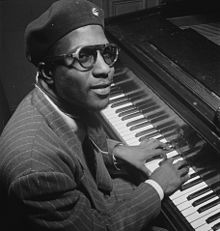
The first was American jazz pianist and composer, Thelonious Monk (b.1917 – d.1982). His improvisational style set him apart from the traditional jazz musicians of the time. In the 1940’s, the music genre known as jazz was experiencing a cultural revolution of sorts, with Thelonious Monk as its revolutionary leader. A new style of jazz – be-bop – was born. Considered jazz for intellectuals, the be-bop sound was all about intricate melodies, complex harmonies – and fast tempos. Thelonious Monk once said: “If you really understand the meaning of be-bop, you understand the meaning of freedom.”
 Freedom – in my opinion – is the most beautiful word in the dictionary. The meaning and experience of freedom is unique to each and every one of us. What tastes like freedom to me may be radically different than anyone else. Some savour it as a private, spiritual experience, while others view freedom on a global scale. There is no right or wrong answer. It is in the eye of the beholder.
I love to listen to the discordant sounds of Thelonius Monk. I never met the man. Nevertheless, I owe him a debt of gratitude because when I listen to improvisational jazz, I feel free – and vibrantly alive.
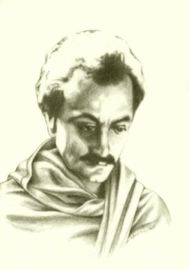 The second visionary genius was the Lebanese-American poet, philosopher, and artist – Khalil Gibran (b.1883 – d.1931). His works (The Prophet became an iconic favorite) were notably influential in American popular culture during the tumultuous 1960’s. On the subject of Freedom, Khalil Gibran’s eloquent poetry always strikes a chord with me –regardless of the number of times I read and reread his words:
“…Verily all things move within your being in constant half embrace, the desired and the dreaded, the repugnant and the cherished, the pursued and that which you would escape.
These things move within you as lights and shadows in pairs that cling. And when the shadow fades and is no more, the light that lingers becomes a shadow to another light. And thus your freedom when it loses its fetters becomes itself the fetter of a greater freedom.”
Finally, there is my muse. Her name, Ayn Rand. Ayn is pronounced “Ein” (which means “one” in German). In my study, there are at least three long bookshelves devoted to Ayn Rand (her novels, essays, philosophical treatises, biographies, and virtually everything I could find that has been written about her). If I ever choose to go back to do my PhD in Philosophy, the subject of my dissertation would most definitely be Ayn Rand.
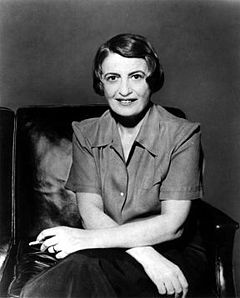 Born in St. Petersburg, Russia in 1905, Ayn witnessed the Bolshevik Revolution firsthand and despised the collectivism that was so entrenched in Russian culture at the time. Her family lost everything in Communist Russia and this intelligent student of philosophy and history decided that the American model of freedom was the path she wanted to pursue. In 1926, she went to visit relatives in Chicago, then traveled to Hollywood … and never looked back. Her first novel, We the Living (1936), was inspired by her earlier exposure to Russian tyranny. In her novels, Ayn understood that in order to create the wonderfully heroic fictional characters, she would have to articulate the philosophical principles which- in her view – made these characters truly heroic. As such, her novels were interwoven with politics, philosophy, economics, metaphysics, ethics and epistemology. And sex. In 1957, her last work of fiction – Atlas Shrugged – was considered her greatest achievement.
However, my personal favorite of hers is The Fountainhead (1943). It was the masterpiece that solidified Ayn Rand as the champion of Individualism. And this is why I am so inspired by this brilliant intellectual who, incidentally, died in 1982.
For me, individualism is freedom. It’s at the core of everything I believe in. Individual thought, choice, and actions. Our journey into this world is a singular experience. As is our journey out of this world. And our lives are made up of a series of individual choices, reactions and experiences that we (and no one else) are accountable for. For every action, there is a reaction. For every choice we make, there is a consequence. Good and bad. (preferably more good , than bad!).
I know, these are pretty heavy thoughts on a Friday evening. So, I’ll leave you with some words that resonate deeply with me. In The Fountainhead, the hero – architect Howard Roark – passionately explains the essence of individualism:
“… Man cannot survive except through his mind. He comes on earth unarmed. His brain is his only weapon. Animals obtain food by force. Man has no claws, no fangs, no horns, no great strength of muscle. He must plant his food or hunt it. To plant, he needs a process of thought. To hunt, he needs weapons, and to make weapons—a process of thought. From this simplest necessity to the highest religious abstraction, from the wheel to the skyscraper, everything we are and everything we have comes from a single attribute of man—the function of his reasoning mind.
But the mind is an attribute of the individual.
There is no such thing as a collective brain. There is no such thing as a collective thought. An agreement reached by a group of men is only a compromise or an average drawn upon many individual thoughts. It is a secondary consequence. The primary act—the process of reason—must be performed by each man alone. We can divide a meal among many men. We cannot digest it in a collective stomach. No man can use his lungs to breathe for another man. No man can use his brain to think for another. All the functions of body and spirit are private. They cannot be shared or transferred…”
I’ve just given you just a snippet of this courtroom speech. It is riveting and worth reading in its entirety.
Here’s to Freedom!
Cheers,
h.f.t.g.
Images via karabess.wordpress.com, wikipedia.org, and civilclothing.com.

 This is one of the twenty-five or so parrots that fly into the sea grape trees in our front garden. They are exuberant, colorful birds that squawk loudly — as they happily nibble on the grapes (their boisterous behaviour is probably a direct consequence of inebriation — from the grape juice!). When I look at these two beautiful trees, which form a welcoming canopy over the front of the house, and the abundance of ripe grapes and tipsy parrots — I feel happy and grateful for these gifts of nature, gifts that can’t be bought in the Mall – or anywhere else, for that matter.
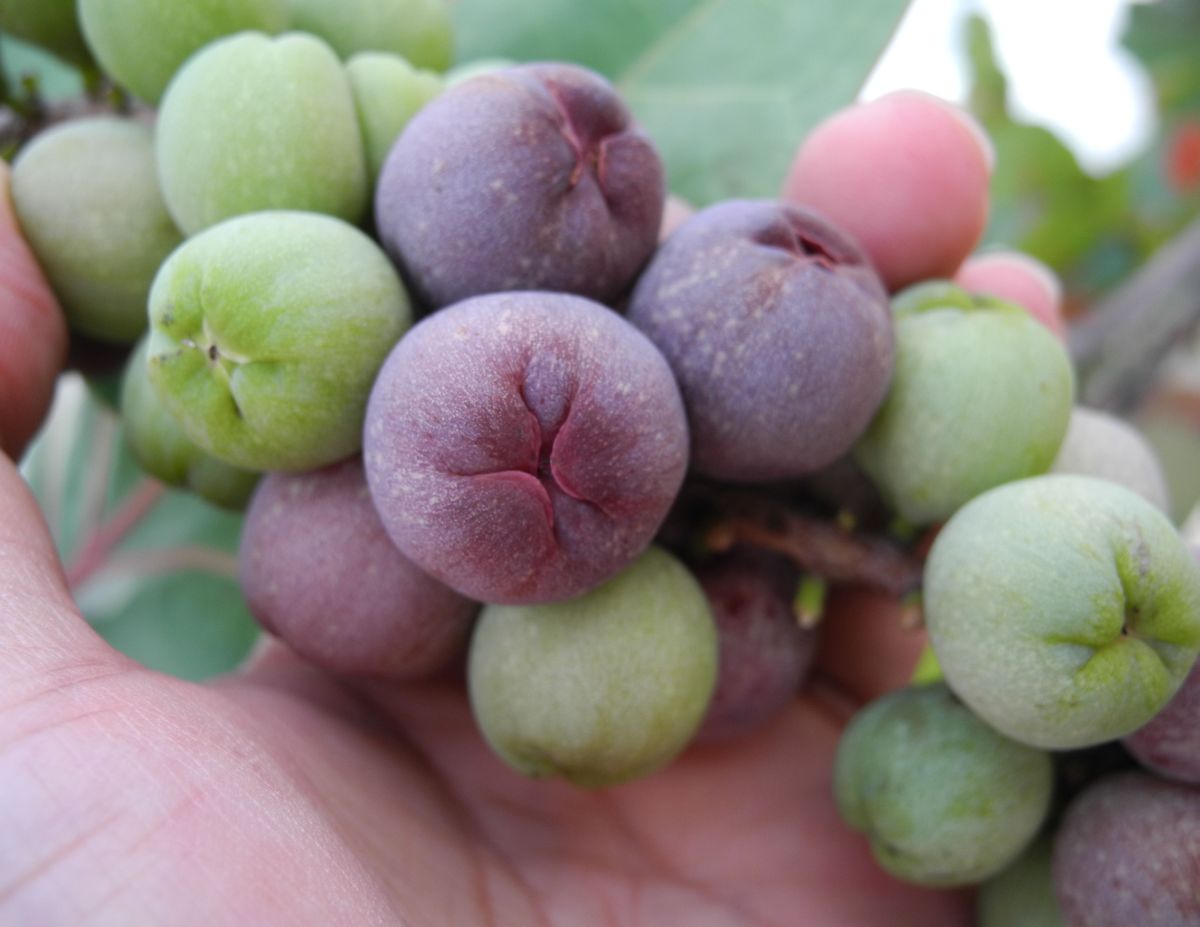 The trees have large branches that flow over the front fence to the street, providing shade on the sidewalk and tasty bounty for passers-by. Often, I go out to the front gate, and give them paper bags to gather the ripened grapes. Sharing a harvest of grapes with neighbors. It just doesn’t get better than that.






 heatherfromthegrove