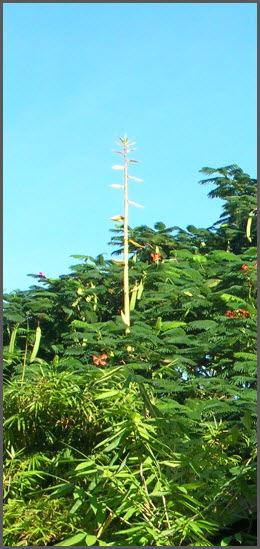
Bamboo in Full Bloom

Bamb00

“Notice that the stiffest tree is most easily cracked, while the bamboo or willow survives by bending with the wind.”

~ Bruce Lee (November 27, 1940 – July 20, 1973)

The sound of rustling bamboo leaves can be heard throughout my house when the windows are open.  By day, I love to do my writing while  sitting in my side garden, surrounded by a grove of these beautiful, mystical trees.  And, at night, I can see shadows of the wondrously resilient  bamboo stalks as they dance with the wind, while weaving in and out of the moonlight. They fill me with a sense of quiet joy and complete serenity.

Back in October, I wrote a couple of posts about the bamboo stalk that was sprouting in my garden and how it was shooting up towards the sky ― higher and higher, as the days passed.  Within the space of just a few weeks, it  was well over twenty feet above my roof line.  Now, it looks like a majestic feather, swaying in the wind.  Below, you can see  my photos of  this amazing tree, as it has evolved.

In my October 7th (2012) post , The Spirit of Bamboo, I mentioned that this fast-growing stalk has inspired my husband and I to “keep raising our eyes in the same direction of our wonderful bamboo …. upwards, always upwards.”

Bamboo_Oct_2012

On October 28th (2012), I wrote Bamboo Rising, where I listed The 7 Life Lessons from Bamboo (by Sompong Yusoontorn).

BambooRising

And here it is today (see photo, below). A symbolism of simplicity and humility, flexibility and strength. In the Asian culture, it is believed that the younger branches on the top of the bamboo stalk will never overshadow the older, larger branches below. This is so the sunlight will reach the elder branches. Conversely, the baby shoots are protected from the shade of the older branches, so that they may have a chance to grow. The dual symbolism is that the bamboo represents the young respecting the old and the old protecting the young.

BambooJan2013

Awesome, isn’t it?

I’ll leave you with an excerpt from William Edgar Geil‘s “Ode to Bamboo” (written over a century ago). An American Baptist missionary and adventurer who was fascinated by China, Dr. Geil made history as the first person to traverse the Great Wall of China in an 82-day excursion. In his Ode, he describes his observations on the usefulness and wonders of Bamboo:

“A man can sit in a bamboo house under a bamboo roof, on a bamboo chair at a bamboo table, with a bamboo hat on his head and bamboo sandals on his feet. He can at the same time hold in one hand a bamboo bowl, in the other hand bamboo chopsticks and eat bamboo sprouts. When through with his meal, which has been cooked over a bamboo fire, the table may be washed with a bamboo cloth, and he can fan himself with a bamboo fan, take a siesta on a bamboo bed, lying on a bamboo mat with his head resting on a bamboo pillow. His child might be lying in a bamboo cradle, playing with a bamboo toy. On rising he would smoke a bamboo pipe and taking a bamboo pen, write on bamboo paper, or carry his articles in bamboo baskets suspended from a bamboo pole, with a bamboo umbrella over his head. He might then take a walk over a bamboo suspension bridge, drink water from a bamboo ladle, and scrape himself with a bamboo scraper.”

Honoring Dr. Martin Luther King, Jr.

download (2)

Dr. Martin Luther King, Jr.

(January 15, 1929 – April 4, 1968)

Today, our nation honors the memory of a man who inspired generations of men and women ― young and old, black and white, and across every creed.  Dr. Martin Luther King, Jr.  ― clergyman, activist and leader in the American civil rights movement  ― received the Nobel Peace Prize in 1964, at the age of 35 (the youngest man to ever have received a Nobel Peace Prize).  When notified that he was selected for this honor, he stated that he would donate the prize money ($54,123) to further the cause of the civil rights movement.

He was assassinated by a sniper’s  bullet on April 4, 1968, in Memphis (Tennessee), as he addressed crowds of people from  his hotel balcony.

He was not only a man of  wise and thought-provoking words, but a man of action.  He acted on his beliefs and the words he spoke came from his soul. His name is on my own personal roster of people who have truly inspired me. Aside from his famous I Have A Dream speech (quoted in its entirety, at the end of this post), I wanted to share some of his thoughts on what, in my view, are four of the most powerful words to live by: Compassion. Forgiveness. Freedom. Hope.  

On Compassion:

“Life’s most persistent and urgent question is, What are you doing for others?”

On Forgiveness:

“We must develop and maintain the capacity to forgive. He who is devoid of the power to forgive is devoid of the power to love. There is some good in the worst of us and some evil in the best of us. When we discover this, we are less prone to hate our enemies.”

On Freedom:

“Freedom is never voluntarily given by the oppressor; it must be demanded by the oppressed.

“Letter from Birmingham Jail,” April 16, 1963

On Hope:

“The hope of a secure and livable world lies with disciplined nonconformists who are dedicated to justice, peace and brotherhood.š


“If you lose hope, somehow you lose the vitality that keeps life moving, you lose that courage to be, that quality that helps you go on in spite of it all. And so today I still have a dream.

I Have A Dream:

(August 28, 1963)

“I am happy to join with you today in what will go down in history as the greatest demonstration for freedom in the history of our nation.

Five score years ago, a great American, in whose symbolic shadow we stand today, signed the Emancipation Proclamation. This momentous decree came as a great beacon light of hope to millions of Negro slaves who had been seared in the flames of withering injustice. It came as a joyous daybreak to end the long night of their captivity.

But one hundred years later, the Negro still is not free. One hundred years later, the life of the Negro is still sadly crippled by the manacles of segregation and the chains of discrimination. One hundred years later, the Negro lives on a lonely island of poverty in the midst of a vast ocean of material prosperity. One hundred years later, the Negro is still languishing in the corners of American society and finds himself an exile in his own land. So we have come here today to dramatize a shameful condition.

In a sense we have come to our nation’s capital to cash a check. When the architects of our republic wrote the magnificent words of the Constitution and the Declaration of Independence, they were signing a promissory note to which every American was to fall heir. This note was a promise that all men, yes, black men as well as white men, would be guaranteed the unalienable rights of life, liberty, and the pursuit of happiness.

It is obvious today that America has defaulted on this promissory note insofar as her citizens of color are concerned. Instead of honoring this sacred obligation, America has given the Negro people a bad check, a check which has come back marked “insufficient funds.” But we refuse to believe that the bank of justice is bankrupt. We refuse to believe that there are insufficient funds in the great vaults of opportunity of this nation. So we have come to cash this check — a check that will give us upon demand the riches of freedom and the security of justice. We have also come to this hallowed spot to remind America of the fierce urgency of now. This is no time to engage in the luxury of cooling off or to take the tranquilizing drug of gradualism. Now is the time to make real the promises of democracy. Now is the time to rise from the dark and desolate valley of segregation to the sunlit path of racial justice. Now is the time to lift our nation from the quick sands of racial injustice to the solid rock of brotherhood. Now is the time to make justice a reality for all of God’s children.

It would be fatal for the nation to overlook the urgency of the moment. This sweltering summer of the Negro’s legitimate discontent will not pass until there is an invigorating autumn of freedom and equality. Nineteen sixty-three is not an end, but a beginning. Those who hope that the Negro needed to blow off steam and will now be content will have a rude awakening if the nation returns to business as usual. There will be neither rest nor tranquility in America until the Negro is granted his citizenship rights. The whirlwinds of revolt will continue to shake the foundations of our nation until the bright day of justice emerges.

But there is something that I must say to my people who stand on the warm threshold which leads into the palace of justice. In the process of gaining our rightful place we must not be guilty of wrongful deeds. Let us not seek to satisfy our thirst for freedom by drinking from the cup of bitterness and hatred.

We must forever conduct our struggle on the high plane of dignity and discipline. We must not allow our creative protest to degenerate into physical violence. Again and again we must rise to the majestic heights of meeting physical force with soul force. The marvelous new militancy which has engulfed the Negro community must not lead us to a distrust of all white people, for many of our white brothers, as evidenced by their presence here today, have come to realize that their destiny is tied up with our destiny. They have come to realize that their freedom is inextricably bound to our freedom. We cannot walk alone.

As we walk, we must make the pledge that we shall always march ahead. We cannot turn back. There are those who are asking the devotees of civil rights, “When will you be satisfied?” We can never be satisfied as long as the Negro is the victim of the unspeakable horrors of police brutality. We can never be satisfied, as long as our bodies, heavy with the fatigue of travel, cannot gain lodging in the motels of the highways and the hotels of the cities. We cannot be satisfied as long as the Negro’s basic mobility is from a smaller ghetto to a larger one. We can never be satisfied as long as our children are stripped of their selfhood and robbed of their dignity by signs stating “For Whites Only”. We cannot be satisfied as long as a Negro in Mississippi cannot vote and a Negro in New York believes he has nothing for which to vote. No, no, we are not satisfied, and we will not be satisfied until justice rolls down like waters and righteousness like a mighty stream.

I am not unmindful that some of you have come here out of great trials and tribulations. Some of you have come fresh from narrow jail cells. Some of you have come from areas where your quest for freedom left you battered by the storms of persecution and staggered by the winds of police brutality. You have been the veterans of creative suffering. Continue to work with the faith that unearned suffering is redemptive.

Go back to Mississippi, go back to Alabama, go back to South Carolina, go back to Georgia, go back to Louisiana, go back to the slums and ghettos of our northern cities, knowing that somehow this situation can and will be changed. Let us not wallow in the valley of despair.

I say to you today, my friends, so even though we face the difficulties of today and tomorrow, I still have a dream. It is a dream deeply rooted in the American dream.

I have a dream that one day this nation will rise up and live out the true meaning of its creed: “We hold these truths to be self-evident: that all men are created equal.”

I have a dream that one day on the red hills of Georgia the sons of former slaves and the sons of former slave owners will be able to sit down together at the table of brotherhood.

I have a dream that one day even the state of Mississippi, a state sweltering with the heat of injustice, sweltering with the heat of oppression, will be transformed into an oasis of freedom and justice.

I have a dream that my four little children will one day live in a nation where they will not be judged by the color of their skin but by the content of their character.

I have a dream today.

I have a dream that one day, down in Alabama, with its vicious racists, with its governor having his lips dripping with the words of interposition and nullification; one day right there in Alabama, little black boys and black girls will be able to join hands with little white boys and white girls as sisters and brothers.

I have a dream today.

I have a dream that one day every valley shall be exalted, every hill and mountain shall be made low, the rough places will be made plain, and the crooked places will be made straight, and the glory of the Lord shall be revealed, and all flesh shall see it together.

This is our hope. This is the faith that I go back to the South with. With this faith we will be able to hew out of the mountain of despair a stone of hope. With this faith we will be able to transform the jangling discords of our nation into a beautiful symphony of brotherhood. With this faith we will be able to work together, to pray together, to struggle together, to go to jail together, to stand up for freedom together, knowing that we will be free one day.

This will be the day when all of God’s children will be able to sing with a new meaning, “My country, ’tis of thee, sweet land of liberty, of thee I sing. Land where my fathers died, land of the pilgrim’s pride, from every mountainside, let freedom ring.”

And if America is to be a great nation this must become true. So let freedom ring from the prodigious hilltops of New Hampshire. Let freedom ring from the mighty mountains of New York. Let freedom ring from the heightening Alleghenies of Pennsylvania!

Let freedom ring from the snow-capped Rockies of Colorado!

Let freedom ring from the curvaceous slopes of California!

But not only that; let freedom ring from Stone Mountain of Georgia!

Let freedom ring from Lookout Mountain of Tennessee!

Let freedom ring from every hill and molehill of Mississippi. From every mountainside, let freedom ring.

And when this happens, when we allow freedom to ring, when we let it ring from every village and every hamlet, from every state and every city, we will be able to speed up that day when all of God’s children, black men and white men, Jews and Gentiles, Protestants and Catholics, will be able to join hands and sing in the words of the old Negro spiritual, ‘Free at last! free at last! thank God Almighty, we are free at last!'”


My Books, My Friends

BOOKS-285x300

“A book is the only place in which you can examine a fragile thought without breaking it, or explore an explosive idea without fear it will go off in your face.  It is one of the few havens remaining where a man’s mind can get both provocation and privacy.”

~ Edward P. Morgan

When I was a young girl, my mother would often call out to me and say “Your friends are at the front door.  They want to know when you’ll be going out to play.”   From my bedroom,  where I was curled up in my armchair like a content puppy — nose deep in a gripping novel, I would shout back (adjusting my glasses, as I did so): “Tell them I’ll be out as soon as I finish this chapter!”  Ten chapters later, my mother would peek around the door and say “Go out and get some fresh air. Your friends will begin to think that you don’t like them anymore.”  Reluctantly, I would put a bookmark in my book and then, very lovingly, place it down on the side table.  I’d walk past my mother, who smiled and shook her head (did she actually roll her eyes at me … really?).  

Many decades later, nothing much has changed.  With a few exceptions.  My mother died over seven years ago and I miss her so much that it hurts.  My childhood friends still live in Canada (while I now live in South Florida).  But, we still keep in touch.  Thank goodness for Facebook!

As fate would have it, my husband likes to spend some time in the company of his own mind, as I do.   So, when I get lost inside my head, reading a thought-provoking piece of fiction or non-fiction, I am rarely interrupted. 

Virtually every room in our house has bookshelves filled with books.  Every possible discipline — from literature, biographies, history, law and philosophy to engineering, architecture, music and art.  And everything in between.  

They are not there for show.  I say this because a few people (not readers themselves) have actually asked whether we truly read them!  We read them.  Some, we’ve read over and over again.

“The scholar only knows how dear these silent, yet eloquent, companions of pure thoughts and innocent hours become in the season of adversity.  When all that is worldly turns to dross around us, these only retain their steady value.”

Washington Irving

When I walk into a room full of books, I am filled with a sense of comfort and well-being.  I know every single book that is in the house and each is alphabetized and organized by discipline/category. 

Libraries are sacred sanctuaries filled with knowledge — private libraries, public libraries, university libraries …. all of them!  That wonderfully musty smell of old leather and paper, the silence (you can hear a pin drop), the rows and rows of books … it’s heaven.

“A good book is the purest essence of a human soul.”

Thomas Carlyle  (excerpt from his speech in support of the London Library, 1840)

Reading is not only good for the soul, it exercises the mind and helps reduces stress. 

Yes, my books are my friends. They are the gifts I treasure most. And, as a writer, they never cease to encourage, challenge and humble me.

beachreading1_wide-1a929731cc5a2143a42a7b6345432d77199d0d48-s6-c10

Slicing and Dicing (or what writers grudgingly call “Book Editing”)

Devour a Book

While contemplating and writing about my 7 New Year Revelations,  I’ve been trying not to think about the redlining, scratchy margin comments, strikethroughs and all the nasty little markings that a few no-nonsense editors are doing to my manuscript. 

As any writer will attest, it’s important to give your completed manuscript a thorough and objective (that’s the hard part) edit yourself first, but then you must hand it over to an editor who will have no qualms about ripping it to shreds,  if need be.   As a person who uses the numbers 3 and 7 all the time (it’s a spiritual thing, perhaps even a bit O.C.D.),  I always like to choose 3 editors (a professional editor, a person who has personal  experience with the subject, and a scholar/professional who is a specialist on the subject).  This gives me a nice cross-section of expertise from people whose commentary I respect and will take to heart, when producing the final copy for publication.  

I give them a timeframe and my own set of  guidelines (for them to keep in mind, while editing)  …  with the expectation that, on the end date, I will receive all their edits and comments. Some prefer to edit on a hard copy manuscript, others edit on my PDF  text. I usually give them three weeks , although it may extend further – depending upon the length of the manuscript.

My manuscript-specific  “guidelines”  vary from book to book. These include a list of questions or points that relate to specific characters or story lines that I want to receive objective feedback on.

However,  the general guidelines simply follow the standard editing process which, in turn, involves multiple read-throughs or “passes.”

1. First Pass:       A READ-THROUGH  (no editing)

It’s important for the editor to get a feel for the book first, before grabbing that red pencil!

2. Second Pass —  SUBSTANTIVE  EDITING

This is the heavy, line editing phase. Sentence structure, grammar, spelling and punctuation are all addressed here.  At this stage, the editor will also look at whether the book  reads  well and whether  or not a story, character, or setting may need readjustment.

3. Third Pass —  CONTENT  EDITING

This may include substantive editing (above) but focuses on the quality of the writing, the use of words, and the strength/continuity of the author’s voice.  The content editing process points its high beam on clarity and conciseness.  This is where a lot of the dreaded snippity-snip-snip comes into play. Conciseness …  the bane of my existence.

4. Fourth Pass —  COPY  EDITING

Once more, punctuation and grammar are reviewed, as well as whether or not the use of words and tense is consistent throughout the manuscript. The copy editing process serves to catch any minor or major mistakes and whether or not the perceived errors were intentional (i.e. stylistic) or not.

5. Fifth Pass —  PROOFREADING*

A final review of  grammar, punctuation and spelling. This is the polishing stage.

*CAVEAT:  Once the writer incorporates all the edits into the final manuscript, the writer must (himself/herself) do another round of proofreading — it is very important to do this carefully. Hasty proofreading will result in unwanted errors.  In the world of home renovation, the do-it-yourself folks are told, time and time again, “measure twice, cut once.”  Well, the same applies in the writing world.  Proofread, proofread, and proofread again!

Furthermore, if the writer is self-publishing, it is important to do yet another round of proofreading upon receiving the printer’s proofs (always request  to have a sign-off on the printer’s proof, prior to printing).  This is not only important for catching any errors within the text, but also to ensure that the formatting and graphics are perfect. Similarly, if using a company like CreateSpace or lulu.com to publish the book, follow the same proofing/sign-off procedure as with the printer. 

By the 21st, I should be receiving all of my edits back, for my manuscript (Casualties of the Recession Depression) — redlines, scratchy margin comments, strikethroughs and nasty little markings.

I can hardly wait.


Image from howtoshuckanoyster.com.

heatherfromthegrove: A Wrap-up of My 7 New Year Revelations

beachreading

As I said before (on this very same day, last year):  

“For those of you who have been following, reading and enjoying each of my seven New Year revelations …. Thank You.

I would like to point out that they are not New Year Resolutions. I don’t make New Year Resolutions anymore. They are my own personal revelations. Epiphanies. Discoveries. In the past decade, I’ve faced some daunting challenges and heart-wrenching events. I’d like to think that I’ve handled them with dignity, compassion, grace, and humor. Always humor. It helps take the edge off.

So, the lessons that these “life tests” have taught me are my “revelations.” As I move forward with my life, I will use them as my guide. Wisdom has to be earned. For me, it’s a work in progress. I hope that they have inspired and even amused you. I hope that they have made you think long and hard.”

Here’s a synopsis (the numbers have a hyperlink back to each revelation post):

Revelation No. 1: LOVE — WITHOUT RESERVATIONS, CONDITIONS OR EXPECTATIONS

Revelation No. 2: KINDNESS IS CONTAGIOUS

Revelation No. 3: RESIST THE MAÑANA SYNDROME

Revelation No. 4: PRACTICE A LITTLE PATIENCE

Revelation No. 5: NEVER, NEVER ASSUME!

Revelation No. 6: UNDERSTAND THE DIFFERENCE BETWEEN “EMBRACE” AND “TOLERATE”

Revelation No. 7: TAKE A WALK ON THE WILD SIDE

And the journey continues.  I believe that 2013 will be a renaissance of sorts. I know that I’m looking forward to tying up some loose ends in my life,  having my book launched at the end of February,  and taking time out to read, sharing precious moments with the creatures (two-legged and four-legged!) I love most, and … of course … dancing in the rain!

I wish you all a blessed, healthy and happy  2013 and may your own personal journey bring you deep fulfillment and wisdom. Remember, we are all — each of us — a work in progress!


Image via eclectic-eccentric.com.

New Year’s Revelation No. 7 of 7: Take a Walk on the Wild Side

explorers-image

“Twenty years from now you will be more disappointed by the things you didn’t do than by the ones you did do. So throw off the bowlines. Sail away from the safe harbor. Catch the trade winds in your sails. Explore. Dream. Discover.”

~ Mark Twain

This is one of my favorite quotes of all time.  I have it posted up on the wall of my study. 

180355160047677058_tbY43tyo_cWe only have one life.  We never know how much time we have left, so we’ve really got to make the most of it.  Make the time to be with the people you love. Splash around in the rain!  Throw a few snowballs. Step out of your comfort zone and try out something new.  Eat something different and more exotic. Take a walk on the wild side …  and savour every damn minute of it!

Life flies by so fast.  We’ve got to grab on tight to its wings, so that we can enjoy every adventure along the way.

I’ll leave you with the lyrics and video of a song that encapsulates what I really mean.  It’s a song by Lee Ann Womack, called “I Hope You Dance.”  Now, I’m not an avid country music fan, but I absolutely love this song.

All of her words reflect exactly what I wish for you, dearest readers. 

Thanks for stopping by.

Lyrics (partial) for I Hope You Dance (by Lee Ann Womack)

I hope you never lose your sense of wonder
You get your fill to eat but always keep that hunger
May you never take one single breath for granted
God forbid love ever leave you empty handed
I hope you still feel small when you stand beside the ocean
Whenever one door closes I hope one more opens
Promise me that you’ll give faith a fighting chance
And when you get the choice to sit it out or dance

I hope you dance!
I hope you dance!

I hope you never fear those mountains in the distance
Never settle for the path of least resistance
Livin’ might mean takin’ chances, but they’re worth takin’
Lovin’ might be a mistake, but it’s worth makin’
Don’t let some hellbent heart leave you bitter
When you come close to sellin’ out, reconsider
Give the heavens above more than just a passing glance
And when you get the choice to sit it out or dance

I hope you dance!
I hope you dance!

Images via congchurchexeter.org (binoculars) and thefifowife.com.au (dancer).

New Year’s Revelation No. 6 of 7: Understand the Difference between “Embrace” and “Tolerate”

115628-monkey-and-puppy

“Our task must be to free ourselves…by widening our circle of compassion to embrace all living creatures and the whole of nature and its beauty.”

 ~ Albert Einstein

I’m going to keep this very short and sweet.  In my view, there is only one (1) race.  It is the human race.  And the beautiful thing about the human race is that we come in so many different shapes, sizes, ages, colors, creeds, cultures, languages, and personalities.

Wouldn’t it be so infinitely boring if we all looked and acted alike?  Oh, I know,  we take comfort in the people, things, and places that are most like us, most familiar to us.  But, the “fear of the unknown and unfamiliar” should not bar us from meeting new people, enjoying fresh experiences, and basking in the realization that, although we are different, we share one common thing …… humanity.

“Our greatest strength as a human race is our ability to acknowledge our differences, our greatest weakness is our failure to embrace them.”

~ Judith Henderson

To tolerate someone means that we can bear to be around them (put up with them).  In my view, the word “tolerate” denotes arrogance (i.e. “I tolerate you but, in reality, I don’t want to be around you”).

To embrace means to open your arms to someone — regardless of who they are or where they’re from. Now, this is what I’m talking about!

The choice is yours.

“We have become not a melting pot but a beautiful mosaic. Different people, different beliefs, different yearnings, different hopes, different dreams.”
~ Jimmy Carter

Image via gerberbabycontest.net.

New Year’s Revelation No. 5 of 7: Never, Never Assume!

assumptions-e1319148318348

“We have a tendency to make assumptions about everything. The problem with making assumptions is that we BELIEVE they are the truth.   

We make assumptions about what others are doing or thinking, we take it personally, and then we blame them and react by sending emotional poison with our word.   

We only see what we want to see and hear what we want to hear. We don’t perceive things the way they are; we literally dream things up in our imagination. Because we are afraid to ask for clarification, we make assumptions that we believe are right, then we defend our assumptions and try to make others wrong.

The way to keep yourself from making assumptions is to ask questions. Make sure the communication is clear. If you don’t understand, ask. Have the courage to ask questions until you are as clear as you can be. Once you hear the answer, you will not have to make assumptions because you will know the truth.”

~  an excerpt from The Four Agreements by Don Miguel Ruiz


Sure, we are all guilty of making assumptions every so often and when we do, nine out of ten times we’re completely off the mark.  Sadly, people often make assumptions —not  because they are afraid to ask for clarification, as Don Miguel Ruiz suggests — but because they choose to sit in judgment.  They are convinced that they are right, despite possible evidence to the contrary or without bothering to delve a little deeper.  They are influenced by their own personal biases. Still worse, they then spread their poisonous thoughts, sometimes publicly, not caring about the damage they have wrought.  That is how reputations get ruined.  In some cases, the damage results in financial ruin and, in more extreme cases, suicide.

We see this all the time.  Public figures, like celebrities and politicians, are crucified in the media.  Private citizens are not immune from this type of unwanted attention and undeserving judgment.  Just turn on the news channel or pick up the local paper and you’ll see someone’s unfortunate personal mistake or trauma plastered all over the news.  Sadly, many people believe what they read or see on television.  Personally, I always feel very sorry for someone whose personal life challenges are made public, regardless of whether they’ve done something wrong.  I feel for them and their families and imagine what they must be going through.

Whatever happened to simple, human compassion?  We shouldn’t be so quick to bring down the gavel.

James 4:12: There is one lawgiver and judge, he who is able to save and to destroy.  But who are you that you judge your neighbor? 

Assumptions are often made based on how we look or dress. Here are a few examples of erroneous and ignorant assumptions:   If you always dress completely in black, you must be sinister;  If you wear t-shirts and jeans all the time, you probably don’t have much money;  Being fat equates to being lazy; If you wear glasses, you must be intelligent; If you have tattoos and body piercings, you’re bad news; Redheads have hot tempers;  Blonde women are airheads; and on, and on … .    

“While you judge me by my outward appearance, I am silently doing the same to you, even though there’s a ninety-percent chance that in both cases our assumptions are wrong.” 

~  Richelle E. Goodrich

Back in 1981, I attended one of my husband’s electrical engineering classes at the University.  Although I was a political science major, I wanted to “take a walk on the wild side” and learn a little about the world of engineering so that I could better understand his chosen field of study.  For the life of me, I can’t recall what the subject of the lecture was, but I do remember (to this day) something that the professor said. He turned to the class and shook his finger, saying (very emphatically, I might add): “Never, never assume!”

We have made this our mantra ever since.

Image via heartspiritmind.com.

New Year’s Revelation No. 4 of 7: Practice a Little Patience

A

“Adopt the pace of nature: her secret is patience.

~ Ralph Waldo Emerson

The duck and her ducklings were not too fussed about bringing heavy road traffic to a halt.  They’re just trying to go from point A to point B safely and at their own pace, regardless of any red-faced, honking drivers who are raising their blood pressure in outrage at being inconvenienced for five minutes or so … by ducks!  The wiser attitude would be to smile, enjoy the scene and take that five-minute opportunity to sit back and relax.  No car can move on until the ducks make their way across the street, anyways.  So, isn’t it a pointless waste of energy to be angry and impatient?

When we are impatient, we act irrationally.   Then, we appear ridiculous (to others … and even to ourselves, if we’re really being honest).

Take, for example, the number of times we engage in a war of words (via email),  where we receive an email that makes us angry and we immediately write a response and press “send.”   This has happened to me a few times and I always, always regret having responded so quickly.  The end result is never what we want it to be.  It would have been smarter to chew on it for a bit and then respond sometime later, when rational thinking and proper perspective has kicked in.

When we are impatient, we make mistakes that we can’t take back.  Then, we’re forced to do damage control.  Patience is the antidote to anger and aggression.  Seethe and then breathe.  You can sit in the energy of your anger, feel the anger and then slowly let it go.

Did you ever stand in the check-out line at the supermarket and, fifth in line, you’re waiting and waiting …. and then you see the cashier having a nice chat with a customer?  Oh, they’re laughing and talking, impervious to the long line of now highly annoyed people.  Does it really hurt to share a few pleasantries?  Are we so important (in our own mind) that we need to be served immediately, chop-chop?

When we are impatient, we forget to breathe.  Just inhale slowly and, then exhale slowly … and repeat.

Patience is all about self-mastery and control.  We cannot control what people say or do to us, but we can control how we conduct ourselves and how we respond. 

In Buddhist thinking, the perfection of patience (ksanti) has three essential dimensions: 

  • The ability to endure personal hardship.
  • Patience with others.
  • Acceptance of the truth.

1. Enduring personal hardship:  Personal hardship encompasses a wide spectrum of issues, such as illness, financial problems, the death of a loved one, devastation from a natural disaster … and so on.   Patience, in these instances, comes with the acceptance that there are times in our lives when we are faced with trials and tribulations, that they are most often temporary, and that we must not let ourselves be defeated by despair.  To face difficulties constructively, rather than destructively, is to endure personal hardship with patience.  Think of the expression “This, too, shall pass.”

2. Patience with others:  Anger is a very destructive energy.  It can explode or (if we allow it to) it can fester.  The way to nip anger and impatience in the bud is by cultivating a sense of equanimity (calm and balance).  And to treat others with kindness, even if our knee-jerk reaction is to throttle them.  Think of the expression “kill him with kindness.”

3. Acceptance of the truth:  In Saint Augustine’s words, “Patience is the companion of wisdom.”   It peels away the layers of arrogance, ingratitude and judgmental thinking.  It allows us to accept the things we cannot change and to accept our experiences as they are — suffering and all — rather than how we want them to be.  This translates to people, as well as experiences.  We must be patient with people and accept them for who they are, not who we want them to be.

The lessons that we learn from Patience will have an irrevocable, positive effect on our lives.  It will lift our spirit, cultivate good character, and we will receive that end-of-the-rainbow treasure that we all seek:  not a pot of gold, but something much more precious …. Happiness.

I’ll leave you with this really sweet commercial video, called “Patience …pass it on.”

Image (ducks) via bookerpetcare.co.uk

New Year’s Revelation No. 3 of 7: Resist the Mañana Syndrome

image-articolo-i-benefici-della-vacanza-manteniamoli-cosi

“Know the true value of time; snatch, seize, and enjoy every moment of it.  No idleness, no laziness, no procrastination: never put off till tomorrow what you can do today.
~ Lord Chesterfield 

In theory, I completely concur with Lord Chesterfield.  In practice, however, I’ve been known to occasionally follow Scarlett O’Hara’s logic (from Gone with the Wind):  “I can’t think about that right now. If I do, I’ll go crazy. I’ll think about that tomorrow …… After all, tomorrow is another day.” 

Putting things off until tomorrow — or, as I like to call it, The Mañana Syndrome …. has been a challenge for me throughout my life — not because I’m lazy, but because I always have so many concurrent projects and so many lists-upon-lists-upon-lists, that it becomes overwhelming sometimes.  And then I completely detach.  But, something changed for me last summer.  It wasn’t any specific event or drama.  I was just sitting at my computer, with Janis Joplin rasping in the background.  The song was Ball and Chain and the lyrics that spoke to me were:

“That’s what it is, man. If you got it today you don’t wear it tomorrow, man. ‘Cause you don’t need it. ‘Cause as a matter of fact, as we discovered on the train, tomorrow never happens, man. It’s all the same fxxxxxx day, man.”

And, right there and then, I thought to myself  “What if tomorrow never happens?”  I would not want to leave this world without having done the things I needed and wanted to do.  Now, I know that I’m taking the meaning of Janis’ lyrics out of context … but it just triggered something in my head.  So, then I thought “How can I complete what I need to complete?”   And the answers came to me in short staccato words and phrases:  You’re not Superwoman.  Be reasonable.  Prioritize.   Compartmentalize.  Streamline.  Keep it simple.  Stop writing lists.  Take a breath. 

Let’s be real, here.  This is not a Mensa puzzle.  I just needed to tweak my thinking and my process of multitasking.  And so I did. 

It worked. My book, Casualties of the Recession Depression, is written and currently in the editing phase.  The launch is set for the 26th of February, barring any glitches. And, I’ll soon pick up where I left off on my next book, When the Child Becomes the Parent. Everything is on track and on schedule. 

Yet, each day I make time to read a book while enjoying the sights, sounds and smells of my garden.

Speaking of thought processes, I’ll leave you with another very loosely related anecdote.  One evening, my husband and I were gazing up at the stars.  I asked him “What do you see when you look up in the sky?”  He looked at me quizzically and said “Well, there’s Orion’s Belt   ….”   He saw the starry sky in a structured, compartmentalized way.  I said, “When I look up, I see a sea of stars in an endless array of different sizes and formations …. too many to count, or even discern.  I just love to soak in the beauty of it all.”  And so I wondered whether the stark difference in the way we saw the night sky was a function of gender (i.e. ‘Men are from Mars, Women are from Venus’) or  was it simply that our personalities are such that he see things in black and white and I, in every shade of grey in between.

Which is why I tended  (note the past tense) to bite off more than I could chew. 

Lesson learned.

“Yesterday is gone. Tomorrow has not yet come. We have only today. Let us begin.” 
Mother Teresa

Image via donnamoderna.com (Photo credit:  Inga Ivanova)