New Year’s Revelation No. 4 of 7: Practice a Little Patience

A

“Adopt the pace of nature: her secret is patience.

~ Ralph Waldo Emerson

The duck and her ducklings were not too fussed about bringing heavy road traffic to a halt.  They’re just trying to go from point A to point B safely and at their own pace, regardless of any red-faced, honking drivers who are raising their blood pressure in outrage at being inconvenienced for five minutes or so … by ducks!  The wiser attitude would be to smile, enjoy the scene and take that five-minute opportunity to sit back and relax.  No car can move on until the ducks make their way across the street, anyways.  So, isn’t it a pointless waste of energy to be angry and impatient?

When we are impatient, we act irrationally.   Then, we appear ridiculous (to others … and even to ourselves, if we’re really being honest).

Take, for example, the number of times we engage in a war of words (via email),  where we receive an email that makes us angry and we immediately write a response and press “send.”   This has happened to me a few times and I always, always regret having responded so quickly.  The end result is never what we want it to be.  It would have been smarter to chew on it for a bit and then respond sometime later, when rational thinking and proper perspective has kicked in.

When we are impatient, we make mistakes that we can’t take back.  Then, we’re forced to do damage control.  Patience is the antidote to anger and aggression.  Seethe and then breathe.  You can sit in the energy of your anger, feel the anger and then slowly let it go.

Did you ever stand in the check-out line at the supermarket and, fifth in line, you’re waiting and waiting …. and then you see the cashier having a nice chat with a customer?  Oh, they’re laughing and talking, impervious to the long line of now highly annoyed people.  Does it really hurt to share a few pleasantries?  Are we so important (in our own mind) that we need to be served immediately, chop-chop?

When we are impatient, we forget to breathe.  Just inhale slowly and, then exhale slowly … and repeat.

Patience is all about self-mastery and control.  We cannot control what people say or do to us, but we can control how we conduct ourselves and how we respond. 

In Buddhist thinking, the perfection of patience (ksanti) has three essential dimensions: 

  • The ability to endure personal hardship.
  • Patience with others.
  • Acceptance of the truth.

1. Enduring personal hardship:  Personal hardship encompasses a wide spectrum of issues, such as illness, financial problems, the death of a loved one, devastation from a natural disaster … and so on.   Patience, in these instances, comes with the acceptance that there are times in our lives when we are faced with trials and tribulations, that they are most often temporary, and that we must not let ourselves be defeated by despair.  To face difficulties constructively, rather than destructively, is to endure personal hardship with patience.  Think of the expression “This, too, shall pass.”

2. Patience with others:  Anger is a very destructive energy.  It can explode or (if we allow it to) it can fester.  The way to nip anger and impatience in the bud is by cultivating a sense of equanimity (calm and balance).  And to treat others with kindness, even if our knee-jerk reaction is to throttle them.  Think of the expression “kill him with kindness.”

3. Acceptance of the truth:  In Saint Augustine’s words, “Patience is the companion of wisdom.”   It peels away the layers of arrogance, ingratitude and judgmental thinking.  It allows us to accept the things we cannot change and to accept our experiences as they are — suffering and all — rather than how we want them to be.  This translates to people, as well as experiences.  We must be patient with people and accept them for who they are, not who we want them to be.

The lessons that we learn from Patience will have an irrevocable, positive effect on our lives.  It will lift our spirit, cultivate good character, and we will receive that end-of-the-rainbow treasure that we all seek:  not a pot of gold, but something much more precious …. Happiness.

I’ll leave you with this really sweet commercial video, called “Patience …pass it on.”

Image (ducks) via bookerpetcare.co.uk
New Year’s Revelation No.2 of 7: Kindness is Contagious

6a00e550a90a1788340177441aede1970d-800wi

“No kind action ever stops with itself. One kind action leads to another. Good example is followed. A single act of kindness throws out roots in all directions, and the roots spring up and make new trees. The greatest work that kindness does to others is that it makes them kind themselves.”

~ Amelia Earhart

A few weeks ago, while I was waiting for the train at the Metrorail station (here in Miami), I happened to glance down at the outer main platform (one story below, outside of the turnstiles) and what I saw simply made my jaw drop.   There were about fifty or so people, either sitting down on the benches or  mulling about, and an elderly man was walking (alone) on the sidewalk.  No one took notice of him, until he fell.  Very shakily, he tried to stand up and almost succeeded but then his legs gave way and he collapsed in a heap on the ground.  No one — and I mean no one — lifted a hand to help him.  Oh, they certainly gawked at him, but apparently no one wanted to “get involved.”   I started yelling from the station above, but my voice was lost in the noisy rumble of the train that was approaching my station.   Finally, a bus driver sauntered over to the man and helped him to stand.  Luckily, he wasn’t hurt, just shaken.  I shook my head in disgust.  What in the bloody hell is wrong with people?

It never hurts to be kind.  Kindness is like the gift that keeps on giving.  It comes back to us in spades.  Some call that Karma.  I call it Humanity.  The Dalai Lama says it best:

“This is my simple religion. There is no need for temples; no need for complicated philosophy. Our own brain, our own heart is our temple; the philosophy is kindness.”

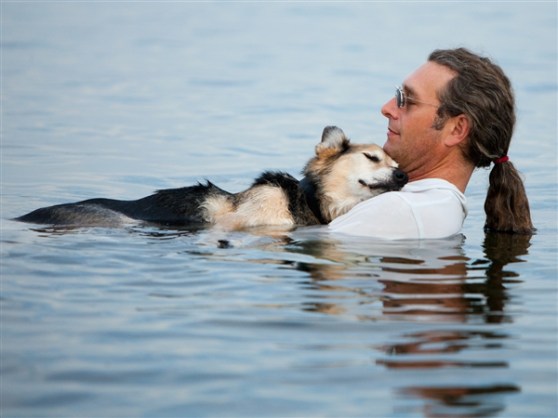
Pure and simple.  Kind acts don’t have to be extravagant, nor should there ever be the expectation of reward or recognition.  The man, pictured above, is an example of the most pure and humble act of kindness (and love).  His very old dog suffers from painful arthritis.  He frequently takes his dog out in Lake Superior and the water soothes the dog’s arthritic joints,  relieving him from pain and allowing him to sleep on his “Dad’s” chest.   Strangers from far and wide, having heard of this moving story via the internet, have anonymously paid for vet procedures and more, to help the ailing dog and to relieve the financial worry from his “Dad.”   Now that is kindness in its purest form — anonymous, random acts of kindness.  I encourage you to read the full story.  It is simply inspiring.

Spending the night listening to a troubled friend.  Offering to carry bags of groceries from the supermarket to the car, for someone you don’t even know.  Giving some wildflowers to an elderly stranger sitting on a park bench.  Feeding a hungry stray cat.  The opportunities to show kindness … are simply endless.

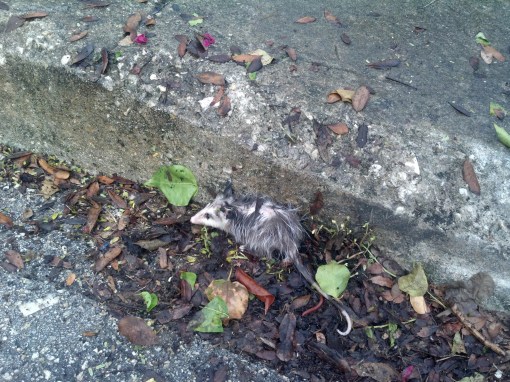
I’ll leave you with yet another one of my own personal stories.  It’s about “Lucky” — the name I gave to the baby possum I rescued about a year ago.  In my neighborhood, Friday is the day that we can leave yard clippings out on the road, to be picked up.   My husband and I had done a lot of tree trimming, so we placed the pile out on the Thursday evening.  On the next day, the truck came and picked up all the clippings and I noticed that there was still some yard debris left.  Annoyed, I took my broom and began to sweep.  The truck driver came around again and honked his horn at me.  I looked up and then he pointed (animatedly) at the edge of the road near the sidewalk.  Puzzled, I looked down and then I gasped.  There was a shivering, wet (it had been raining earlier) baby possum, playing dead (as only possums know how to do).  I hadn’t noticed the little fella, because his color blended with that of the road.  I knew that if I left him there, a car would park and the tires would run right over him.  So, I ran into the house and got a plastic container and a sheet of cardboard.  I slipped the plastic container over him and the cardboard under him, lifted him up and brought him into my side garden.  I removed the cardboard and container and watched him for a moment.  I truly thought he was dead. His eyes and mouth were open and he would not move, even though I prodded him gently.  I left him there, amid all the grass and shrubs and then went into the house, to watch him from the window.  After about five minutes, he got up, shook his head (very similar to what my dog, Bacchus does)  and then he grazed on some grass.  After a while he went exploring.  I named him “Lucky” for obvious reasons.  He was so lucky that he didn’t get flattened by a car whose driver wouldn’t have noticed him.  Lucky still lives in my garden.  Very late at night, when I walk around — to make sure that all is well and secure — I sometimes have a chance encounter with my old friend.  He’s not so tiny any more.  I like to think that he remembers my voice (possums don’t have the best eyesight).

It gives me great joy to be kind.   We are all God’s creatures.  It would behoove us to remember that, from time to time.

Lucky (2)

“Lucky” … the day he was rescued

Image (of dog and man) via hypnotistpaulramsay.typepad.com, photo by Hannah Stonehouse Hudson.