If I could be anywhere, where would I be?

I’d be in Africa.  For at least two decades now, I’ve wanted to explore this vast and, in many parts, still untamed continent. Not just for a brief visit, but perhaps for a year or two. I’d want to spend time observing and writing about the awe-inspiring work that the dedicated men and women from Doctors Without Borders do, or the selfless missionaries who spend their days helping those who can’t help themselves.

I imagine the wide open spaces, vistas where magnificent wild animals roam free, and the ever-present yin and yang  — horror and beauty, violence and serenity, the looming undertow of all that is uncivilized – masked by an outward appearance of all things “civilized.” 

Africa, a land of contrasts, is where I would be — if I could.

And, one day, I will.

There are so many passionate poems about  Africa and here’s one that I thought I’d share with you (by Zulu poet, LLM Mbatha) :

I Have A Dream Of An Africa

I have a dream of an Africa
A united Africa! 
Self sustaining and self-reliant
Able to produce 
Anything out of nothing
And trade within her-self
And with the world at large
A proud Africa 
Of a civilizing people
Like our Egyptian, and
Olmec ancestors…
I dream of an Africa that 
Patrice Lumumba died for
Kwame Nkrumah stood up for 
Nelson Mandela paid dearly for
An Africa of Haile Selasie I
An Africa of GIANTS
Where men are great, proud and dignified
An Africa of Cleopatra, Maqeda, Nzingha and Nyamazana
An Africa without genocide, starvation, or disease
An Africa, without dictators! 
A free Africa
Taking on the driver’s seat 
Teaching without enslaving
To show the world it’s possible! 
No refugees because
All the Children belong! 
An Africa, a Mother Land
Where an elephant 
Feeds from the Elephant Tree
And the gorilla roams free
And the lion goes to hunt
If he wants
Because God loved him to! 
An Africa that
Bhambatha (ka Mancinza) 
Sobukwe (Robert) 
Fanon (Frantz) 
Biko (Steve) 
X (Malcolm) 
Garvey (Marcus) 
And Douglas (Frederick) 
Would look at and smile about
I have a dream of an Africa
But from this one, I shall not wake
Because I dream standing up
My eyes looking out
My arms open wide
To the ones, mad enough, to dream the same 

~ by LLM Mbatha


Image via thesummerlad.com.

The Story of Your Face

lines

When you stand back and look at someone, really, really carefully, you’ll notice that her (or his) face tells a story.  It’s the story of a life — well-lived or not, beset with tragedies or joys.  A roller-coaster of experiences that can be discerned in every laugh wrinkle, frown line, deeply-etched pain crease and sometimes, like a surprise rainbow, a dimpled cheek followed by lots of  )))).

Every line across your face tells a story. Mine certainly does.  If you look very carefully.  And, like every good story, you need to share it with someone.  Someone who understands, who sees you, hears you, who’s been there with you — during the best of times and the worst of times.  Someone who shares a history with you.  

Never underestimate the power of many decades of shared history.  It’s one of the secret ingredients to a relationship’s longevity and solidarity. 

As we face life’s challenges, it’s important to have at least one such person stand beside you.

I am deeply grateful that I have one. He happens to be the person I most respect on this planet.

Before you hit the “Play” button on Brandi Carlile’s beautiful rock ballad (“The Story”), I want to say — once again — that the lines across your face tell a story.  Don’t erase those lines.  Despite the latest beauty fads or what the trendy plastic gurus babble on about,  your lines are beautiful.

After all, they’re who you are.  

Και η ιστορία συνεχίζεται, αγάπη μου.   Αυτό το τραγούδι είναι για σας.

Photo (top) of  me at a seaside restaurant in Vouliagmeni (Athens, Greece, July 2007). 

Ideas lost in shades of grey …

Photo Credit: K.R. Deepak

“However vague they are, dreams have a way of concealing themselves and leave us no peace until they are translated into reality, like seeds germinating underground, sure to sprout in their search for the sunlight.” 

~ Lin Yutang  (b.1895 – d.1976) – Chinese writer and inventor.

Have you ever thought  of a brilliant idea in your sleep, only to wake up and  find that you can’t remember it?

I hate it when that happens!

Last night, a few really good ideas for one of my chapters came to me and, being a light sleeper, I should have had the sense to wake up and jot them down but …. no, I decided to go back to sleep!

And now, for the life of me, I can’t bloody well remember them!

I’ve been wracking my brain, trying to retrace my thoughts ….

… still drawing a blank.

Maybe they’ll come back to me again tonight. Fingers crossed.

So this begs the question: Why does this happen? Why? WHY?

Is it because we:

  1. are sleep-deprived?
  2. suffer from too much stress?
  3. don’t meditate enough?
  4. lack vitamins?
  5. don’t eat enough seafood?
  6. are growing old (er)?

It could be any one, a combination, or all of the above.

As I’ve said many times before (maybe one day I’ll take my own advice!), the recipe for a healthy mind, body and spirit lies in one, simple practice:   Balance.

“We have overstretched our personal boundaries and forgotten that true happiness comes from living an authentic life fueled with a sense of purpose and balance.”   

~ Dr. Kathleen Hall, Author and Stress Expert

When we maintain a balanced life, we operate at peak level.  Our minds are stimulated. We think well and sleep well. We dream. And, amazingly, we recall/remember.  Here are a few tried and true tips to achieve Balance:

  1. Rest. Insomniacs are not able to function optimally. The brain needs to rest, in order to operate at its best.
  2. Meditate. Take a break and relax the mind. Gather our thoughts. Sit in silence. Regroup. This will bring us clarity of thought and completely re-energize us.
  3. Exercise. Do not omit this step! The process is simple:  cardiovascular exercise → improves blood flow to the brain → thus optimizing brain function.
  4. Eat healthy.  And, do NOT skip breakfast. Nuts (unless allergic), fresh fruit, green veggies and, yes, fish!
  5. Reduce your alcohol consumption.  Especially two hours before we sleep.  Alcohol is a depressant and it slows down/impairs mental function.
  6. Turn off the tellie (TV)! It’s a brain drain and, for the most part, a waste of valuable time.
  7. Stop relying on gadgets and exercise our minds.  Do we really need to use a calculator for simple math?  Do we really need to use the GPS every time?  Isn’t it fun and adventurous to discover a new place … by chance?
  8. Read a good book.  Reading helps us process ideas and thoughts.  It stimulates the imagination.
  9. Laugh and laugh often. Laughter is a great tonic for the brain and the spirit. Blood pressure goes down, and the “feel-good” endorphins flow to the brain.  Play the song  I Love to Laugh (from Mary Poppins) – remember that one? Laughter is infectious … in a good way!

On that note,  I shall go and fetch my notebook.  I just remembered the ideas and need to jot them down, lest I forget again!


Image via thehindu.com.

Today, Greeks Around the World Celebrate Orthodox Easter – Καλό Πάσχα! Happy Easter!


Χριστός ανέστη εκ νεκρών, θανάτω θάνατον πατήσας, και τοις εν τοις μνήμασι ζωήν χαρισάμενος.

Christos Anesti ek nekron, thanato thanaton patisas, kai tis en tis mnimasi zoin harisamenos.

Christ is risen from the dead, trampling down death by death, and to those in the tombs, granting life.

To all my Greek family and friends, and to all who are celebrating Orthodox Easter today, Happy Easter and enjoy your feast!

Στην υγειά μας! Stin iyá mas! Cheers! 

heatherfromthegrove


A Writer’s Primer on Fitness and Ergonometry

I am by no means a fitness guru, although — once upon a time — I did have a 24-inch waist and could sit (effortlessly) in the lotus position with perfect posture.

Once upon a time.

The ravages of time and (admittedly) neglect have taken their toll.  It wasn’t an overnight transformation, and there were definitely plenty of warning signs.

My mother always used to say: “Where there’s life, there’s hope.”  Modern day translation:  “As long as we’re still breathing,  we can do damage control!”  We can’t turn the clock back, but we can certainly turn things around — for the better. 

Our bodies speak to us. Sometimes the messages are subtle, like a slightly stiff neck, a tingling sensation in the hands, or a split-second numbness in the feet.  Often (too often) we shrug them off, until our bodies send us more urgent signals like swollen legs, severe back pain/spasms, insomnia, and shortness of breath or even arrhythmia (irregular heartbeat).  These messages and signals, if unheeded, may possibly lead to a deterioration in health, mobility, and lifestyle — or worse.

Listen to your body.  Try to be proactive. Get out of the chair, stretch and move around. A sedentary lifestyle is a prescription for poor health.

“We are under exercised as a nation. We look instead of play. We ride instead of walk. Our existence deprives us of the minimum of physical activity essential for healthy living.”

~ John F. Kennedy (b.1917 – d.1963)  — 35th President of the United States – In office from January 20, 1961 – November 22, 1963

As writers (and, indeed, anyone who spends 8+ hours per day sitting in front of a computer), we face several “occupational hazards.”  We sit for prolonged periods of time (especially when the creative juices are flowing) and, more often than not, our backs are crouched and tense, our hands are curled over the keyboard (when not clutching the mouse). Sometimes we squint at the screen, because it’s either too bright or we lost track of the time and forgot to turn the light on (which happens to me very, very frequently when I’m caught up in an intense writing spurt).  Knees are bent and legs are in the same position for hours on end. I have a nasty habit of placing one foot over the other – and leaving it there.  It’s easy to forget to take a break, to have a bite to eat or drink a glass of something refreshing – like water, juice or tea.

“Intellectual tasting of life will not supersede muscular activity.”

~ Ralph Waldo Emerson (b.1803 – d.1882) — American essayist, champion of individualism, lecturer, and poet

Yes, we need to move our muscles, so that we can be mentally alert, energized, and physically able to continue doing what we love to do … write.

Fitness 101 for Writers

Invest in a good chair. The two tools that a writer should not scrimp on is (a) a computer and (b)  a chair.  Your writing chair should have the right amount of cushion, back support, and adjustability (for height). There are some superbly ergonomic chairs on the market —  designed specifically for writers and computer users.  More on that  further on in this post.

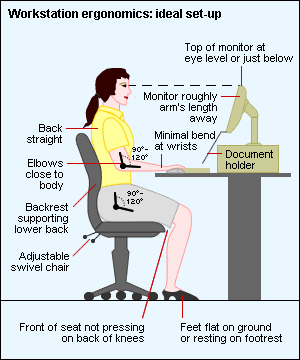
Minimize eye strain. Place the monitor directly in front of you (so you don’t have to turn your head). The top of the monitor should be directly in front of your eyes, at a distance of 18-24 inches. Reduce the screen glare and adjust the brightness/contrast. Periodically look away from the screen and focus your eyes on something else. Consult your ophthalmologist and/or optician, should you encounter any problems with your vision.

Maintain good posture. It’s all a matter of simple geometry. Specifically, right angles (90°): feet and lower legs (at ankles) must be 90°; lower legs and thighs (at knees) must be 90°; buttocks and back (at hips/waist) must be 90°; lower arms and upper arms (at elbows) must be 90°.  If your elbows aren’t on a 90° angle, this means that your desk is too high.  Simply adjust the chair height.  Do not slump your back!!!

Take care of your hands. Carpal Tunnel Syndrome is, according to the  Mayo Clinic (.com)“a progressively painful hand and arm condition caused by a pinched nerve in your wrist.”  Take a break from time to time. Typing continuously will have an adverse effect on your hand and wrist. Do finger and wrist exercises.  Move your fingers, do wrist stretches and rub (massage) your palms.

Use a timer. When you’re “on a roll,” it’s easy to get lost in your writing and forget that you need to move and stretch your muscles.  Why not set a timer/alarm every hour, to remind you that you need to get up and walk around for a bit, just to get that circulation going once again.

Exercise at your desk. If you’re feeling a little numb or stiff, consider doing some stretching exercises right at your desk.  Do neck rolls; loosen your hands with circular motions – clockwise, and then counter-clockwise; shrug your shoulders and release, then repeat (loosens neck and shoulders); do torso twists, and leg extensions

Take a break! If you can, break up your time with a walk (or run) outside. Maybe you could do an impromptu yoga or pilates session.  If you don’t want to lose your writing mojo, you may want to consider carrying a voice recorder with you. Remember to eat and, repeat after me, “Hydrate, hydrate, hydrate!”  


Ergonometry 101 for Writers

When we use the word “ergonomics,”  we are referring to “the applied science of equipment design, as for the workplace, intended to maximize productivity by reducing operator fatigue and discomfort.” And, if anything reduces user fatigue or discomfort, it’s an ergonomic chair!

This is the Ergohuman V2 Chair V200HRBLK  – High Back with Black Frame and Mesh. This chair also comes in either leather or fabric.
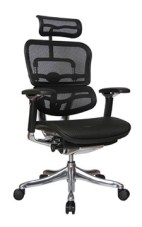
Need I say more? 

One final word about exercise.  Running is not for everyone.  Walking is always a good thing. But, if you want to boost your spirit (as well as your fitness level), grab your nearest and dearest …. and dance!  You’ll be rejuvenated and ready to write that next chapter … !

Note:  Before commencing any physical exercise or fitness program, please consult your physician.

Images via bodyandsoul.com.au, brainmass.com, ergonomics-info.com, and ergohuman.com.

“Easter Day” by Oscar Wilde

One of my favorite writers is the Dublin-born Oscar Wilde (1854-1900).  Poems (1881) — an anthology of poetry  — was his first published work.  Easter Day was poem number 20 in a collection of 62.  I thought I’d share this with you. 

Sláinte, 

h.f.t.g.


EASTER DAY

The silver trumpets rang across the Dome:
The people knelt upon the ground with awe:
And borne upon the necks of men I saw, Like some great God, the Holy Lord of Rome.
Priest-like, he wore a robe more white than foam,
And, king-like, swathed himself in royal red,
Three crowns of gold rose high upon his head:
In splendour and in light the Pope passed home.
My heart stole back across wide wastes of years
To One who wandered by a lonely sea,
And sought in vain for any place of rest:
‘Foxes have holes, and every bird its nest.
I, only I, must wander wearily,
And bruise my feet, and drink wine salt with tears.’

Sláinte!

An Irish Blessing:

Always remember to forget
The things that made you sad.
But never forget to remember
The things that made you glad.

Always remember to forget
The friends that proved untrue.
But never forget to remember
Those that have stuck by you.

Always remember to forget
The troubles that passed away.
But never forget to remember
The blessings that come each day.

Happy St. Patrick’s Day!

Sláinte! (Cheers!)

hftg

The stories houses tell

Every house tells a story.  Who lived here before you?  What did they do?  How did they live?  Was there more happiness and laughter than sorrow and pain?  Were children born here?  Did anyone die here?  Why did they leave?  Where did they go?  These are just some of the questions that fill my mind when I look at a house, especially an old house.

I love history. That, combined with a natural (almost feline-like) curiosity, is what motivates me to research everything that catches my fancy — family origins, different countries, cultures, religions and, yes,  houses.

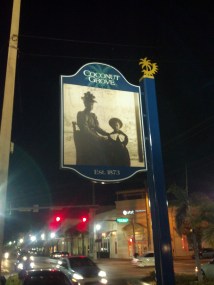
So, when we bought our historic home in the bohemian  (as in “free spirit, eclectic, artistic”) village of Coconut Grove (in South Florida), I was thrilled.  What struck me was that the house had really, really good energy.  Now, this is not my imagination.  Every friend or family member who has either visited or stayed overnight in this home has said exactly the same thing:  It’s got good vibes.  And, I’m happy to say, it’s also got good bones.

But,  like most  old houses,  it is not without some “challenges.” Built in 1928,  this small house – with loads of windows and creaky floors – has been a haven for many families. Laughter and tears, births and deaths, triumph and defeat – it’s seen it all. Now it’s our turn to play a role in its long history.

Coconut Grove was first inhabited in 1825 by an influx of Americans from the Northeastern United States, as well as British and Bahamian immigrants. Formerly an independent city, Coconut Grove became annexed to the city of Miami in 1925.  It is Miami’s oldest village and the beautiful architecture, rich tropical flora, artistic community, delightful restaurants, cafés and shops make it a highly desirable place to live … or, at the very least, visit.

Native flora in Coconut Grove

Our cottage-like house was built by the Bahamians (as in “from the Bahamas”) who first lived in it.  As was customary at the time, builders made use of all the available natural materials indigenous to the area, such as coral and Miami-Dade pine.  Homes were simple, yet full of character.  Back in the day, there was no air conditioning and, as such, air flow via windows (windows, windows, everywhere!) was  how the steamy South Florida weather was made bearable.

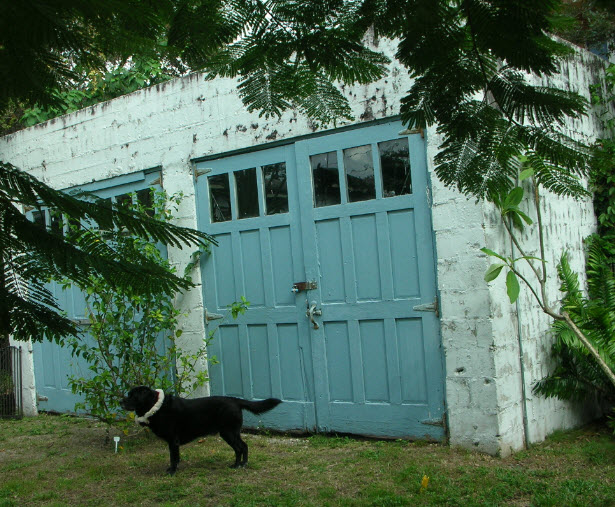
Thankfully, the previous homeowners have managed to preserve much of the original character of our home.  We have thick Miami-Dade pine frames around all doorways and windows. We have a beautiful coral fireplace.  And, we even have a barn — complete with the original doors!  Of course, we currently use it as a garage but we intend to convert it into a two-story architect’s studio with a roof-top deck. However, we will keep the first floor (with original doors) completely intact.

Our “barn” (with Bacchus standing guard!)

We’ve had to streamline our life. Over three decades, we’ve collected so much “stuff.”  Too much stuff.  At some point, it becomes almost obscene, this collection of material things. When this house beckoned to us (it really did!), we knew that it was time to downsize and simplify. So, we’ve been taking stalk of what is really important to us and, amazingly, the downsizing process has become quite simple.  There are many others who need these things far more than us. And it’s to these families that we will pass them on.

And, so, the house is a work in progress and its story continues to the next chapter…

My Silent Companion

He may be silent, but his eyes speak volumes.  He is my muse. A gentle, guiding spirit who curls up beside me whilst I write for hours on end.

As I’ve mentioned before, his name is Bacchus and he will be 11 years old next month.  Surprisingly, although his fur is greying, he is as spry as ever.  Nevertheless, we decided to buy him a large Red Radio Flyer Wagon, complete with padding (bottom and sides) and installed with an “umbrella” to keep the UV rays out. When we take him for a long walk, we lift him into the wagon as he gets tired.  He can lie down comfortably and enjoy the scenery or take a nap as we continue our stroll. I know this sounds a bit over the top but, he is – after all – our “son.” (Note: we also have doggie ramps ready to be installed for that time – hopefully not for a while yet – when stairs become a challenge for him). People do look at us rather strangely, but we don’t mind appearing a little “eccentric.”

We feed him natural, preservative-free food — a combination of home-cooked and Orijen (a wonderful brand – made in Canada, of course!) , which makes his coat shiny and soft.

Bacchus came into our lives when he was an 8-week old puppy. He has been a source of joy from the first day I held him in my arms.  He has taught us a lot about loyalty, love, patience, and trust. Most importantly, he helps us to understand — truly — that life doesn’t need to be as complex as we humans make it out to be.  There is serenity in simplicity.  Bacchus continues to help us keep things in perspective.

Right now, I feel his breath on my feet.  He is content, eyes half-closed and probably thinking that I spend way too much time on the computer.   He’d be right about that.  Come to think of it, maybe I should take a break and take him outside to the garden for a bit. It’ll do him good.  And me, as well.

Signing off for now …. h.f.t.g.

“He is your friend, your partner, your defender, your dog. You are his life, his love, his leader.  He will be yours, faithful and true, to the last beat of his heart. You owe it to him to be worthy of such devotion.”    -Unknown

Legacy of Words

I do not have children.  I will not be passing on my legacy through a next generation of my own creation.  But please do not misunderstand or make assumptions.  This was a conscious choice — made by two people who chose a path which focused exclusively on the pursuit of knowledge, advanced education, career, business ventures, literary pursuits, and travel.  If I could turn the clock back, I believe that I would have followed that same path.

So, when I read this passage written by an author I deeply admire —Alexandra Fuller — it resonated with me and, frankly, I couldn’t have articulated my thoughts any better.  In the Author’s Note of her novel, Scribbling the Cat: Travels with an African Soldier, Alexandra Fuller says it best:

“What is important is the story.

Because when we are all dust and teeth and kicked-up bits of skin — when we’re dancing with our own skeletons — our words might be all that’s left of us.”

Words. I hope that they will be my legacy.

h.f.t.g.

Image via arkarthick.com.